What On Earth Were They Thinking?

How often have you heard somebody question people who lived “back then,” in the swirling historical mist, who somehow just didn’t have the knowledge, the nuance, or the capability that we so proudly wield today?

“Things back then were just a lot more simple.”

“They just weren’t as developed back then as we are today.”

“Society back then was a lot less informed than we are today.”

It’s difficult to even confront such statements out of their context, but where I’ve had all three of these spoken to me in (separate) conversations, I challenged each impression as an insinuation that we’re somehow smarter than all the peoples of history, more skilled, more sophisticated, more aware, more woke (as they say, these days), that we’re, in the main, altogether better than our elders merely for having lived later than they did. These days, apparently, “we’re more evolved” – ha! 🙂  more evolved, that’s always a good one, as if back then everyone was Australopithecus while here we are jetting across the oceans, toting our iPhones, and drinking fine wines.

Well, sure, maybe things have changed since back then, whenever “then” was. But, more typically I’ve found, contemporary judgments levelled upon history are borne of an unintended arrogance, a symptom of 20:20 hindsight and the self-righteous assurance that, today, we’ve finally seen the error – actually, make that the errors – of their ways.

Surely, these days, few – or any – would believe that we’re ignorant or unaccomplished or incapable, not the way someone might say of us while looking back from our future. At any given point on the historical timeline, I wonder whether a person at that point would feel as good about their era, looking back, as any person on some other point of the timeline would feel, also looking back, about theirs. Is it a common tendency, this judgment of contemporary superiority?

These days, we might well feel superior to people who had no indoor plumbing or viral inoculations or Internet access, just as someone earlier would have appreciated, say, some technological tool, like a hydraulic lift to raise heavy objects, or a set of pulleys, or a first-class lever. It really is arbitrary for a person, looking back at history, to feel better about contemporary life because contemporary life infuses all that person’s experience while history’s something that must be learned, at a minimum, second-hand.

I’ll guess that learning ‘history’ means learning whatever has lasted and been passed on because what has lasted and been passed on has been deemed to have merit: we’re taught the history that has been deemed worth remembering. The kinds of things I’ve found to have been deemed worth remembering, i.e. the kinds of things I learned in History class, are the general mood of the times, the disputes and fights that occurred (violent or academic), a select handful of the figures involved, and an inventory of whichever non-living innovations and technologies simultaneously arose alongside all that. If, later, we demerit and no longer pass on the history that lasted up until then, and instead pass on some different history, then that’s entirely indicative of us, now, versus anyone who came before us, and it reflects changed but not necessarily smarter or better priorities and values.

For me, we shouldn’t be saying we’re any smarter or better, only different. So much literature has lasted, so much art. Commerce has lasted, institutions have lasted, so much has lasted. Civilization has lasted. Cleverness, ingenuity, shrewdness, wit, insight, intellect, cunning, wisdom, kindness, compassion, deceit, pretense, honesty, so many many human traits – and they all transcend generations and eras. People vary, but human nature perdures. I’ll trust the experts, far more immersed in specific historical study than me, to identify slow or subtle changes in our traits – hell, I’ll even grant we may have culturally evolved – and I can only imagine how many ways the world is different now as compared to to back then before now. But what does it mean to be better? Better than other people? Really? And who decides, and what’s the measure?

We can measure efficiency, for instance, so to say technology has advanced and is better than before is, I think, fair. Even then, an individual will have a subjective opinion – yours, mine, anybody’s – making culture not proactive and definitive but rather reactive and variable, a reflection, the result of comprised opinions that amplify what is shared and stifle what is not. As we’re taught merited history, you’re almost forced to concur, at least until we reconsider what has merit. That’s a sticking point because everyone will have an opinion on what is culturally better and what is culturally worse. What we call ‘morality’ inevitably differs, and suddenly we have ‘ethical’ debate, which is to say disagreement or even discord over which perspective is ‘right’. But to blithely say a people or culture is better, I think, is too subjective to rationalize, not to mention a questionable path to tread… a path that maybe says a little more about the one who said it.

Consider this as well: we each know what we’ve learned, and as individuals, we’ve each learned what we value. But what we’re taught in Culture ‘X’ is what’s broadly valued and, thereby, prescribed for all ‘X’s. We’ve all heard the rather hackneyed epigram, that those who neglect history are doomed to repeat it. But maybe the ones screwing up just didn’t learn the right history to begin with.

I tend to abide by another hackneyed epigram, that they are wisest who know how little they know. And wouldn’t real historical wisdom and real historical understanding mean being able to see and think and understand as people earlier did? But short of firing up the Delorean for an extended visit some place some time, it seems to me that judgments about history are made with an aplomb that might be better aimed at acknowledging our finite limitations. We’re no angels. If anything, this error of judgment speaks volumes about us. Condescension is what it is, but in my opinion, it’s no virtue.

We should hardly be judging the past as any less able or intelligent or kind or tolerant or virtuous as us, especially not if we aim to live up to today’s woke cultural embrace of acceptance. Being different should never be something critiqued; it should be something understood. Conversely, in proportion to how much we know, passing judgment is assumptive, and we all know what Oscar Wilde had to say about assuming (at least, we know if we’ve studied that piece of history). At the very least, we ought to admit our own current assumptions, mistakes, errors, accidents, troubles, disputes, and wars before we pass any judgment on historical ones.

On that positive note, I will say that considering all this has prompted me to notice something maybe more constructive: so often, at least in my experience, what we seemed to study in History class were troublemaking cause-and-effect, bad decisions, and selfishly motivated behaviours. Far more rarely was History class ever the study of effective decision-making and constructive endeavour – maybe the odd time, but not usually.

Maybe my History teachers were, themselves, stifled as products of the system that educated them. What could they do but pass it along to me and my peers? Bearing this in mind, I might more readily understand how people, alive today, could conclude that all who came before were simply not as enlightened, not as sophisticated, or not as adept as we are now.

Yet that merely implicates contemporary ignorance… assumptions and mistakes still happen, errors still occur, accidents – preventable or not – haven’t stopped. Troubles and disputes and wars rage on. If the axiom of being doomed to repeat history were no longer valid, we wouldn’t still feel and accept its truthful description, and it would have long ago faded from meaning. All I can figure is that we’re still poor at learning from history – the collective “we,” I mean, not you in particular (in case all this was getting too personal). We need learned people in the right positions at the right times, if we hope to prevent the mistakes of history.

Not enough people, I guess, have bothered to study the branches of history with genuine interest. Or, no, maybe enough people have studied various branches of history, but they don’t remember lessons sharply enough to take them on board. Or, no no, maybe plenty of people remember history, but the circumstances they face are just different enough to tip the scale out-of-favour. Epigram time: history doesn’t repeat, but it does rhyme. Or maybe we’re just full of ourselves, thinking that we’ve got it all solved when, evidently, we don’t.

It also dawned on me, considering all this, that high school “History” class influences what many people think about broader “history.” My high school experience, and university too, was mostly a study of politics and geography, and toss in what would be considered very elementary anthropology – all this as compared to those other branches of historical study: archaeology and palaeontology come to mind as detailed, more scientific branches of history, but there are so many – literary history, philosophical history, religious, environmental, military, economic, technological, socio-cultural… on and on they go, so many categories of human endeavour. I’ve even come across a thoughtful paper contemplating history as a kind of science, although one that is normative and susceptible to generational caprice. One final epigram: history is what gets written by the winners, which some will rue, some will ridicule, and some will call “unfair,” but which I will simply acknowledge as what people evidently do.

And that’s really the point here: throughout what we call human history, where we’ve subdivided it so many ways – right down to the perspective of every single person who ever bothered to contribute, if you want to break it down that far – it’s people all the way back, so it’s all biased. So it’s neither complete nor even accurate until you’ve spent oodles of time and effort creating a more composite comprehension of the available historical records. And, dear lord, who has time for that.

History, in that respect, is barely conceivable in its entirety and hardly a thing to grasp so readily as to say, simply, “Back then…” History is people, and lives, and belief inscribed for all time. To know it is to know who lived it as well as who recorded it. Knowing others is empathy, and empathy is a skill trained and fuelled as much by curiosity and diligence as emotion or opinion. p.s. emotion and opinion come naturally and without effort. For me, valid history derives from informed empathy, not the other way around.

As far as recording history for future study… ultimately, it will again have been people recording and studying all of it, “it” being whatever we care to remember and record about what somebody was doing, and “doing” being all of what people were doing to attract the attention of those doing the recording. It’s all a bit cyclical, and completely biased, and someone will always be left out. So people might be forgiven when shaking their heads in judgment of the world “back then” because, without empathy, what else could they possibly know besides themselves?
The Latest Visual WHY

Click here to read the latest Visual WHY.

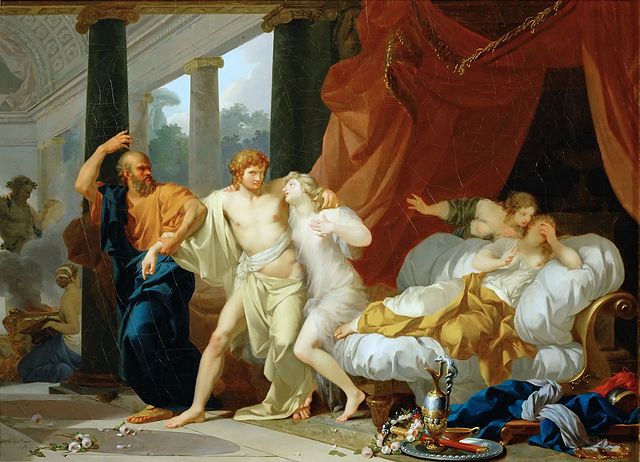
Jean-Baptiste Regnault - Socrates Tears Alcibiades from the Embrace of Sensual Pleasure (1791)
…could we ever know what art makes oneself better, if we were ignorant of what we are ourselves?”

“…a picture’s usually worth even more than the thousand words we commonly ascribe.”

The word “text” derives from Latin, texere, meaning to weave or fit together. For me, text connotes far more than just the printed word – photography, movies, music, sculpture, architecture, the list goes on. The Visual WHY offers a specific look at paintings, texts with no less substance and arguably far more aesthetic. But underpinning the textuality of art altogether is its human endeavour. And beyond weaving something together for the sake of weaving, a weaver – an artists, a person – has a further end: communication.

Artists across all media are people with influences and motives for expressing themselves. Conjointly, texts of all kinds are also plenty human: provocative and reflective. Whether rich and symbolic for a global audience, or doodled sketches for your own amusement, art is text, and text has purpose. As we try to understand it more thoroughly, we can’t help but raise the level of discourse. Who knows, someday maybe art will save the world…

For those who’ve been wondering about the painting featured both here and on this site’s front page, this latest update may help explain that, too.

Click here to read the latest Visual WHY.

A Pathetic Throne Speech is Not a Dangerous One

Maclean’s columnist, David Moscrop, wrote today (June 23, 2017) about BC Premier Christy Clark’s shallow grasp at retaining power. Below, in reverse order, are my response and Moscrop’s opinion piece that prompted me.

A Pathetic Throne Speech is Not a Dangerous One

“Insidious and dangerous” is a bit much. I do agree on some basis with the article – my own first thought after hearing Clark’s platform announcement was “OK, why even have parties”?

But, obviously, among that 40% of voters are some very upset conservatives. They’ll see that Clark gets turfed as leader, and that will be a measure of accountability for her pathetic desperation-move. She can’t change horses mid-stream without upsetting plenty of Liberals so, no, nothing insidious or dangerous in her move. Moscrop puts it best, himself, near his closing: “…she imagines a world…”

Exactly. In Clark’s imagination, this shameless attempt actually had a chance, which is the only explanation for her attempting it – all the more reason to pity her, cast her aside, and move on. Politics and cynicism are sure to find new heroes anyway. Meanwhile, sixteen years of Clark has been far more than plenty. This move underscores her character, and the one thing long-serving professional politicians need is a dose of humility.

If any government move is insidious (although not necessarily dangerous, as compared to the potential for impasse after impasse), it’s Trudeau’s non-partisan Senate. Plenty has been written about that, even this week. Or how about the ‘Access To Information’ revisions revealed this week that actually expand exemptions and make access to information more difficult?

Incidentally, there’s nothing, repeat, nothing Machiavellian going on with Clark, for a couple reasons: (i) Machiavelli was advising Medici, who wasn’t known for his embrace of representative democracy, and (ii) when implemented shrewdly under the right circumstances, Machiavelli’s advice works. Please don’t insult Machiavelli’s intelligence and insight by lifting Clark to any such achievement. Machiavelli would be pitying her bald-faced panic and laughing – not rolling – in his grave. As for Sophocles, he at least had Antigone kill herself. Then again, Antigone had integrity.

I also agree that Clark’s move reflects the broader political extremism that Moscrop mentions. Seems a bit of poetic justice, then, given how much Clark referred to the US President and his looming presence during her campaign, that she’s fallen victim to similarly extreme behaviour and its consequences. She can’t be impeached, but she can be discarded.

One final point: the NDP-Greens are absolutely not “in the rather awkward position of having to vote against their own ideas” – not at all. What they’re voting against is Clark’s trustworthiness and credibility. Thanks to Clark, they’re able to vote “no confidence” with not only honesty but accuracy. It can only be described as one of the utterly truthful moments politics has ever known.

From Maclean’s

The foul cynicism of Christy Clark’s speech from the throne

Why the doomed B.C. Liberals’ Throne Speech—gruesomely stitched together from the platforms of the party’s rivals—was insidious and dangerous

David Moscrop

June 23, 2017

British Columbia Premier Christy Clark, left, and NDP leader John Horgan, right, look on as B.C. Lieutenant Governor Judith Guichon gives the Speech from the Throne in Victoria, Thursday, June 22, 2017. THE CANADIAN PRESS/Jonathan Hayward

There’s an old joke, often attributed to Groucho Marx, that I spent the better part of Thursday thinking about after British Columbia’s premier, Christy Clark, presented her doomed government’s speech from the throne. The comedian is said to have quipped: “These are my principles. And if you don’t like them, I have others.” To be honest, I’d be laughing more right now if the line wasn’t so prescient and insightful as an explanatory tool for understanding politics in the province right now.

In Clark’s speech, read by B.C.’s Lieutenant Governor Judith Guichon, the premier made 30 pledges that were absent from her Liberal Party’s platform of just weeks ago, including more than a dozen lifted from the platforms of the likely-to-govern-soon New Democrats and their Green Party backers. After opposing proposals (presumably as recently as a week ago) such as a referendum on electoral reform, a ban on corporate and union donations to political parties, increases in funding for daycare, social assistance, and disability, scrapping the requirement for a referendum on new transit funding sources, and getting rid of tolls on the Port Mann Bridge, Clark and her Liberals hastily came to embrace them—and others, too.

Friends, I think I’m starting to become rather cynical towards politics.

The Liberals have spun their remarkable about-face as “listening to the voters.” I call shenanigans. The party received about 40 per cent of the popular vote in the 2017 election—down about 4 per cent from their 2013 result—and dropped from 49 seats to 43. These numbers raise the question: just who is the party listening to? Were they not listening to them in 2013? Or is it different voters they’re listening to now? Which ones? Perhaps voters in swing ridings? Or in presumably safe ridings where they lost by a slim margin? I suppose what the premier means is that she’s listening to some new voters, if those folks happen to live where it counts.

Clark’s dramatic conversion to an NDP/Green-light version of her party seems rather like an overcorrection given the modest shift in support between 2013 and 2017. Indeed, if I can be ever-so-cynical for another moment, it seems like the premier is desperately trying to cling to power by selling out her party and its supporters by offering a de facto “renewed” policy platform that stands in stark contrast to the last several years of the B.C. Liberal government and the still-warm corpse of the party’s election platform. No, I think Clark’s volte-face has nothing to do with “listening”—instead, it looks to be the most cynical ploy to maintain (or soon regain) power that I’ve seen in politics in Canada. I mean, who knew that when you mix orange and green you’d get B.C. Liberal blue?

I seem naive, don’t I? How is this any more cynical than politics-as-usual in late-modern liberal democracies? Perhaps Clark’s speech is no different in type when compared to other political ploys, but it’s certainly more extreme in degree. Honestly: The premier lost an election just weeks ago. Her party has been in power for 16 years. She has been premier for six years. And staring down defeat, what does she do? She “borrows” policies from the parties poised to defeat her days from now, abandons years of party commitments, and spins her reversal as “listening to voters,” as if she’d just now discovered the practice of consulting the electorate whom she is meant to serve. And all this after declaring that NDP leader John Horgan is a flip-flopper who isn’t to be trusted and labeling him “Say Anything John.”

Cynicism aside: will the gambit work for Clark? I don’t think so. It’s unlikely that any New Democrat or Green member of the Legislative Assembly (MLA) will break ranks and support the premier. Why would they? Once the Liberal government falls, they’ll get their shot at governing, short-lived as it may be; even if an NDP MLA were tempted to trade their shot at governing for a more stable legislature and some of their policies, their supporters wouldn’t soon forget the betrayal. And for the Greens, they’ve just made a deal to support the NDP, so it would be tricky from them to try to wiggle their way out of it so soon. On top of it all, of course, who can trust Clark and her Liberals now? No: the NDP and the Greens will, as expected, defeat the Clark government next week on a confidence motion and John Horgan will become premier of British Columbia.

Nonetheless, the Throne Speech does put the two opposition parties in the rather awkward position of having to vote against their own ideas. Yes, NDP leader John Horgan and Green Party leader Andrew Weaver must instruct their caucuses to defeat their own agenda—for the moment—so that it can be reborn and pursued under the aegis of the NDP-Green supply and confidence agreement. It’s a moment worthy of Sophocles. If Sophocles were a total hack.

As shrewd as this move may seem to Clark, who will surely use the “Nay” votes of NDP and Green MLAs as fodder for her election argument—“See, I tried to work with these guys! I even copied their platforms!”—the Premier may end up hoisted with her own petard. What happens when the NDP and Greens re-introduce these policies in the months to come (after all, the policies are their ideas) and Clark as Leader of the Opposition is faced with either supporting the government or voting against pledges she’s just recently made in her own Throne Speech? Perhaps she’ll be able to find some minor concerns to use as a pretext to oppose the NDP-Green iteration of the policy, but by then we’ll be way, way down the rabbit hole.

Whatever happens in the days, weeks, and months to come, though, one of the most insidious threats embedded in Clark’s cynical Throne Speech is a deeply disturbing conception of politics. Premier Clark has, in effect, tried to reduce politics to mere management and power; by raiding the NDP and Green platforms with abandon, by taking policy ideas that happen to be popular now, and by arguing that she is just borrowing the best bits from each party, she has indicated that deep and persistent ideological differences, which are reflective of real differences that one should expect and even celebrate in a pluralist democracy, are trivial concerns when power is at stake. Clark has stitched together a Frankenstein’s monster that she claims she’s best suited to command. What could go wrong? After all, everything turns out okay in Frankenstein, right?

The Premier’s vision of politics presented in the Throne Speech is post-political; she’s imagining a world where parties are mere brokers of the public will of the moment, interchangeable except for their respective management expertise, and the only questions relevant to politics is how to gain and keep power, alongside some technical questions about how to implement whichever policies happen to be fashionable at the time. Clark’s approach to politics is dangerous, not only because it’s hopelessly and shamelessly cynical, but also because it’s disrespectful and unhelpful to voters who rely on parties as aggregators of ideas that lead to policies they like. Reducing politics to mere whims of the moment, technocratic management concerns, and Machiavellian power struggles undermines parties and productive partisanship as helpful touchstones for voters while also pretending that there aren’t very real and very persistent disagreements in our society that cannot be reduced to technical questions of “how” and “by whom,” rather than “what” or “why.”

British Columbians will survive this frustrating and embarrassing chapter in the history of our politics. Citizens are not fools, and our system of government remains, as ever, plenty sound—if not quite as inclusive and participatory as it might be. Indeed, I believe Clark’s cynical gambit will fail, and we’ll all move on.

And yet, we shouldn’t forget what happened with this speech from the throne. That speech represents the worst of a short-sighted, desperate, and cynical kind of politics. In the future, leaders ought to hold it up as an example of what we should all strive to avoid in civic life. If we can do that, perhaps some good will come from this sad mess.

http://www.macleans.ca/opinion/the-foul-cynicism-of-christy-clarks-speech-from-the-throne/