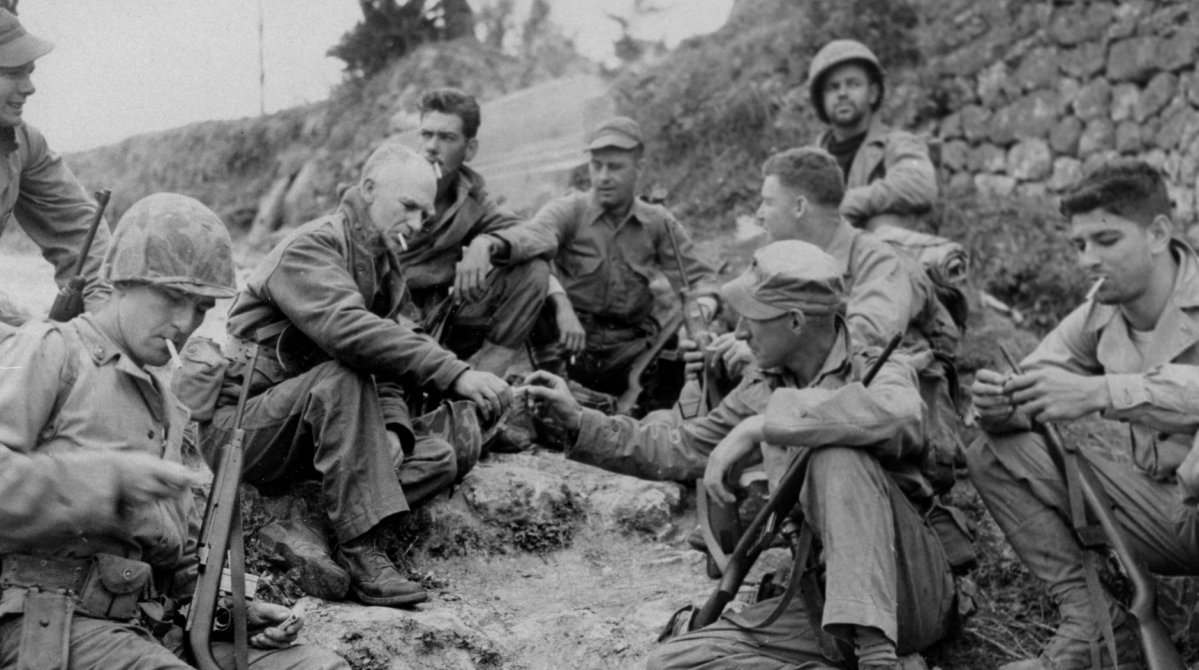
The Burden of Sacrifice

My students will recognize war correspondent, Ernie Pyle, and his accounts of World War II, including a series of three columns that describe with stark intimacy the aftermath of the Normandy invasion. This week, all three will be reprinted by members of the Pennsylvania NewsMedia Association in commemoration of the 75th anniversary of D-Day.

Also well worth reading is this article from The New York Times, a tribute by David Chrisinger to Pyle, the man who told America the truth about D-Day, and the soldiers he commemorated, whose sacrifices in war leave us all indebted.

Controversy arose over whether or not to publish a photo of Ernie Pyle in death. In this article, a different war correspondent named Pyle, the late Richard Pyle, quotes Ernie Pyle biographer, James E. Tobin…

“It’s a striking and painful image, but Ernie Pyle wanted people to see and understand the sacrifices that soldiers had to make, so it’s fitting, in a way, that this photo of his own death… drives home the reality and the finality of that sacrifice.”

Indiana University has a great repository of Ernie Pyle’s wartime stories – click here to see them

In addition to soldiers, I would add, casualties of war include the child with no parent, the home with an empty room, the people with nowhere to live and nobody willing who is yet able to help them. Families might live in separation as a consequence of war. Civilians can be caught or placed into the path of chilling technology and lethal weaponry. People left alive find themselves rudely displaced and nakedly vulnerable. We have seen pride and duty elapse into jingoism, internment, and genocide. War is fought and casualties suffer in many different ways.

Our historical record is clear for its brutality and the dispensing of lives, and any disdain for the politics that incite war might well be justified. We have so much to answer for. Yet flatly shaming war as foolhardy or inhumane is simplistic. By the same turn, dismissing observances of war as banal or romanticised might overlook the personal roots that inspired them. How do we reconcile this? Pyle is clear: despite its cruelty, war is sometimes necessary.

… and when it is unnecessary? Well, we have the liberty to have our say. But no matter our opinions or our politics, to live “in the joyousness of high spirits it is so easy for us to forget the dead.” Is this the imposthume of wealth and peace or the world of rights and freedoms? I can’t cover it all, or know every angle. For people like me, removed from war, what compels us into political debate differently than those facing imminent threat?

Beyond what I think of each war, anguish is real to those for whom war has meant sacrifice. Separate to written accounts, troubling memories are not easily and often never shared, but they are memories because those things really happened. Certainty of loss, uncertainty of fate: each is frightening, and both leave scars. Pain does not necessarily subside for no longer being inflicted. To disregard the sacrifices of war is to risk dishonoring, and nullifying, the people who made them, even as they might already be dead and gone.

Particularly on an anniversary such as this, we carry the cost of their service to us. Yet their sacrifices will never amount to nothing because the debt we owe is one we can never repay. For this reason, let us value and earn our debt. As the sacrifices of war are permanent, the onus for us to honour them is everlasting.
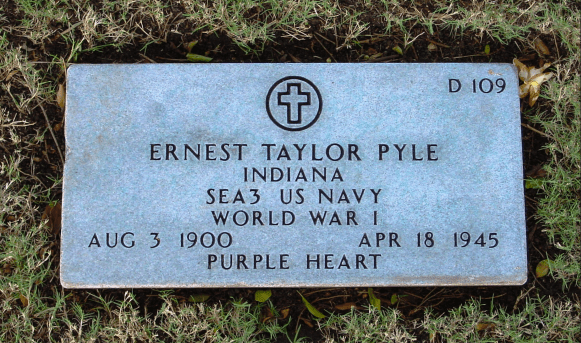
Ernie Pyle's Gravestone
Ernie Pyle’s gravestone, at the National Memorial Cemetery of the Pacific at Punchbowl Crater in Honolulu, HI

On July 23rd 2019, the Wright Museum of World War II hosted a symposium on D-Day – click here for more information

This post proved difficult to compose although, with reflection, I think the answer we need is somehow to be found in what we share – not our differences but our similarities.

‘Tis the Season to be Silly!

Here’s a curiosity… I wrote this thirty years ago in Grade 12 for – wow! wee! – the high school newspaper. Good lord, thirty years. When you’re able to say such-and-such happened thirty years ago, and remember it…

!!!!!

Sigh. Beats not remembering, I suppose. While we’re at it, how about a wow-wee for thirty-year anniversaries: diamonds, pearls… joy buzzers? Better watch your back at the reunion, folks.

So what do I remember? My Journalism teacher, Mrs Sullings, had been waiting for me to overcome writers’ block and finally granted me an extension until the following issue, figuring I’d never make the deadline for end-of-March.

I really appreciated that from her but now felt all the more determined (and a bit guilty…) to meet the deadline the next morning. I remember sitting on my bed later that afternoon, struggling woe-is-me, and finally just flipping through the thesaurus as some desperate chance-worthy way of inspiring an idea. I think it was “rapscallions” that got the ball rolling, and from there, as the saying goes, the thing just wrote itself! Then it got buried on page 7 because every newspaper has a layout crew. Joke’s on me, I suppose.

Fringe benefit, though… the next time I nearly missed a deadline, for the June edition, Mrs Sullings wasn’t nearly so concerned. She left that to me, that time.

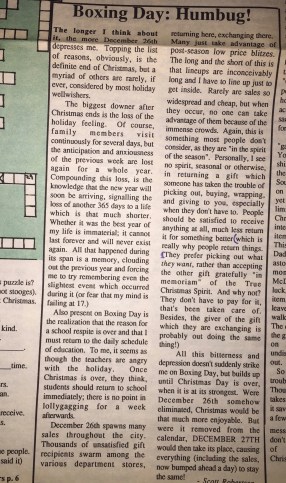
I’m pretty sure this is the second piece I ever wrote for a public audience, as in something actually published somewhere, out of my hands. Boxing Day - Humbug!.jpgThe first was a few months before, this Boxing Day editorial for the December edition, although officially my class hadn’t switched over yet – you either went from Journalism to Creative Writing in January, or you were vice-versa like us. Admittedly, neither piece is rocket science, much less brain surgery, but hey, every piece does more than just fill its own space in the puzzle. A curiosity, like I said.
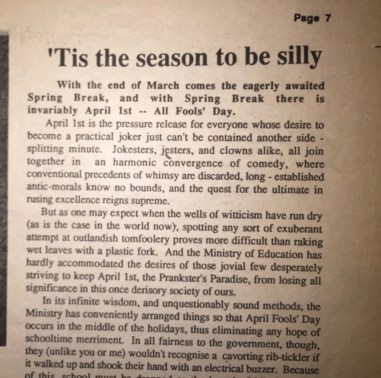
So here ‘tis! a piece from the past, yet as much for posterity inspired! O Come, all ye Jokesters, unite!

(If you’re interested, click here, here, or here to learn a little more about the history of April Fools’ Day.)


‘Tis the Season to be Silly

March 1989

With the end of March comes the eagerly awaited Spring Break, and with Spring Break there is invariably April 1st – All Fools’ Day.

April 1st is the pressure release for everyone whose desire to become a practical joker just can’t be contained another side-splitting minute. Jokesters, jesters, and clowns alike all join together in an harmonic convergence of comedy, where conventional precedents of whimsy are discarded, long-established antic-morals know no bounds, and the quest for the ultimate in rusing excellence reigns supreme.

But as one may expect when the wells of witticism have run dry (as is the case in the world now), spotting any sort of Page 7.jpgexuberant attempt at outlandish tomfoolery proves more difficult than raking wet leaves with a plastic fork. And the Ministry of Education has hardly accommodated the desires of those jovial few desperately striving to keep April 1st, the Prankster’s Paradise, from losing all significance in this once derisory society of ours.
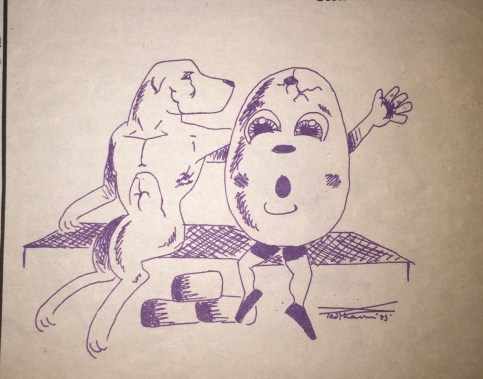
In its infinite wisdom, and unquestionably sound methods, the Ministry has conveniently arranged things so that April Fools’ Day occurs in the middle of the holidays, thus eliminating any hope of school-time merriment. In all fairness to the government, though, they (unlike you or me) wouldn’t recognise a cavorting rib-tickler if it walked up and shook their hand with an electric buzzer. Because of this, school must be dropped as the hostel of hilarious high-jinks.

Where, then, can one perform those pie-in-the-eye shenanigans and still achieve slapstick perfection? Home seems a logical place to start. And why not? For the abundance of potential targets, direct family ties keep anger broiling at a constant low, which is a major determining factor when dealing with the art of rabble-rousing, as are the many options open to the aspiring mischief-maker while on a mission of mirth.

There are the obvious escapades like exploding cigars and fake barf, or such monkey tricks as switching the salt and sugar, baking chocolate EX-LAX brownies, or stretching Saran Wrap over the toilet seat. As well, there are some old favourites to fall back on during instances of carefree nostalgia, like the bucket perched above the half-open door, or replacing the shampoo with NEET. Even the family car isn’t immune, as some skylarking rapscallions decide that switching on the radio to full volume, the windshield wipers to maximum speed, the air-conditioning to its coldest setting, and just about anything else located on the dashboard before the ignition is started, can provide for boisterous buffoonery in the highest degree.

Frozen Bunny.jpg

If this doesn’t tickle your fancy, then send someone you know a letter filled with sneezing powder – make sure it’s post-dated April 1st. You may try soaking your mother’s underpants and then freezing them overnight. Or remove the Sani-flush from the toilet and put green food colouring in the toilet bowl. When the shocked victim flushes the apparent “algae,” it is replaced by red-stained water from the toilet tank, which you have surreptitiously prepared the night before, in the name of all that is hallowed and holy amongst the flamboyant heroes of comedy whose Day you’re helping to celebrate.

Obviously, April 1st – All Fools’ Day – is one of the most important events of an otherwise blasé year, breaking the cat-gut tension with its relaxed, devil-may-care attitude. It is a time for everyone to get, get gotten, and be a good sport about it, either way.

Enjoy your April 1st this year, and if you’re one of the fortunate few to succeed in your sally – CONGRATULATIONS! You can appreciate the hearty effort undertaken by all those looking for an April Fools’ Fest.

And if you’re one of the unlucky targets of this annually occurring “puerile idiocy,” just grin and bear it, because half the joke is watching the victim’s reaction. Stay calm, laugh along with them… and then start plotting for next year.

Thu Pham.jpg

Lest We Forget

I am indebted to three of my students – Maddy, Kira, and Shannon – for collaborating to write this essay, which we formally read aloud during a school Remembrance Day ceremony in 2013. As I told them at the time, our planning sessions together were as good as any committee-style work I’ve ever done – everyone thoughtful, respectful, contributing, and focused – and I remain as proud of our group effort today as I was then.

I have only slightly revised our essay, for fluidity, to suit a print-format but have endeavoured to avoid any substantive changes.

One hundred years ago, the Dominion of Canada’s soldiers fought in the Great War. By November 1917, the Canadian Expeditionary Force had been in Europe for over three years, staying one more year and sacrificing their safety and their lives for their country on behalf of the British Empire.

What is sacrifice? Sacrifice is soldiers seeing past terror on the battlefield, placing themselves into vulnerability, and giving themselves on our behalf. Each year on November 11, Remembrance Day in Canada, we recognize our soldiers by wearing a poppy over our hearts. ‘Why’ a poppy is more well-known, yet since its adoption in 1921, ‘how’ the symbolic pin has remained potent is perhaps less well-considered. A century later, in such a different world, the relevance of the poppy as a way of honoring the sacrifice of wartime warrants reflection.

As time passes, the poppy’s symbolism, in and of itself, remains the same. We change – people, culture – and inevitably, as we change, our relationship with the poppy changes, too, however much or little. The poppy, the same symbol, is different for those who feel firsthand the costs of war: so many people separated, harmed, and displaced, so many lives lost.

Pains of loss are felt most intensely when they occur, by those who are closest to the people involved. For those of us with no direct wartime experience, what we feel and know matters, yet it also differs. To activate a more complete appreciation, one meaningful place to which we might turn is poetry.

During World War I, poetry was a common means for those with direct wartime experience to share, and to cope. For the lover in the poem, “To His Love,” by Ivor Gurney, one particular soldier’s death has wiped out his lover’s dreams for a comfortable future. Experiencing the fresh pains of loss, she could not possibly forget her soldier or his sacrifice. The poppy we wear both honours his sacrifice and “[hides] that red wet thing,” her loss. But, because of our distance, our poppy does not hold the same raw pain as it does for her, for those who have so immediately lost their loved ones. So, if our poppies do not hold that same raw pain, why do we continue to wear them?

The poppy stays the same because of the fact that each soldier’s death remains. Again, from “To His Love,” Gurney writes, “You would not know him now…” Generations removed, do we remember who this soldier was? Would we recognize him on the street? No. “But still he died.” We may find it difficult to assess the significance of his death, here in our world, far removed by time and distance. But let us appreciate, let us remember, in that moment of a soldier’s death, how he died: “… with due regard for decent taste.” A soldier dies with dignity, for his own sake, because that is all he has. He is a small blip in the universe. “But still he died,” and that will forever be. And for all who loved him, and for all he loved, we remember.

We continue to honour our soldiers, and the sacrifices of all during wartime, because of the timelessness of that sacrifice, which each one makes. Even now, removed from war, we can find reasons to remember the deaths of soldiers because the memory that remains of each soldier embodies our definition of a hero: ordinary people facing extraordinary circumstances and giving themselves, perhaps giving their lives, on our behalf. When we wear their poppies, we let their deaths weigh on our present.

Let their deaths weigh on our present, and let their memories live in their stead.

“They shall grow not old, as we that are left grow old:
Age shall not weary them, nor the years condemn.
At the going down of the sun and in the morning
We will remember them.”