We Get What You Pay For

Featured Photo Credit: Jan van der Wolf on Pexels

Am I the only one who sees at least a hazy comparison between banning social media and banning vices like alcohol and tobacco?

Just for instance… over the past fiftyodd years, we’ve not only managed to restrict the age for purchasing alcohol and tobacco, we’ve also reached some level of comfort that such restrictions may be growing somewhat more culturally acceptable, and even worth further pursuit.

Today, similar acceptance seems evident in myriad age-restricted bans upon the usage of social media, even as weighed against its benefits… one Google search is all anyone needs to confirm the health concerns. And let’s set aside that any threat to the health of so-called “minors” might also mean a threat to the health of so-called “adults” – we’ve apparently reached a comfort level on that, too, one that leaves the adults free to decide for themselves whether or not to damage their health.

Illicit drugs, pornography, firearms – all restricted, if not illegal. Even movie theatres, video games, and music releases can have age restrictions or purchase & supervision requirements. As for me (though not sure for you), I’ve known plenty of minors in my lifetime who were turned down when they asked adults to forgive such bans and let them purchase [ restricted Product X ]. The point just now is not enforcement, which in real consequence is hit-or-miss, but more plainly actuality, which by point of fact is cultural evidence that we’ve found actual reason and method in our past for imposing restrictions and bans.
 
As for the current hoo-haw… if it suggests anything, could it be simply that plenty of people have raised considerable concern? On its face, the mere call to ban social media seems grave enough to warrant a far more judicious – and far less rapid – pursuit of any usage, widespread or minimal, while we try to understand the longer-term consequences of social media, not to mention A.I. As much as the pace of e-culture has reduced our tolerance for waiting, it has also accelerated our lack of patience, which in turn has amplified our imprudence. Among these various cultural reductions, it’s that last one for me (though not sure for you) that really threatens our future.

Someone will argue that social media, and A.I. too, still have practical utility and that weighing this against any ban would short-change the deprived children and youth who use them. Yes, and a 12 year-old can’t just walk into the Motor Vehicles office and book a Road Test, yet driving too has great practical utility. Driving also presents a severe threat to public safety, even after motorists have earned their privilege by passing various licensing processes. Take issue as one may against protecting the duration or stringency of road safety and driver licensing, but for good reason, we do restrict its access.

So, as we halt a minor’s purchase of alcohol or tobacco, why not also a smart phone? Instead of banning social media or A.I., why not restrict the age for operating the devices and accounts we use to access them. How about restricting Rogers / Telus / Bell accounts to make it illegal for minors to be signed on as family members? As no responsible parent simply turns over their car keys to a 12 year-old, why hand them a restricted smart phone? That’s a cultural thing – a willingness to obey the law on account of respecting the belief that instituted it. Unless, of course, that’s a comfort level thing too, and people just aren’t comfortable with it – either way, wouldn’t that tell us something more about what we value most?

Funny over the past ~10-12 millenia how human civilization managed to grow without electronic anything – even longer than that, if we start redefining “human civilization.” Funnier still – and a little ironic – how all that non-digital time finally landed us here to be facing all this, just the same… did we follow some improper process along the way? Along that timeline, as social media and A.I. suddenly now present socio-economic threat, are we even capable of regulating or curtailing or halting their production and usage quickly enough? Are we even concerned enough to try? If no incentive to try outweighs the incentives to not try, at least not for the people who could try, then I’d say we definitely do and don’t know much about what we value most.

Do we value our health? As social media bears a documented health threat, why aren’t we flatly banning it all, for everyone? Or, if we won’t ban what’s addictive because its addictive, then at least we might regulate it because its addictive, and distorting, and hyper-personalized, and fatiguing, and algorithmic, and profitable. Regulate social media the way we regulate alcohol, or tax it the way we sin-tax alcohol and tobacco. Or at least license its proper usage… how ubiquitous would it be if access to social media were limited, even by dollar-cost? Wait, I forgot – it already is. So how important is any of this, as a health concern, when at least some people are evidently addicted? No problem – remember? Adults make their own decisions, plus bars and nightclubs seem to fare pretty well, and people still smoke too, if just a different shrub than before. Lucky for us, all that stuff is legal.

Bans and restrictions are no more effective in practice than their enforcement – in the world where I live, everyone who really wants to is able to smoke and drink and drive and shoot. But, as any of them might be held to account, well… that’s usually something after the fact, if even then. Lucky for us.

As for me though (not sure for you), rather than hassle everyone with bans and restrictions, rather than nag young people with “A.I. makes you lazy” or “Social media makes you ill,” I prefer to help them learn why “being lazy” or “being ill” is a worthwhile concern. I prefer to persuade people with more inclusive, longer-term responses, apart from whichever bans and restrictions might still get imposed. And I’d rather see us educating people about which choices we face, and which reasons underpin worthwhile debate, and which alternatives are available to those who want to live some better way than enduring threats to health and safety.

Create incentives that change behaviour – or hey, create disincentives that change behaviour, whichever – but create something more nuanced and imaginative than the decree of bans and restrictions, something more capable than getting peoples’ backs up. Unless, of course, we’re clearer now on what we value most.

This Just In…

Featured Photo Credit (Edited): Steve Buissinne on Pixabay

Emotions are an authentic human response – at least that’s what people say when they agree with those emotions. If it really is true, that would mean emotions are just as authentic a response when people disagree.

Probably just a handful of posts on this blog fall into the ‘rant’ category although Hey! that includes the one that started it all.

So at least the following emotions don’t lack precedent.


This Just In…

A lead on the morning news one past winter about heavy snow: “Great for skiers, bad for drivers.”

The past year, the past decade, and longer, you’ll have noticed an unquestionably gradual and ceaseless severity of weather effects, here and around the world. Heat domes, atmospheric rivers, bombs and cyclones, vortices and hurricanes and typhoons. You may also have seen news reporting that characterises the planetary climate as the enemy of motorists at the same time as it’s the victim of greenhouse gases, not to mention the harbinger of far worse to come.

From one TV news story: dozens of vehicles, some halted, some helplessly sliding, all paralysed by snow… enough to bring any motorist to tears. I’m almost paraphrasing the anchor’s light-hearted sympathy.

Each flake imperils the “unprepared” driver, who seems to risk the same foolhardy decision year upon year – though, let’s grant, it’s hard to know every circumstance. Let’s also grant that no enemy threatens winter driving quite like the reckless shitheads who lord their superior winter confidence over every other fool and sage behind the wheel: “Go home!” shouts the DB passenger of a white Eff-150 as they showboat past every stranded car they can scorn. “Go home,” as if they could. If you’re keeping score, weather thus far is not the enemy.

Someone far wiser than me will surely be explaining by now that Enemy Bad Weather is simply an affectation of our Harried Rat Race by the Charm of Morning News.

Could be… or could be the augury of addled brains, muddled thinking, and the subtle catalyst of still more unpredictable beliefs and behaviours yet to come, the kind that take decades to manifest before they’re detectable. Did you also know, you can pretty much say “shit” on TV now, and “eff” puns too. Still, as helpful as it would be, it’s hard to know for sure how long it might take culture to change as detectably as it took the climate. I guess we’ll see what happens.

Anyway… what’s to come of having reached millions upon millions of people, for whom a daily wish for good suitable weather competes with a daily war against undesirable bad weather… and all this, maybe – but, then again, maybe not – aside from an existential fight to “save the planet” while also chasing ambitions of travel and leisure and global what-not… sorry, by the way, all that was a question: ‘What’s to come of it all’?

Well, back to the news… literally the next story: “Massive overnight snowfall is the perfect storm for local ski resort!” which of course is code for ‘financial windfall’, which of course is not one but two weather metaphors to keep things light in an offhand way that says, “Have you got your shit together?”

And this from a few weeks earlier: “… forecasts predicting a risk of frost.” I can remember in the past hearing a “chance” of frost. These days, though, it’s a “risk.” A “risk” of frost. Frost.

One bleak headline even pits nature against nature although, sure enough, the frost in that story is mere backdrop for the Science that saves vulnerable naked vineyards, which of course is code for ‘commercial investment’. Granted, a belligerent “cold snap” isn’t exactly Daniel Plainview, or even Cobra Commander, but this story, with its closing remarks about “the silver bullet” – especially up against severe 60° temperature swings – betrays little beyond concern for our wine.

And exactly how do our priorities measure up with our frivolities – or, sorry, is that no longer a distinction? Anyway, I’m told we don’t use upmarket words like “frivolities” because too much Inside Baseball gets us too deep in the weeds… a risk of losing the audience, you know – must be that eff-word thing again.

Same week, same newscast… multiple winter tornadoes: “destructive” and “devastating.” A few weeks prior… once-a-century local flooding that restores a lake upon the flood plain, at the cost of homes, livestock, and livelihoods. Two weeks later… winter wildfires: “frightening” and “deadly.” In truth, all of these were terrible and damaging events – and all preceded the catastrophes of Lahaina and Los Angeles by two and three years’ time.

Against these events, and their human cost, rate this post as little more than a callous, self-absorbed tantrum.

Then rate the incoherence of news outlets, as they forewarn “Icy danger!” while smirking at “Snowy fun!” – nothing seems amiss? News outlets that prosecute seasonal war against the bitter “risk” of frost, and a cold-hearted enemy known only as “snow”… then broadcast the roar of trucks and ploughs and blowers, and hail those diesel heroes who salt and clear our roadways for the very traffic that helps to pollute and push our climate – and us – toward severe and unquestionable doom…

Against all this we might ask whether the recasting of “Global Warming” as “Climate Change” instead might have been, “Global Just Pleasantly Wintry-slash-Summery Enough Everywhere All the Time in the Place I Live – but, I mean, not too hot, and not too cold, and not too rainy, but not so dry… especially for, like, Vacation – but, other than that, yeah no, totally! yes! Save the Planet and all because, like – are you kidding me? – look what we’ve done, I mean, it’s just awful.”

Which brings us to one last cringe-worthy critique – this one not a headline but a slogan: “We’re killing the planet.”

Is there really no better statement to replace this ridiculous assertion of self-importance self-impotence? … no statement that captures the human species’ relatively momentary historical insignificance in contrast to the vast entirety of the planet??? … its perpetual environment, its magnetic and gravitational forces, its eons of solar formation and space-time existence at 4.5 billion-with-a-‘b’ billion years, it’s out-and-out gargantuan volume, mass, and physical composition – really? We think we are killing that?

Imagine that dolly shot from [ latest streaming dystopian holocaust ] with all the shrubs and weeds reasserting themselves through twisted concrete rubble, as the sun shines down once more. And, let’s rant – er, let’s grant – that we have reached a point where I could hardly blame the Planet for preferring to sustain life without us – except, of course, the planet has no preference because the planet is no enemy. It’s a planet.

A.I. Image Credit: Jack Drafahl on Pixabay

So… sorry, not sorry: we are not killing the planet.

And looking back on our 0.007% share of its history, there isn’t a soul alive or dead who could boast otherwise. Flipside, for those who have been keeping score: consider in return the number of people over our centuries upon centuries upon centuries of 0.007% history who have been affected – killed or otherwise – by the Planet’s natural geological activity… at worst, we’re a nuisance upon its face.

“We’re killing the planet.” Does nothing in this statement betray the same hubris that caused all our problems in the first place? Rest assured, the Planet will see to us and be just fine long after we’re gone.

If we’re killing anything, it’s hope of our own tolerable survival as planetary inhabitants so, yeah no, we do face real urgency to get behind a perspective that fears an existential threat because it fears the planet – which, by the way, is one last subtle play on eff-words.

As for the influence we continue to inflict upon the face of the Planet, we’re all of us indisputably reckless shitheads for our collective failed stewardship. And any triage of priorities and frivolities – of enjoyment and antagonism, danger and fun – will confirm that these are not the planet’s response to all our spewed contaminants – these are our response(s). If you have been keeping score, by now you’ll surely see: the enemy is us.

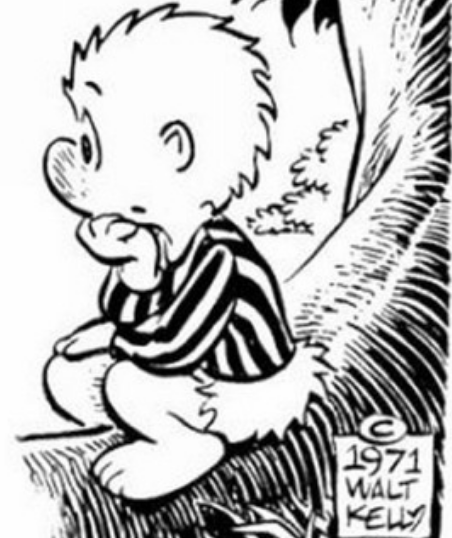
We imperil only ourselves.

Pogo” by Walt Kelly

From drowningintheshallow – “Traditions, not Traditional”

Sometimes, when we look into a mirror, we’re making sure everything is presentable, just right.

That seems like a bit of a trap to me – for one thing, you could only know ‘just right’ if you had some standard for measure, which seems like a recipe for perfectionism. You might also simply fall into seeing what you want to see. But what may be worst of all is the risk we take for granting our own self-assurance to the judgment of others.

On another day, that may have just described school, but setting that aside, I think it’s still fair to say that a mirror, like any household item, has its pros and cons.

Another way to characterise that look into the mirror is a search for flaws. In a similar way, this also seems to me like a risk since now we’re adopting a frame-of-mind for spotting what is wrong and applying that to our own self-esteem. It’s like practising how to be critical, with you as the practice dummy.

If you combine these two looks – the one, for self-assurance, and the other, a search for flaws – it almost seems no surprise those times we encounter hypocrisy… then again, isn’t there just something about people, that we seem to excel at paradox? I’m sure the psychologists have plenty more to say on this although I’m also sure those are details no one would credibly seek in a blog post. So setting that aside as well, I think it’s still fair to say the search for flaws seems pretty easy to adopt precisely because nobody’s perfect. Everyone’s a critic.

All that seems pretty ‘con’ when it comes to mirrors, so maybe let’s finish with a ‘pro’: we might conceivably look into a mirror for healthy self-appraisal, a more balanced search that weighs itself somewhere in between flaw and assurance, in order to learn and grow. That kind of look inherently grants itself placement among others, which seems honest to me, and humble too.

For me, this featured post from drowningintheshallow looks into the mirror for just this sort of self-appraisal, and by emphasising the ‘thinking’ bit of critical thinking, it credibly raises the level of discourse.

One last thing, although I wonder how many academics and teacher educators seek on-line blogs for credible detail… to this list of words oversimplified by popular usage, such as ‘traditional’ and ‘critical thinking’, I would add ‘self-reflection’.

Like I said, we seem to excel at saying what we want to say.