Conceptualising the In-Between: II. Logos

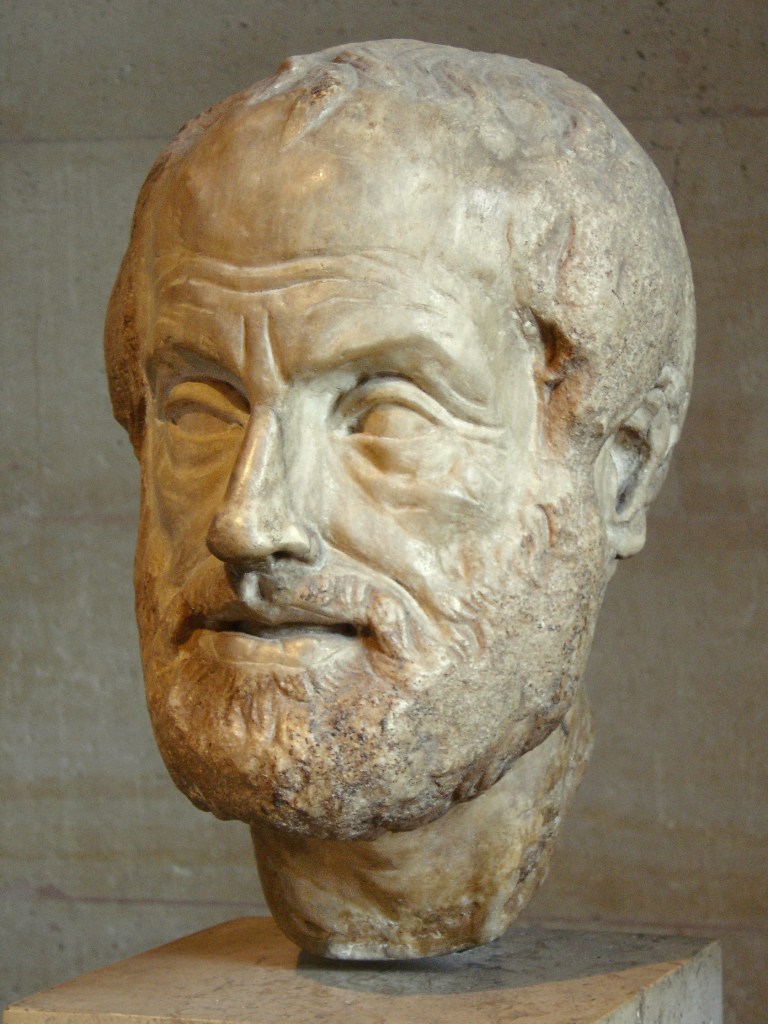
Featured Image by Mladifilozof & Aristeas: Own work, CC BY-SA 3.0 https://commons.wikimedia.org/w/index.php?curid=5957893

Click here to read Part I. Language

Something obvious, to start: our use of language directed to others and prompted by others is intended for others and received by others.[1] This is equally plain to see from the Rhetorical WHY’s foundation, the Rhetorical Model of Communication:

  • a message-as-conceived and -as-conveyed
  • a message-as-received and -as-interpreted
  • a message’s connotations and resonance
  • small-‘t’ “truth”

Small-‘t’ “truth”[2] at the center denotes the weight of responsibility we bear for our beliefs, the meanings we claim as “true” in the presence of everyone else doing the same thing. Language, then, seems as vital to our common well-being as the air we breathe and the water we drink.[3]

As to Gadamer’s Biblical comparison, introduced in Part I… from the Greek of the New Testament, “Word” translates as λóγος (logos), and language – logos, the Word – within us reflects the imago Dei of Creation. From this root issues a robust etymological lineage: word, speech, discourse, logic, reason, rational thinking – traits in the 21st century that seem so empirical, dependable, reliable, and antithetical to faith. Yet, for having language, we still have no supernatural facility to claim as our own – no omnipotent glory – that might make eternally creative use of it. We have but vaulting ambition – sinful pride – that frustrates our use of what feels somehow essential yet lies somewhere beyond our finite capability.

Thus we misconstrue our essence as instrumentality and our existence as authority… again that hazy distinction between essence and aim: imagine the world where hubris is surpassed only by vanity. We do in fact bicker endlessly over alternative facts, and our shared understanding – a shared estrangement – does in fact increase. And thus (again with added emphasis), in light of Heidegger – in light with Heidegger, in the clearing – I might read the opening verses of the Gospel of John as descriptive and readily spot both real and figurative IB:

In the beginning was the Word, and the Word was with God, and the Word was God. He was with God in the beginning. Through him all things were made; without him nothing was made that has been made. In him was life, and that life was the light of all mankind. The light shines in the darkness…

(John 1:1–5)

The darkness is an image also invoked by Taylor, certainly bearing a negative tone, to describe our bids at imposing our own light within Heidegger’s clearing. John counters the darkness with two essential claims: (i) God is logos, and not in some protean way but definitively, while (ii) the Word is the underlying source of ‘making’ and ‘made’, of light and life, with our goodwill or human essence being but an image of His.

One final detail from Arthos is worth adding to this spiritual aspect of IB, for two reasons: first, to credit Gadamer’s “fusion of horizons” as a way to describe IB, and second, to acknowledge Gadamer’s concept of “conversation” as something spontaneous, emergent, and unpredictable. Of the spiritual footing for Gadamer’s hermeneutical approach, Arthos says this:

For Gadamer, Christian incarnation “is strangely different from” the manifestations of pagan gods in human form (TM, 418/WM, 422). In Christology, the spirit made flesh is “not the kind of becoming in which something turns into something else” (TM, 420/WM, 424). This strong enigma places the credal[4] faith apart, and upends the normal relation of the spiritual and the material. The indivisible bond between the word and the person is a fuller ontological relation than simply the unity of the spiritual and material. The relation between word and person is no bloodless, conceptual abstraction. The constancy of the person in the word represents a concentration or fullness of meaning and an increase of being. We can see this, for instance, in the idea of a promise, in which a person stands behind the word that is given, since it is they as much as the word that is at stake, and the fulfillment of the promise strengthens the person who made it and the community it forms. The innovation of the doctrine of the word is to reverse the trend set in motion with the Greeks that the reasoning faculty distills the mind’s work from the accidents of the flesh. Logos is rather the fully embodied medium of human community.

(Arthos, 2009, p. 2)

Earlier in the chapter of Truth and Method that Arthos quotes, Gadamer explains that our diverse world of languages and their associated cultures have this in common: when speaking of the Word, none is able to express its true positive being:

The greater miracle of language lies not in the fact that the Word becomes flesh and emerges in external being, but that that which emerges and externalizes itself in utterance is always already a word.

(Gadamer, 2004, p. 419)

The Word “[being] always already a word” I liken to a simultaneous positive ‘freedom to…‘ and negative ‘freedom from…‘, an autonomy we can observe and describe but not impede or control. This “externality” oddly serves as a great equalizer across cultures, if we let it – that is, if we heed Taylor and seek not “to impose our light [in its place and] close ourselves off to [others]” (Taylor, 2005, p. 448). As compared to something in between us that enjoins, Gadamer describes something among us that joins.

To take all this spiritually, or else not, is up to each person – as apparently it must be. I can only express my words, here and now, for you to take or leave, as you will. Yet this much for all seems undeniable: each one of us might cast our self in this role of creator, as such: “If it were up to me… if I were the one in charge… if only we did things my way… .” Is it little wonder if the world and life and history seem defined by our multitudinous disagreements? And if saying so seems obvious, or pessimistic, consider too that Heidegger’s entire point seems to be an imperative to “Listen,” advice most infamously needed when it’s not happening.

One final analogy for IB departs from philosophy and the spiritual for natural science, which I include here on account of wonder. I take it from physicist Dr. Robbert Dijkgraaf during a 2015 appearance on PBS Nova:

“In this very simple formula, the whole geometry of the universe is hidden.… It’s also a signature formula for Einstein. The true mark of his genius is that he combines two elements that actually live in different universes. The left hand side lives in the world of geometry, of mathematics. The right-hand side lives in the world of physics, of matter and movement. And-- so perhaps the most powerful ingredient of the equation is this very symbol, equals sign, here: these two lines that actually are connecting the two worlds. And it’s quite appropriate they’re two lines because it’s two-way traffic: matter tells space-and-time to curve; space-and-time tells matter to move.
“You know, you have the huge universe, and it obeys certain laws of nature. But where in the universe are these laws actually discovered? Where are they studied? And then you go to this tiny planet, and there’s this one individual, Einstein, who captures it. And now there’s a small group of people walking in his footsteps and trying to push it further. And I often feel, Well, you know, there’s a small part of the universe that actually is reflecting upon itself, that tries to understand itself.”

I can imagine Dijkgraaf granting to Einstein a cosmic generosity, the goodwill to have made room in the clearing for others, e.g. a “small group of people walking in his footsteps.”

Some people get spiritual about cosmology, and physics too, so offering this analogy in the wake of Heidegger’s cosmic spirit seems more à propos than non sequitur. Personally, I think science and spirituality would find plenty to talk about together, if they would willingly join forces and listen to each other, and perceive expressions of interest, and develop some basis of shared understanding.

Besides its temporal implications, the second part of Dijkgraaf’s remark resembles a concept I have elsewhere called mirroring: briefly, an effect of interaction where the response provoked in Person ‘A’ by the prompt of Person ‘B’ serves as a reflection of Person ‘B’, as if Person ‘A’ were a mirror for Person ‘B’ to see themselves. Re-action reflecting action implicates both participants, and of course, the mirroring effect is simultaneously mutual, travelling both ways at once: between people, IB is a compelling imperative to listen and also respond – it suggests our joint interaction. By Dijkgraaf’s Einstein analogy, mirroring might also suggest that equals sign.

In all these concepts of mutual relatedness – philosophical, spiritual, cosmological – IB is a kind of setting, albeit not a literal physical location. Where ‘one’ thing ends and ‘another’ begins is an abstract third space between the two in relation. That said, IB is temporally present – each moment figuratively here and literally now, continuously underway and under continual renovation, forever in adjustment, always resembling, never quite remaining. This third space may overlap, such as when two people share something in common, or it may be a gap, such as when two people have nothing in common. Either way, it’s IB’s dynamic that is defining their relationship.

Click here for Part III. Relationships


[1] By “others,” we might also include “self,” in the more straightforward matter of defining the “audience.”

[2] Subsequently, any resultant small-‘t’ truth offers some capital-‘A’ Assurance, even if capital-‘T’ Truth remains beyond certainty or else relies on some kind of faith. Whether we even call this consensus the capital-‘T’ “Truth” would seem to depend on how well we get along together.

[3] Exactly how Heidegger came to understand language as this vital is the focus of Taylor’s essay although, admittedly, I am still pondering his overall discussion. But, again, I broaden “language” – as well as “text” – to comprise all our communicative efforts, and as I often said to students, “If it’s done by people, it’s rhetoric,” by which I meant, “it’s persuasive,” i.e. it’s something inherently communicative.

[4] An alternative definition for agenda is “things to be done,” originally theological, “matters of practice, as distinguished from belief or theory”; as opposed to credenda “things to be believed, matters of faith, propositions forming or belonging to a system” from which we derive creed. Thus I note with interest Arthos’s reference here to “credal faith.”

Conceptualising the In-Between: I. Language

Over the years, I have made many inspired allusions here on The Rhetorical WHY to a concept called the in-between (IB), often by describing the overlap imagery of the IB space as “the place where ‘one’ ends and ‘another’ begins.” For me, IB is the crux of education, the capstone, because it describes the simultaneous multiple perspective of our interaction.

The in-between concept is key to the separate works of storied philosophical educators, Ted Aoki and Gert Biesta. Aoki explores IB from the Heideggarian clearing (Lichtung), a space reserved between us for disclosure and understanding, and Biesta from the pragmatism of Dewey. Each emphasises shared experiences and communication between teachers and students, and both locate inter-relational curricular dynamics in the figurative “in-between” space that arises as Person ‘A’ and Person ‘B’ (+ ‘C’, ‘D’, ‘E’…) relate to – and, typically, take up interest in – each other.

As I conceptualise IB in my doctoral work, the relatedness we find in between is holistic, as much an emotional or empathetic consideration of one person for another as it is some intellectual coming-together. This holism comprises as much or as little of whatever is shared by the people involved. However, IB is even more still than this ‘place’ of joint interaction; it is an energetic interface where we find the back-and-forth dynamism of ‘process’ in process – a kind of underway-ness that our cultural eyes seem trained to not see. For being figurative, IB is yet very real.

A brief foray into philosophy can help illustrate how or why Aoki, or Biesta, or you or me or anyone might decide to take up interest in the IB concept, beginning with a study by Charles Taylor of Heidegger:

“The human agent is here an emanation of cosmic spirit.… [T]he idea of expression itself can nudge us toward a third way of locating the clearing. It gives us a notion of the clearing which is essentially Dasein-related… [b]ut it doesn’t place the clearing simply inside us as a representation; it puts it instead in a new space constituted by expression. And in some versions it can acknowledge that the constituting of this space is not simply our doing.”

(Taylor, 2005, p. 445, added emphasis)

Taylor’s broader focus here is language. He describes what he believes Heidegger felt was the nature or aim of a cosmic spirit – although whether that’s either or both nature or aim is harder to discern. In any case, he describes a composite recognition of reality, negotiated between beings (Seiendes), that is not “placed ‘within’ minds, but… out between the interlocutors” (p. 445, added emphasis). As one person expresses, another perceives, and between them occurs an understanding – that is, from continuous perceived expressions arises continual or on-going understanding.

Imagine, for instance, while dressing for Halloween, how you might react not only to your own reflection in a mirror but also to your friend’s reflection as they stand next to you: at once, you are able to take in both of your reactions. Expressions thus perceived are Heidegger’s clearing / light (Lichtung), and “its locus is the speech community” (p. 446), within which I also include non-verbal communication, such as facial expression or body language. We might imagine all our joint interactions, in person or separated, as some living demonstration of this imagery. For each at once, by both in turn, something comes simultaneously to light for each as well as for both. That simultaneity is important yet, as I would argue, more frequently missed, if not ignored.

What Taylor calls an emanating cosmic spirit seems to be some kind of tacit consensus or settlement between two (or more) peoples’ expressions that, when combined, connote some additional ‘something’, something diachronic,[1] like when scientists weigh evidence with theory in order to draw conclusions. All these continuous perceived expressions amalgamate,[2] as we might describe the gradual renovation of a building or the refitting of a ship, right down to the labour contributed by each worker: upon a pre-existing frame we each contribute to building – or rebuilding – something different, something new, something else.

The more people involved, the more potentially complex becomes the consensus that arises from all these amalgamating contributions. Such tacit consensus occurs time-upon-time between us: here and now between you and me as (currently) displaced interlocutors as well as between each of us with [ whomever ] across space and time. Within all our combinations, we are indeed “caught in an inescapable network of mutuality… .” As such, the more people involved – and preferably the more sincere our exchanges – the better. And, to paraphrase Heidegger (with added emphasis), let our consensus set a more stable foundation of shared clarity or enlightenment; let us reach a shared understanding. Otherwise, in rather more chaotic spirit, we may concede to misunderstand and bicker endlessly over fake news and alternative facts.

Rather than a will to power or a will to control, the emanating cosmic spirit aims for something more patient: a shared understanding, an on-going will to live and let live. I call it a will, which suggests vitality, but maybe it is a motive or a desire, some reason-for-being – that starts to seem more teleological, whether inherent or imbued. And I do not mean some platitude, “the will to live and let live,” like a bumper sticker. I mean literally goodwill, and here now is that hazy distinction between nature and aim: a mutually respectful sharing of existence[3] that is…

  • humble in expression
  • appreciative in community
  • inclusive of all whom we accept as well as tolerate, like as well as dislike

… and by which all our interaction and negotiating sets to thriving. As goodwill, this spirit’s thriving welcomes more than any one’s selection of some but is inclusive of all – the preferred, the desirable, the undesirable, the unfamiliar, the outcast, and all the rest as well. And where not everybody’s will is prepared to be so generous, perhaps instead seeking some need to force or to control, well hey… here’s at least one educational objective for anyone humble enough to embrace it.

And how humble are we? As compared to how certain we are about the expressions we offer to others, how generous are we willing to be? And how aware are we of our simultaneity, those expressions that others continuously receive from us while we continuously receive from them? And, in between all these, how anchored are we to the stable foundation upon which we claim the consensus of shared understanding between us, here and now as well as across space and time?

As it happens, all this concurs with Gadamer’s (2004) impression of Dasein as analogous to the Holy Spirit of the Biblical Trinity. This is not to suggest that Dasein is Biblical per se but that Dasein somehow transcends us; as a topic, then, spiritualism seems able to accommodate it. So, to continue (though not yet finish) the Biblical point, a triune impression of Dasein also squares Taylor’s assessment of Nietzsche, Leibniz, Sartre, and others whose work, he says, eventually “leads to our conceiving reality itself as emanating from will” (Taylor, 2005, p. 444). I am no expert on these particular philosophers, but theirs seems generally a branch of thinking that is, from a Biblical understanding, bound for idolatry “in the service of a triumphant will to will” (Taylor, 2005, p. 448). Theirs would supplant with human will the will of God, which created all by His utterances to “Let things be so-and-so.” In such a philosophy…

“… we come to see language as our instrument, and [Heidegger’s] clearing as something which happens in us [i.e. inherently selfish within us, not in the clearing negotiated between interlocutors].… At the end of this road is the reduction of everything to standing reserve in the service of a triumphant will to will. In the attempt to impose our light, we cover the sources of the clearing [i.e. other people and their expressions] in darkness. We close ourselves off to them [and]… the total mobilization of everything as standing reserve threatens the human essence.”

(Taylor, 2005, p. 448)

Existing between us, Taylor’s “human essence” corresponds to the goodwill mentioned above and refers to Heidegger’s “cosmic spirit” that opens this post.

In short, some wilful effort by one person to create and declare “so-and-so” frustrates the shared cosmic spirit of all the rest, by which we might otherwise negotiate a common consensus of… the way things are? … the way we perceive them to be? … the way we contribute to each other’s perceptions and understandings? Regardless, for any one person to declare “reality” is for that person to play God, which undermines all the rest,[4] even while another person might be attempting the very same thing: a battle of wills.

Conversely, if we think of reality as already created and underway, as something of which we are a part, not from which we are apart, then the warning is as dire as the promise is a marvel: communication, and language specifically – verbal, non-verbal, whichever kind – is no mere instrument to our being but the essence of our being, you and me and everyone, at once together: being here and now.

Click here for Part II. Logos


[1] For something diachronic, imagine a film montage: the director edits particular shots into a sequence, e.g. first, the shot of a car approaching a railway crossing; second, the shot of a steaming locomotive barrelling down the track. The two shots might actually have been filmed days, or even years, apart. But presented in sequence to an audience watching the film, they suggest the danger of a collision, especially since film audiences are accustomed to such devastating drama.

[2] In my dissertation, I imagine the accretion of rocks and gases that formed the planets around the Sun as a metaphor for the gradual historical assemblage of teachers who comprise the continuity of the on-going profession. From accretion to assemblage to amalgamation, I develop the imagery toward something of deepening significance or value.

[3] Note here the mutuality of people whose overlapping lives construct the complexity of a “real world” for which education is purported to prepare us, only now I highlight the feature of this mutuality that transcends time: we all live together, just not all at once.

[4] … the assumption here being that all people and their decisions and dignity are equal in stature, value, and worth. History, of course, would have us believe otherwise, which I think is Taylor’s point as well as the reason Gadamer might invoke a Biblical perspective, i.e. our inherited sinful nature – more on that in the next post.

This Just In…

Featured Photo Credit (Edited): Steve Buissinne on Pixabay

Emotions are an authentic human response – at least that’s what people say when they agree with those emotions. If it really is true, that would mean emotions are just as authentic a response when people disagree.

Probably just a handful of posts on this blog fall into the ‘rant’ category although Hey! that includes the one that started it all.

So at least the following emotions don’t lack precedent.


This Just In…

A lead on the morning news one past winter about heavy snow: “Great for skiers, bad for drivers.”

The past year, the past decade, and longer, you’ll have noticed an unquestionably gradual and ceaseless severity of weather effects, here and around the world. Heat domes, atmospheric rivers, bombs and cyclones, vortices and hurricanes and typhoons. You may also have seen news reporting that characterises the planetary climate as the enemy of motorists at the same time as it’s the victim of greenhouse gases, not to mention the harbinger of far worse to come.

From one TV news story: dozens of vehicles, some halted, some helplessly sliding, all paralysed by snow… enough to bring any motorist to tears. I’m almost paraphrasing the anchor’s light-hearted sympathy.

Each flake imperils the “unprepared” driver, who seems to risk the same foolhardy decision year upon year – though, let’s grant, it’s hard to know every circumstance. Let’s also grant that no enemy threatens winter driving quite like the reckless shitheads who lord their superior winter confidence over every other fool and sage behind the wheel: “Go home!” shouts the DB passenger of a white Eff-150 as they showboat past every stranded car they can scorn. “Go home,” as if they could. If you’re keeping score, weather thus far is not the enemy.

Someone far wiser than me will surely be explaining by now that Enemy Bad Weather is simply an affectation of our Harried Rat Race by the Charm of Morning News.

Could be… or could be the augury of addled brains, muddled thinking, and the subtle catalyst of still more unpredictable beliefs and behaviours yet to come, the kind that take decades to manifest before they’re detectable. Did you also know, you can pretty much say “shit” on TV now, and “eff” puns too. Still, as helpful as it would be, it’s hard to know for sure how long it might take culture to change as detectably as it took the climate. I guess we’ll see what happens.

Anyway… what’s to come of having reached millions upon millions of people, for whom a daily wish for good suitable weather competes with a daily war against undesirable bad weather… and all this, maybe – but, then again, maybe not – aside from an existential fight to “save the planet” while also chasing ambitions of travel and leisure and global what-not… sorry, by the way, all that was a question: ‘What’s to come of it all’?

Well, back to the news… literally the next story: “Massive overnight snowfall is the perfect storm for local ski resort!” which of course is code for ‘financial windfall’, which of course is not one but two weather metaphors to keep things light in an offhand way that says, “Have you got your shit together?”

And this from a few weeks earlier: “… forecasts predicting a risk of frost.” I can remember in the past hearing a “chance” of frost. These days, though, it’s a “risk.” A “risk” of frost. Frost.

One bleak headline even pits nature against nature although, sure enough, the frost in that story is mere backdrop for the Science that saves vulnerable naked vineyards, which of course is code for ‘commercial investment’. Granted, a belligerent “cold snap” isn’t exactly Daniel Plainview, or even Cobra Commander, but this story, with its closing remarks about “the silver bullet” – especially up against severe 60° temperature swings – betrays little beyond concern for our wine.

And exactly how do our priorities measure up with our frivolities – or, sorry, is that no longer a distinction? Anyway, I’m told we don’t use upmarket words like “frivolities” because too much Inside Baseball gets us too deep in the weeds… a risk of losing the audience, you know – must be that eff-word thing again.

Same week, same newscast… multiple winter tornadoes: “destructive” and “devastating.” A few weeks prior… once-a-century local flooding that restores a lake upon the flood plain, at the cost of homes, livestock, and livelihoods. Two weeks later… winter wildfires: “frightening” and “deadly.” In truth, all of these were terrible and damaging events – and all preceded the catastrophes of Lahaina and Los Angeles by two and three years’ time.

Against these events, and their human cost, rate this post as little more than a callous, self-absorbed tantrum.

Then rate the incoherence of news outlets, as they forewarn “Icy danger!” while smirking at “Snowy fun!” – nothing seems amiss? News outlets that prosecute seasonal war against the bitter “risk” of frost, and a cold-hearted enemy known only as “snow”… then broadcast the roar of trucks and ploughs and blowers, and hail those diesel heroes who salt and clear our roadways for the very traffic that helps to pollute and push our climate – and us – toward severe and unquestionable doom…

Against all this we might ask whether the recasting of “Global Warming” as “Climate Change” instead might have been, “Global Just Pleasantly Wintry-slash-Summery Enough Everywhere All the Time in the Place I Live – but, I mean, not too hot, and not too cold, and not too rainy, but not so dry… especially for, like, Vacation – but, other than that, yeah no, totally! yes! Save the Planet and all because, like – are you kidding me? – look what we’ve done, I mean, it’s just awful.”

Which brings us to one last cringe-worthy critique – this one not a headline but a slogan: “We’re killing the planet.”

Is there really no better statement to replace this ridiculous assertion of self-importance self-impotence? … no statement that captures the human species’ relatively momentary historical insignificance in contrast to the vast entirety of the planet??? … its perpetual environment, its magnetic and gravitational forces, its eons of solar formation and space-time existence at 4.5 billion-with-a-‘b’ billion years, it’s out-and-out gargantuan volume, mass, and physical composition – really? We think we are killing that?

Imagine that dolly shot from [ latest streaming dystopian holocaust ] with all the shrubs and weeds reasserting themselves through twisted concrete rubble, as the sun shines down once more. And, let’s rant – er, let’s grant – that we have reached a point where I could hardly blame the Planet for preferring to sustain life without us – except, of course, the planet has no preference because the planet is no enemy. It’s a planet.

A.I. Image Credit: Jack Drafahl on Pixabay

So… sorry, not sorry: we are not killing the planet.

And looking back on our 0.007% share of its history, there isn’t a soul alive or dead who could boast otherwise. Flipside, for those who have been keeping score: consider in return the number of people over our centuries upon centuries upon centuries of 0.007% history who have been affected – killed or otherwise – by the Planet’s natural geological activity… at worst, we’re a nuisance upon its face.

“We’re killing the planet.” Does nothing in this statement betray the same hubris that caused all our problems in the first place? Rest assured, the Planet will see to us and be just fine long after we’re gone.

If we’re killing anything, it’s hope of our own tolerable survival as planetary inhabitants so, yeah no, we do face real urgency to get behind a perspective that fears an existential threat because it fears the planet – which, by the way, is one last subtle play on eff-words.

As for the influence we continue to inflict upon the face of the Planet, we’re all of us indisputably reckless shitheads for our collective failed stewardship. And any triage of priorities and frivolities – of enjoyment and antagonism, danger and fun – will confirm that these are not the planet’s response to all our spewed contaminants – these are our response(s). If you have been keeping score, by now you’ll surely see: the enemy is us.

We imperil only ourselves.

Pogo” by Walt Kelly