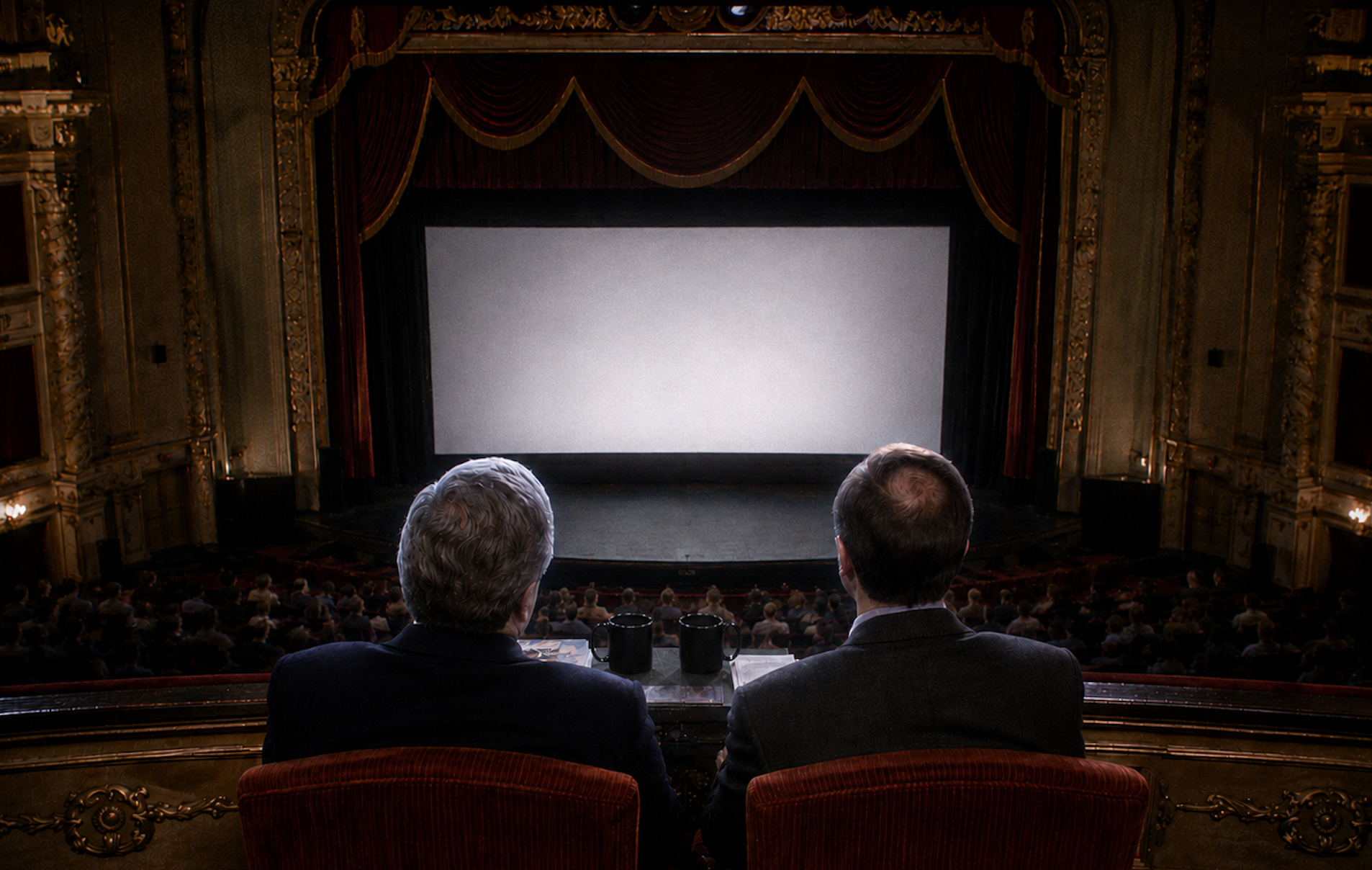
For as long as I can remember, I’ve liked movies. I grew up in a home that watched them, and it’s something I’ve carried on since becoming a parent, myself. I also remember, early on, when I began learning to like movies – that was around age six, when I started watching Siskel and Ebert.
For those who don’t know, of course… that would be Gene Siskel of The Chicago Tribune and Roger Ebert of The Chicago Sun-Times.
Originally paired on public television in November 1975, these two critics offered complementary movie reviews in an aisle-side format that was by turns conversant and quarrelsome, and never outright formal although always somehow compelling. For being TV-brief, their reviews were fluent and well-informed – notably so.
But what people really got a kick out of was the keen and perceptive banter and bickering that quickly came to define their relationship, underscored all the more by Siskel and Ebert’s shared zeal for movies and obvious respect for each other’s discernment. Here were two who knew how to disagree, vociferously, by way of some hold upon human foible and dignity that was surely also what sowed their critiques.
Conversely, their uncomplicated rating meme, two-thumbs up or down, condensed these erudite opinions into a succinct Gold Standard for the box office: a trustworthy symbol of substance for movie-goers that also inspired a whole school of empty mimicry, not unlike today’s movie industry, which – rather like today’s movie industry – seems to have missed the point that Siskel and Ebert were making week after week, year upon year, about the kinds of movies worth watching, and why.
For the record, that would be ‘thumbs down’ from me for the culture of sequels, reboots, and non-original risk-averse CGI crap that infests the big screen today.
Siskel and Ebert were iconic, a face-to-face template entertaining enough to earn national stardom and informative enough to sustain an audience across four broadcast moves over a nine-year span. I was at pains, sometimes, tracking down each new program in an era when Chicago newspapers were only to be found at Chicago newsstands.
By the time they reached a sadly abrupt end, in February 1999, Siskel and Ebert had become a media archetype, one lasting nearly twenty-four years. Ebert carried on for twelve more years, as good as ever, but that irreplaceable partnership was always greatly missed.
Today, I still find Siskel and Ebert’s reviews enjoyable, informative, accessible, and relatively timeless. That’s a remarkable thing, when something offered confirms itself as something lasting.
Although… I suppose they haven’t exactly lasted since someone out there today will have likely never heard of ‘Siskel and Ebert’. On the other hand, whatever is familiar probably reflects a culture’s values, whether directly or inversely, just as whatever gets remembered probably reflects what that culture more prefers. Case in point: I sure do miss Siskel and Ebert, these days. And, evidently, I’m not the only one although that isn’t why I posted this. What’s more, it’s no small irony that culture today is rife with critique, the kind of published informal opinions that target every thing imaginable under the sun.
One might even imagine Someone with Plenty to Say posting their YouTube reaction while watching a ‘Siskel and Ebert’ review… and, just so we’re clear, that would be an audience watching a review by a reviewer watching two reviewers offering reviews to an audience of viewers about the value of something to watch. OK, that’s larger irony than I first let on, and I can only guess what Siskel and Ebert might have said about it.
Still, I suspect it might have been one of those times when they found reason enough between them to agree.
Check out this 50th Anniversaryretrospective from CBS News, which features an equally entertaining montage of Gene Siskel as the critic for Channel 2 News with CBS Chicago.
The academic community – a community to which I have belonged for decades – trades in ideas, and thinking is our currency-in-trade.
Throughout my teaching career, as I’ve offered elsewhere, I’ve devoted my practice to helping people make thinking a habit:
Thinking is the value in our ideas, and since we’re accountable by means of personal responsibility to defend these, there’s our incentive for thinking to be informed by knowledge, practised with discipline, and weighed by healthy scepticism. Discussing and testing ideas is the purview of thinking, and as such, thinking’s an invaluable skill.

Along the way, as our thinking skills mature, we yet retain at our core something personalised and uniquely individual: let’s call this integrity, which literally derives from roots that combine to mean something “untouched,” i.e. something “pure.” As puzzle pieces integrate to form a whole picture, so we might imagine all the pieces that form 'ourselves'. Full integrity finds every piece contributing, no piece erroneous or superfluous although, unlike puzzle pieces, ours we are able to enhance and improve. Distinct from “integrity the buzzword,” integrity is the character and experience to cope, or else not cope, with real consequences. Integrity is how we spot adversity, and it fuels our will to leave comfort zones in order to measure how much we’ve grown.
As a coach since 1990 and a teacher since 1999, I’ve long felt my responsibility, on behalf of people, to help players and students find ways to grow and contribute in accordance with their own integrity.
Fuel for this growth includes the earnest effort we expend in the academic setting to develop and explore imaginative, inventive, even original ideas, and then to properly credit the earlier thinkers who provided our source material. Citation is a formal way to indicate where other thinkers’ ideas ended and our ideas began. But such ‘academic integrity’ goes beyond formal citation.
Academic work is an investment – rigour now for pay-off later. Investing in the development and expression of ideas now, out of what came before, not only works the thinker’s valuable skill, it also advances the growth and maturity of broader confidence and social esteem into the future. This social responsibility, from my experience, is one reason for tying student success directly to engagement with others in a classroom, which is hardly some revelation but remains important enough to reiterate.
As for me… when I teach, I need to hear from students too, particularly in person, although whatever the case, in their own words. And I appreciate the utility of a Zoom call, but in-person contact time between students and teachers is such a precious commodity that face-to-face teaching-and-learning – for me, anyway, not sure for you – is simply irreplaceable and will never be going away… not unless we so utterly lose our broader social integrity that we just stop being human.
That said, we do manage to prove, now and again, that the pieces comprising our integrity seem to contain at least a few impurities. For instance, you may be surprised to learn how, even before the Digital Age, we found ourselves facing opportunities and enticements not only to draw upon others’ ideas, words, images, and videos but also to risk presenting these irresponsibly as our own. Yeah, you heard me right – even before the Digital Age.
These days, as we have access to scads of text and media literally in the palm of our hands, legitimate schools are left to counter our worser nature by emphasising quaint abstractions like honesty, fairness, and respect. Such schools expect students and teachers to behave as honest and responsible members of an academic community by complying with policies, regulations, and prohibitions that uphold that academic integrity thing.
One common prohibition is plagiarism, which means submitting the oral or written ideas, words, images, or videos of another person as one’s own without giving that other person proper credit or acknowledgement. Plagiarism is intellectual theft though, more simply put, plagiarism is cheating, by which I mean falsifying anything that is subject to formal evaluation or peer review. And again in my experience, I’ve found plagiarism is far more common than most students ever realise. But whether it is or isn’t tantamount to stealing or cheating, plagiarism is a form of academic dishonesty that we absolutely must not tolerate, much less accept. Why?
Plagiarism is a serious academic obstacle that poses significant, permanent consequences, whether detected or not. Ideas that are not one’s own must be given credit at all times – perhaps this is the fundamental precept of academics – because, without respecting this credit, any pursuit or growth or refinement of existing knowledge is fruitless, and any working of the skill of thinking utterly ceases for having no available fuel… well, apart from ‘How can I steal and get away with it?’ or maybe ‘How can I justify being lazy?’ or how about ‘How can I excel at being an ‘Enter’ button presser?’ Presenting the same or substantially the same work more than once, in the longer-term, gains us nothing beyond the muddled growth of thinking about ‘how to cheat and prosper at the same time’.
How about the uncredited use of Generative Artificial Intelligence tools, as in ‘Gen A.I.’ – the other A.I.… is this also plagiarism? Honestly, how can it not be? In order to draw upon what’s available, Gen A.I. scours and indexes all available ideas, words, images, and videos, and these not just from some one person but from most everybody out there who’s accessibly published on-line.
Not a search engine in sight… no people either Image Credit (edited): hyeok10_12 on Pexels
This being the case, then what of any work completed with Gen A.I. – correctly cited or not… what isn’t plagiarism? Good question, one that evidently poses an inconvenient truth yet to be addressed by the euphoric mania, beyond watery defenses like “pattern matching,” “fair use,” and “non-human agency”… bullshit excuses as evasive and lazy as the humans whose use of Gen A.I. warrants all concern for academic integrity in the first place.
“Always ask when you are unsure…”
Thus far, to students who ask me, I’ve found myself able to suggest that Gen A.I. – like Wikipedia before it – makes for a poor academic resource, which is to say, “An easy place to start is rarely a good place to finish.”
Upon saying this to students, I’ve occasionally faced a reminder that the analogue world of my past experience is something to smirk at. Don’t get me wrong, we did have electricity and computers back then, but I’ll grant it was also a time when TVs received broadcast signals, telephones had a dial tone, the Commodore Amiga was cutting-edge technology, and everyone wore Lacoste. More to the point, though… back then, when the encyclopædia on your shelf was all you had, it was also your motive to visit the library, or a magazine stand, or your friendly neighbourhood teacher, who’d also done those same things.
As for those students who smirk at me today, I gather that somebody they’ve never met must have laid my past to rest on their behalf, and therefore nothing – repeat, nothing – from that past had better even try holding threat upon their attention, especially not when it can’t be accessed via smart phone.
By the same turn, I hold what seems to me a reasonable expectation on behalf of these Students of the Digital Age, namely that they appreciate their responsibility to…
understand how ‘academic integrity’ applies to each activity across a program of study, and
clarify not merely what constitutes ‘academic misconduct’ but also why its consequences threaten our whole endeavour
p.s. while you’re at it, also take note whether your school has any kind of “Student Declaration of Responsibility” to which you may have assented upon registration – and then, whether you find one or not, respect it anyway
I should say, I never smirk when I expect all this because, at its core, academics is about our social responsibility to steward broader growth and human progress. It’s about human lives and our livelihoods underway. It’s about how well we expect to be doing once we pass things on… things like ideas and how to think them through.
And hey, if you don’t feel like this endeavour requires work compelled by sincerity and integrity, then maybe it’s time to re-think your involvement. Or maybe just get out of the business altogether because it’s each scholar’s personal responsibility on behalf of everyone else to respect the principles of academic integrity, foremost by applying those principles in your own practice.
At a minimum, we might describe ‘doing the laundry’ as a two-step process, the second being when we turn on the dryer. Some people even add a third step: ‘Folding the laundry’.
But whether specific or generic, gerunds do little to convey any sense of the stages or steps to that ongoing process. If anything, a 2–3 word gerund phrase reduces a series of steps – ‘the ongoing process’ – to ‘a singular thing’ or ‘a discrete event’, e.g. “Doing the laundry is such a chore!”
In Part I, I called this manner of thinking “shorthanding,” as we conceive and describe and reduce multi-step complexities into solely singular events, and I wondered whether innovation, progress, and technology might be having a longer-term influence that reiterates this reductive effect upon our outlook and our thinking…
(a) We develop technology for doing Task ‘A’ so that we don’t have to, which yields surplus time
(b) We develop an accompanying frame-of-mind, which reinforces itself more and more with each innovation that comes along
For all its efficiency and time saved, Technology teaches us a commitment to surplus. Think Wall-E and all those people buzzing around the Axiom spaceship in loungewear and e-chairs.
As we grow more accustomed to the surplus, our accompanying frame-of-mind more readily reconsiders matters of ‘process’ from being a series of steps to being a singular moment or event – this is shorthanding. This feedback loop is training us to think in ways that are more and more accustomed to shorthanding, and on it goes.
All this I’m deliberately claiming informally – it was me who picked the word, “shorthanding,” with zero empirical science to back it up, so…
Sorry, STEM – blame it on STE(A)M, if you like.
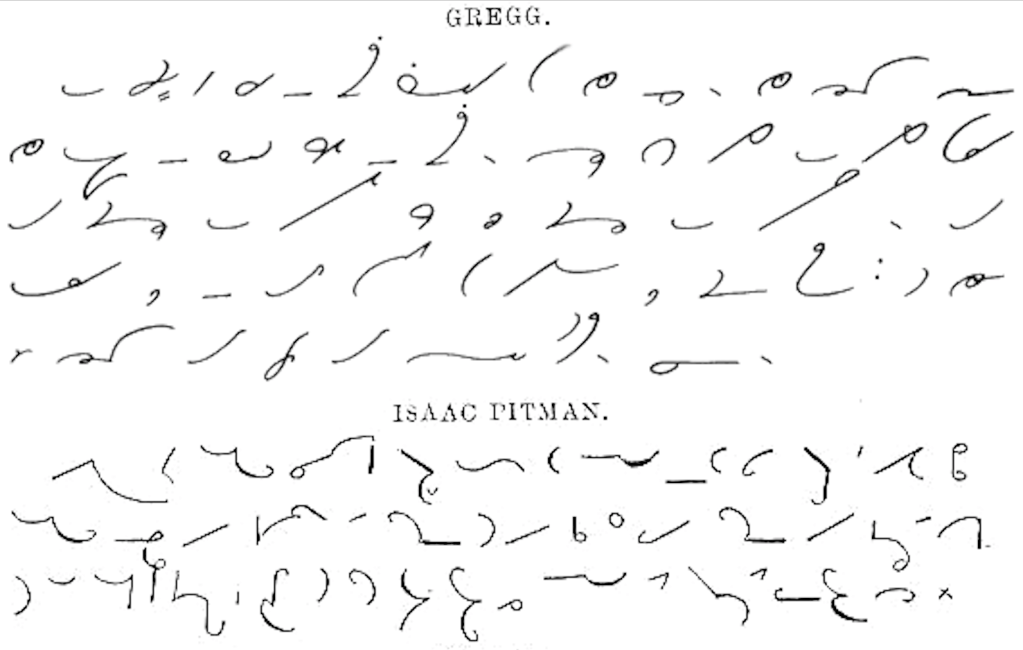
And, sure, shorthanding’s a bit abstract and hard to define. For starters, it might be more akin to Pitlick & Gregg than Pitman & Gregg.
Two minutes for… cross-checking? Image Credit: Public Domain
And language shorthands like this all over the place – look no further than the gerunds and nouns, already mentioned: ‘vacations’, travelling’, living’, life’.
But we’re not simply trading up on Technology for time and convenience, nor on chores and labour for preferred activities. We’re trading in one kind of living for another, by way of a specific manner of who we are and how we live, which is to say by way of how we think. And we appear to have been doing all this without much concern for the price of the trade-off. Whatever that price might be, I suspect we’ve been the ones left short-changed.
For all its marvellous ease, Technology has been feeling more and more to me like a bad habit none of us can resist, and that gets me wondering where else we’re shorthanding. How else have we been altering some ongoing process into a misleading singular notion or concept, like ‘doing the laundry’? And what might be the nuance of such abbreviated shorthand thinking?
One altered concept, I’m afraid, is the process of ‘learning’.