Click here to read Pt I. An Uncertain Faith
A Kind of Certainty
II. Curriculum, or What You Will
Baumlin (2002) distinguishes three concepts of temporality. Chronos is linearity, our colloquial passage of time, “non-human; impersonal objective nature” (p. 155), from which we understandably define past, present, and future. In relation to this is kairos, a single point in time, “[describing] the quintessentially human experience of time as an aspect of individual consciousness, deliberation, and action… that single fleeting moment … when an individual’s fortune is ‘set in motion’, … [providing] the means” and yielding “Fortuna, the consequences” (p. 155). Interwoven with kairos, then, is Occasio, the cause to Fortuna’s effect, a sense of “‘right-timing’ and prudent[1] action,” an opportunity[2] to better the capricious lies of fortune and fate. Although this sense of opportunity was emancipating, it also engendered accountability for consequences.
The developing belief that we possessed not mere agency but free will weighed upon Renaissance thinking and was a trait that Shakespeare often imparted to his characters, Hamlet (4.4.46-52) being but one example.[3] By the time 17th century Elizabethans first watched Hamlet on stage, the humanist challenge to “a grim… Christian sufferance and resignation to time” (Baumlin, 2002, p. 149) was well underway. Unsurprisingly, Shakespeare offers nothing firm in Hamlet as to where our belief should lie, either with fortune or with free will; indeed, leaving the debate ruptured and inconclusive seems more to his point. To this end, perhaps most notable is his placement of Hamlet alongside Horatio in the graveyard to ponder the dust and fortune of Alexander, Yorick, and – hard upon – Ophelia.
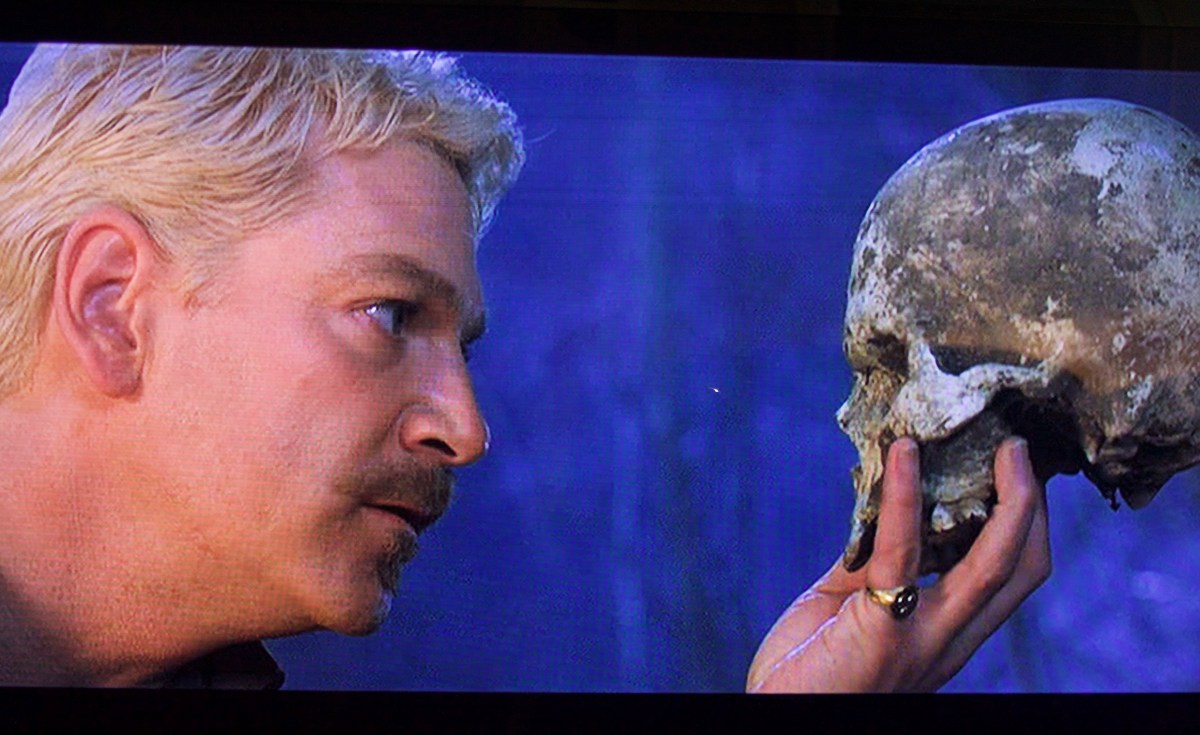
In handling Yorick’s skull, Hamlet revives the poor fellow’s “infinite jest [and] excellent fancy” (5.1.186), memories of such fond “pitch and moment” (3.1.86) as to “reactivate” (Pinar, 2017a, p. 4) his own childhood, even momentarily. Such specific remembrances educed by Hamlet (which is to say, by Shakespeare) expose the springe of kairos; ultimately, certainty is beyond our capacity, rough-hew it[4] how we will. Colloquially, this might seem obvious, i.e. “the best laid plans…” and so forth, and no one person apparently able to pick the right lottery numbers each week. Yet the extent to which we consider ourselves masters of our own fortune is, for Hamlet, presently in the graveyard, a kind of epiphany, “a spiritual (re-) awakening, a transformation” (Baumlin & Baumlin, 2002, p. 180).[5] He decides that yielding himself over to “divinity” (5.2.10) is wise as compared to the folly of trying to control what was never within his grasp to begin with.
He does not give up any freedom – which but seems – so much as give over to dependence, which of course is a leap of faith based on [ exactly how much, exactly how reliable ] gathered evidence. Shakespeare poses a question of allegiance – to obey, or not to obey – further compounded by which allegiance – obedience to father, or to Father; to free will, or to fortune; to an unweeded garden, or to what dreams may come – all these are the question.[6] Shakespeare has Hamlet “reconstruct” (Pinar, 2017a, p. 7) his conceptions of allegiance and obedience during the exchange with the Gravedigger, which hardens Hamlet’s resolve yet also enables him to come to terms with his tormenting dilemma over fealty and honour. By the time his confrontation with Claudius is inevitable,[7] Hamlet’s decision to “let be” (5.2.224) “[marks his] final transcendence of deliberative action in worldly time” (Baumlin & Baumlin, 2002, p. 180). Thus is indicated the subtle dominance of the third temporal concept, aion, “the fulfillment of time” (Baumlin, 2002, p. 155), a circularity like the uroboros, the serpent swallowing its tail. As such, aion signifies what is boundless or infinite, neither more nor less than eternity.
Oddly enough, these three concepts, in concert, can seem both time and place,[8] describing a “spatial-temporal sequence… from point, to line, to circle”; from “natural to human to divine orders” (p. 155). I am not fixed to the idea of a “sequence,” but the general composite still shapes my response to Hamlet’s most famous question of all.[9]
Let go. Learn from the past, but don’t dwell on it.
left (past)
Let it work. Anticipate the future, but no need to control it.
later (future)
Let come what comes. Every possible decision will still yield consequences.
Let be. Pay attention now to what is now.
The readiness is all. (5.2.222-223)
lasting (present)
The rest is silence. (5.2.358)
(a clever double-meaning here: “the rest” = either past regrets and future anxieties or else the undiscovered country, death)
As I take them, these four “Let…” statements (and the accompanying quotations from Drez) amount to sound wisdom, like trusted advice from teacher to student or parent to child.
As a student and child, myself, writing this paper, I faced some question of certainty – the same question, strangely enough, that we ask about curriculum: what is worth including? By the same token, what is worth omitting, and from there, what will also be otherwise left out or unmentioned? Whatever we decide, one thing is certain: we can neither cover nor even conceive it all, which of course was my original problem. In fact, knowing as much as we know can even shed paradoxical light onto how much we remain in the dark. Eventually, as my Dad recommended over the phone, I simply needed the courage to make a decision and go with it, and even with his voice in my ear, I knew my own advice with my students had always been the same.
Hanging up, I reasoned further that any feedback I did receive – from peers during revision or from my professor’s formal evaluation – would illustrate how effectively I had collated and communicated my message. Beyond that, say revising the paper for publishing, I would have some ready direction. And there it was, I realised, staring me in the face, curriculum in a nutshell: conversations, decisions, actions, evaluations, reflections – all these, in relation to me as I wrote this essay, amounted to a lived curricular experience of my very own.[10]
My curriculum, like this essay, does not simply pose the straightforward question about what is worth including. That question is insufficient. More particularly, my curriculum, like this essay,[11] prompts me to consider what is worth including in light of the audience, the topic, what is already known about the topic, and whatever aims exist in further pursuit of the topic.[12] Succinctly, my curriculum – all our curricula – is contextual, multitudinous, and a question of – questions of – what is particularly worth knowing about any topic of study under the sun: “Why this, why here, and why now?”[13] That is the question.
Well, maybe that is the question. The essence of this question, this curricular particular, lies in kairos, the concept of opportune timing or occasion that “signals the need to bring universal ideas and principles to bear in historical time and situations [i.e. deductively] and, thus, calls for decisions [requiring] wisdom and critical judgment” (Smith, 1986, p. 15). We can only note what matters to us once we have a reference point. And since nothing occurs in a vacuum, any detail can be potentially informative, so we must learn to pointedly ask not, “In what way(s) do I already know what I’m looking at?” but rather, “In what way(s) do I not know what I am looking at?” which tends to be deductive. Typically, curriculum begins inductively, with what someone already knows, and we all know plenty of things. But we generally bring to bear only what we deem relevant to the moment.
By the same token, someone who knows what is relevant to the moment has a kind of prescient “mechanism” (Christodoulou, 2014, p. 54) for spotting what will likely be of use.[14] So curriculum is a means of determining, if not discovering, in the moment what works. It is, therefore, also a means of coming to know ourselves. As we develop confidence and self-esteem, and dignity, we grow to feel that we have something to contribute, that we matter, all of which prepares us for helping others. Curriculum helps us to sort out our values and beliefs,[15] which provide a frame-of-reference in order to select and, later, to measure our day-to-day efforts. Of course, none of this happens immediately; we need time to grow more self- and other-aware, each kairos experience filing in alongside the rest, like a crowd of ticket holders. I can only wonder whether Shakespeare might have characterised curriculum as something akin to being held over for an indefinite engagement.
In any event, we never stop learning – may our auditoriums ever sell out – as we continually induce as well as encounter influence. But how deliberately do we do so? Maybe that is the question.
Click here for the Bibliography
Click here for Pt III. A Scripture of Truth
Endnotes
[1] As Baumlin (2002) notes, “For the student of prudentia, time reveals itself as golden Opportunity rather than as fickle, devastating Fortune” (p. 141). Certainly, Shakespeare and his Elizabethan audiences were feeling such debate permeate their own lived experiences, a dram of an idea that, once diffused, might only thereafter suffuse.
[2] According to Claflin (1921), “‘opportunity’ in Shakespeare means more than it does now [in the 20th century]; it is closer to the original force of Latin opportunus, and means ‘a specially favourable occasion’” (p. 347). Curiously enough, however, as I searched a concordance of Hamlet (Crystal & Crystal, 2002), I found no usage of “opportunity” whatsoever and only three of “chance,” most notably that of Hamlet to Horatio: “You that look pale and tremble at this chance…” (5.2.334) in reference to the dead and dying at the play’s closing. Of further interest is the concordance’s report that Shakespeare used “opportunity” throughout his entire catalogue of poems and plays only sixteen times as compared to “chance,” which he used 114 times.
[3] Kiefer (1983) examines Fortune at length as one colour in Shakespeare’s palette for his characters, noting of King Lear: “In no other of Shakespeare’s plays do characters invoke Fortune so insistently [or] so frequently at pivotal points of the action” (p. 296).
[4] Read either “certainty” or “our capacity,” here, in place of “it”; either works just as well. The line from the play I have paraphrased, of course, because the original antecedent is “our ends” (5.2.10) in place of “them” (5.2.11). However, where I have changed the diction of the thought, as a matter of perspective, the meaning remains intact. The implication that we – in essence – play God might not be nearly so alien for Shakespeare’s audience as to their feudal predecessors. By contrast, to postmodern audiences these days, the notion of a divinity standing apart from our own free will and shaping our ends might be the more alien concept.
I might finally point out that Shakespeare, as his creator, is Hamlet’s god, of a kind. But that analogy does not last long under scrutiny since Hamlet, being a fictional character, has no sentience, free agency, or tangibility, and actors who portray him are left with prescribed dialogue and beliefs.
[5] Because I am ultimately discussing what Shakespeare did, his characters being only conveyances as such, I was tempted to complete this sentence with a line from Macbeth, as follows: “The extent to which he considers himself master of his own fortune, presently in the graveyard, is laid plain for Hamlet, leaving him to conclude only that ‘…all our yesterdays have lighted fools the way to dusty death’ (5.5.22-23).” The key difference, of course, is that Hamlet decides against being a fool whereas Macbeth seems all too keen to excel at it. Where Hamlet best demonstrates a respect for “divinity [shaping] our ends,” Macbeth better represents the rough-hewing bit, which makes him a far less redeeming character in the end. So, upon reflection, it seemed prudent to stick substantively to just the one play. Thank heaven for endnotes, I guess.
[6] Had he fallen clearly to one side, as a subject to his monarch, Shakespeare might very well have sealed whatever freedom he did enjoy; his own response, evidently, was to render unto Caesar, and render unto God, and continue writing plays. Four centuries on, what is there about us, that we might think we are any less susceptible than he was to coming to terms with our finite nature? We live in civil society, by the rule of law under a Constitution, within which are Rights and Freedoms that include the assurance to believe, or not to believe, whatever we decide suits us best – and then let come what comes. Furthermore, we have the advantage over Hamlet in that his example exhorts us, interminably – just ask my students, remember? Alas, though, poor Yorick.
[7] As Horatio notes, “It must be shortly known [to Claudius]” that Hamlet has tricked Rosencrantz and Guildenstern to their deaths at the hands of England (5.2.71-72), a move by Hamlet in his contest that must certainly harden his uncle’s resolve to have Hamlet dealt with once and for all. Of course, Claudius had sent Hamlet to England to be killed, but that in secret, on account of both Gertrude and the public’s love for the Prince (4.7.5-24). However, in dispatching his childhood comrades – and with such calculation (5.2.57-70) – Hamlet has now given Claudius justifiable means to overcome any such favourable opinion as might have benefitted Gertrude’s “son” (5.1.296).
[8] Time and place are what we commonly refer to as setting in English class, which is a curious way to consider eternity.
[9] Seldom mentioned amidst all the consternation is that Hamlet does not actually ask a question. If he had, he might have worded it as, “Is it to be, or not to be?” In that case, we would need to know what “it” means. Alive? Dead? Happy? Sad? Anything goes, I suppose, but then… what would you expect? He might have been asking, “Am I…” or “Are we to be, or not to be?” But where that is still somewhat existential and vague, now we might want to know whether his use of the verb, to be, is more open-ended or copular. I suspect Shakespeare knew enough about a general audience to trust that only the most fastidious grammarians would fuss over particulars such as antecedents and verb tenses in the dialogue. Otherwise, why decide to use the most protean verb in the English language?
[10] As far as lived curricular experiences go, there are many like it – as many as there are people to have them – but this one is mine.
[11] At this early stage, I confess: why struggle writing a paper when I could use the age-old trick of writing a paper about writing the paper? Why…? Because the age-old trick is just that – a trick – and spinning academic wheels stalls any hope of contributing to knowledge, so I would hardly be honouring my responsibility if I tried pulling that off. Still… the paper within a paper got me thinking about Hamlet, which oddly enough had been my original inspiration for this essay. As my students used to say… once you study Hamlet, he just never goes away. How true, how true…
[12] According to Hartmann (2014), it was just such questions that prompted Ezra Klein to leave The Washington Post and establish Vox.com in 2014.
[13] Students in all my courses learned to rue the question “Why?” so much so, one year, that it became a running joke simply to utter “why” as a pat-response, whether as a question, an interjection, a plea, a curse, an epithet – those last two maybe reserved for me, I don’t really know. In honour of their perseverance, and their angst, I named this blog The Rhetorical WHY.
[14] Surrounded by Winkies, confronted by certain capture, only Scarecrow eyes the chandelier above the Wicked Witch, so only he can yank Tin Man’s axe across in time to chop the rope that suspends it. Hardly the grandeur or the gravitas of Hamlet, I realise, but The Wizard of Oz has much to offer pertaining to curricular theory as well as teacher autonomy.
[15] In keeping with the three temporal concepts, perhaps a more suitable metaphor than threading our own needles would be to say we surf a long pipeline. But, this essay being more concerned with curriculum and theatre, any such Hang-Ten imagery is better suited to another time, like connecting curriculum to gnarly waves and bodacious beaches (“Surf’s Up,” 2015). Anyway, certainly no one would ever dream of linking Hamlet to surfing (“‘Hamlet’s BlackBerry’,” 2010) in the first place, would they?