The Bridge to Hell…

Peter Benson’s article, “Francis Fukuyama and the Perils of Identity,” in Philosophy Now (Issue 136), got me thinking again about multiculturalism. I’ve had plenty to say about multiculturalism – seldom positive – although none of it here on The Rhetorical WHY.

If you haven’t yet leaped to conclusions about me, I’ll point out that the full title of this post is “The Bridge to Hell is Paved with Problematic Intention.” It’s meant to be a little satirical, a little disparaging. It’s a wordy mash-up of axioms, cultural and academic. I’m okay with wordy this time.

I’m also conscious of the juxtaposition of my crude title and the wisdom of Dr. King. I’m less okay with this but felt the contrast worth any shock, ambiguity, or misapprehension.

Read on, and take issue as you must or as you will.


The Bridge to Hell is Paved with Problematic Intention

Has the trumpeting of multiculturalism taken itself so literally that even individualism (… multipersonism?) is insufficient?

Taking itself, as I say, more literally, multiculturalism sets one culture at equal stature with the rest – seems fair enough – apparently, a shift in meaning from diversity to inclusion, which implies that diversity wasn’t working on account of exclusion.

So, within Culture X or Culture Y, as we might imagine an individual being equal alongside other members, we can imagine across the two cultures potential impasse: “… unresolvable conflicts between mutually exclusive viewpoints [that] dominate the political landscape” (Benson, 2020). I still grant here individual differences, but I have in mind some divide between distinct communities of individuals, i.e. a divide between cultures.

In relation to Culture Y, for example, Culture X might deem its equality mere lip-service and feel de facto unequal: “How are we in Culture X obliged to consider those in Culture Y as ‘equal’ if our culture is not equal to theirs?

Image by MetsikGarden from Pixabay

“How can we treat them as equals, much less be treated as equals, if our larger culture is not equal – that is, if Culture Y does not accept us on equal terms?” Culture Y might declare all individuals equal to begin with and counter that Culture X only perceives inequality. Yet this simply compounds the same injustice for Culture X, who will hardly waive their due consideration.

In any case, equality of cultures seems not the same thing and unable to play out to the same effect as equality of individuals – even more so since an individual who identifies with more than one culture might feel strewn across their own intersections. (Curiously, this assumes one’s identity to be chosen as much as bestowed, which echoes individualism as much as collectivism.) In fact, if equating cultures equates individuals, then equality rests further upon equity, a mantle of justice issuing from a superior authority.

Perhaps Culture Y lives by some unproblematic axiom, such as ‘might makes right’, ‘stay the course’, or even just ‘common sense’ while Culture X lives by ‘power to the people’, ‘diversity is strength’, or ‘revolution is no dinner party’. Can they bridge their divide? Is one culture responsible to reach across, as it were, halfway? We might define an obligation to come any distance according to power of authority. To be sure, imbalanced authority does seem a constant throughout history; for exactly this reason, though, would we expect the side with authority to yield?

I turn to Dr. King. In his time, a generation or two before mine, Dr. King sought and fought for equality and “the cause of peace and brotherhood,” there surely being little more equal than “a single garment of destiny” (King, 1963). As we are all, he claimed, paradoxically yet beautifully this makes us one. Standing upon the authority of centuries, of historical proclamation and practice, and there resting in long studied philosophy and lived experiences of spiritual belief, Dr. King challenged his brothers to bear witness upon themselves. Such authority remains as stable for those to come as for those preceding – that is, unless or until those to come decide to wrest authority someplace else.
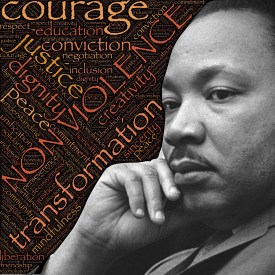
Image by John Hain from Pixabay

In our time, justice supersedes civility, and restitution tinges redress. The zeitgeist these days is emotional, distinctly angry. Individuals possess rights, and cultures bear responsibilities. “The politics of identity,” Benson says, “multiply conflicts and divisions.” As we ostensibly advocate for the equality of all individuals, identity politics fights a culture war, a battle for equity across cultures-of-particular-individuals, which actually precludes a wider equity. Cultural equity has supplanted individual equality because, where there is axiomatic ‘strength in numbers’, multiculturalism can only ever be ‘us vs them’. If so, is it still defensible? Is multiculturalism a way to ensure that our outcomes match our aims? Or are the aims of those with authority forever destined to pre-empt the aims of those without it? Indeed, what is the way to ensure that no one of all will ever be marginalised?

For one final point I turn to Benson (2020), not in comparison to Dr. King but out of respect for all being one: “Only when we stop having identities in the group-defined sense can we return to being individuals” (original emphasis). We may discover too late the folly of burning a bridge-too-far while crossing it.

Washington, DC (March 2014) - Day 4 - 101

True North Strong… but Free?

True North Strong… but Free?

The Dog's Bollocks.jpg

post-modern

post-national

non-patriotic

These are all descriptors I’ve encountered for Canada, from one source or another. I can make of each one something contextual. Yet as each suggests a departure or break from something previous, that’s really just a subtle way of saying, “Here’s what we aren’t.”

Yet describing something with negative terminology is ultimately meaningless because it can end up becoming silly; for instance, “I am not a giant Godzilla-like dragon that breaths fire and enjoys sipping my iced coffee on Tuesdays.” We could literally imagine anything that isn’t the case and say as much, and we’re no further ahead knowing what actually is the case.

So when I see descriptors like these – for Canada but really for anything – I’m unclear and confused about what to think. It’s a concern for me, the citizen, because who I am and what I value have direct effect on you and everyone else, and me in return all over again.

In the vaunted year 2015, according to Canada’s newly elected PM, Trudeau the Lesser, “There is no core identity, no mainstream in Canada.” True leadership, spoken with not a jot of intended irony.

Ottawa-Toronto 2015 (Day 1) - 028
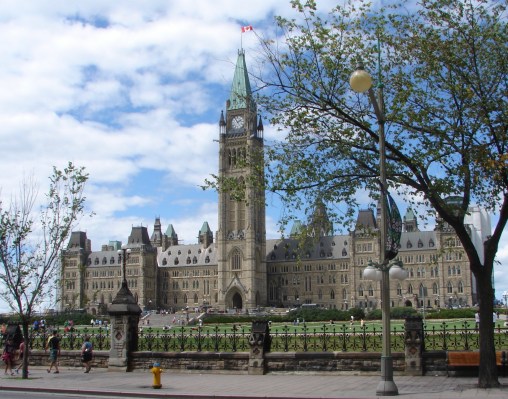
Canada’s Parliament Building

Ignoring the post-modern fallacy, i.e. nothing is true other than the statement that confirms nothing is true, this description of Canadian identity caresses its negative terminology. It’s an on-ramp to the freeway of silliness upon which no Godzillas sip their Tuesday coffee.

And where the link above was an American take on our Prime Minister’s interpretation of whom he leads, others have taken noted concern of his statement, too, among them some Canadians whom he leads…

On the other hand, and perhaps in response (?), the Government of Canada is now apparently reversing course, telling Canadians and would-be Canadians something awfully more specific about Canadian identity:

I admit, once more, to losing track as a “Canadian,” although at least this time the terminology is positive: “We are indeed ‘this’ and ‘that.’”

Some pretty specific stuff in the now-defunct Global Affairs guide – shame you missed it. For example…

“When lining up in a public place, the bank for instance, Canadians require at least 14 inches of space…”

Right down to the inch? Granted, I’m not the most social-media savvy citizen you could find, but I think a colloquial Canadian response to this – at least on-line – might be “WTF!!!”

Ottawa-Toronto 2015 (Day 7) - 02
… anybody here still know that guy, Al Waxman?

Still, please don’t let me speak on your behalf. That said, that guide seemed to have been compiled by one person in an interview format with a second person because it was written with a first-person perspective: uniquely Canadian, you might say.

Now, if your rejoinder is to excuse that guide as merely a helpful list of suggestions for what is “Canadian,” then allow me to counter with the challenge to separate, in its suggestions, what are quintessential as compared to what are stereotypical descriptions. After all, what Canadian does NOT love beer and hockey and The Hip, just as they detest the gesturing of hands and public displays of affection?

*HINT: you’ll note how I’ve been using negative terminology…

Bowen Island Day Trip (Greycaps Pre-Season 2015-16) - 44
Beautiful British Columbia

We’re approaching another freeway on-ramp, this one a sloped and slippery freeway that circles and loops and arrives at no particular destination because at its terminus interminably works a construction crew, who build it out just a little further than before, apparently with no idea who they are, or what they do, or – perhaps worst of all – why they might want to reflect, with no small concern, upon the work they consider to be of national significance.

Seriously, am I the only one who’s concerned by this?

Play’s the Thing…

I used to say to my students, “Find the overlap between our English coursework and, say, Trigonometry, or the link from persuasive writing to PhysEd. Where does Hamlet end and organic chemistry begin? Find that one out… there’s genius in that.” The courses my Department offered were called “English” and, helmed by some teachers, they were more traditional, as one might expect. The most common feedback I received from students, though, was how unlike English our coursework seemed to them. I took those remarks as a measure of success: my aim was to prepare young people, soon enough entering the world as older people, to be responsible… to families, communities, careers, and so forth. For me, that’s the purpose of school and its teachers.

What’s prompted me to reflect was reading Science, Order, and Creativity, by David Bohm and F. David Peat – specifically, such remarks as “the appropriate relationship between thought and experience… [in which] creative new perceptions take place when needed” (p. 49). That distinction between thought and experience reminded me of another distinction, this between dialogue and conversation. And again I was prompted to recall my English courses – what we had, I’d say, were definitely conversations, scratching new surfaces and digging into things with fluid spontaneity, as compared to the “my turn / your turn” protocol of dialogue, which might dig one trench but deeper and deeper. Where dialogue strikes me as instrumental, a means to an end, conversation is an end in itself, without start or finish but continual – that is, until the bell rings. We notoriously lived beyond the rigour of scheduling in some of my courses.

Those conversations were hard to let go. And what exactly were we after? “The creative person does not strictly know what he or she is looking for,” say Bohm and Peat. “The whole activity [is] play itself,” and no better description of teaching (at least, my teaching) have I ever read. Who knew I was so creative? Not me although I did have fun. So who knew teaching was just so much play? “The play’s the thing / wherein I’ll catch the conscience of–” well, anybody, really. I should clarify that I respected my colleagues and our Departmental philosophy as well as my professional obligation to Ministry curricula.

At the same time, I relied on my own interests and concerns to guide our coursework, by day and by year. The result was a mixture of reading, discussion, writing, and presenting about topics as disparate as literature, film, fine art, civics, politics, economics, philosophy, etymology, all manner of topics – yes, even science and math – all bundled together in a process of classical rhetoric. Eventually, I developed a suitably disparate canon of texts, too, that flowed meaningfully from English 9 through 12. And I relied on students’ differences to alter and adjust the flavour however they might. I loved teaching for how creative it allowed me to be, and for how much creativity it provoked in my students. “Let come what comes,” Laertes tells Claudius – brazen, even foolhardy. Genius, perhaps?

Bohm and Peat seem to suggest that genius is not creativity per se so much as the effect of having challenged some assumptions, and maybe that’s mere semantic distinction. Either way, I like the notion. Later, reading Allen Repko, I found myself nodding likewise at what he calls “boundary crossing” (p. 22). There it was, this discovery of common threads in disparate disciplines, this crossing of amorphous boundaries, what my students have heard me call “genius” although I might now redefine that trait as “ingenuity.” Accompanying “boundary crossing” is a reaching across disciplines, with intent, what Repko calls “bridge building.” This, I think, I would call visionary.

Discovery and vision, both what I would forever consider, as a teacher, to be meaningful developments of the learning process.

Repko also points out the origin of the word, “discipline,” deriving from the Romans and their need to “relate education to specific economic, political, and ecclesiastical ends” (p. 32). How delightfully Roman! I thought, reading that. Such instrumentalism, “the logic of utility.”[1] Finis at its finest: How long, O Lord! Will their legacy never end? But I trust in teaching and my unfailing students.

I enjoyed sixteen years teaching Secondary English to brilliant students. In that time, we developed a philosophy, addressed the BIG Questions, and fed our curiosity. But my planning process was seldom more than make-it-up-as-we-go. “We could never get away with this in Math,” I used to say to them, “although if you do find a way, I’d love to hear about it.”


[1] Phelan, A. (2009). A new thing in an old world? Instrumentalism, teacher education, and responsibility. In Riches, Caroline & Benson, Fiona J. (Eds.) Engaging in Conversation about Ideas in Teacher Education, (105-114). New York, NY: Peter Lang.