WARNING! This post is an analysis and celebration of Joseph Heller’s novel, Catch-22, and it DOES contain PLOT SPOILERS. If you wish to read the novel for the first time, do not read this post.
“Give the first twelve chapters a chance” has long been my advice to anyone who asks about Catch-22, Joseph Heller’s modernist masterpiece that critiques the absurdity of the military during wartime. If you haven’t read the book, I will hardly spoil things by explaining how eagerly we witless first-timers set out to read such a lauded modern classic, only to be confronted by what might be the most frustrating paragon of show-versus-tell in existence. (However, I will be discussing spoiler details from here on, so be warned.) From the seemingly disparate chapter titles to the disjointed narrative, which repeatedly folds back upon itself, from a maddeningly mirthful plot device, which tempts you to toss the book aside and deny its existence, to an irresolute closing – if you make it that far – the book continually challenges readers to deduce what’s happening and piece together what’s happened. Toss in what seems like an endless cadre of characters, ranging from odder to oddest to perhaps not so odd, the book is a challenge, no question.
For seven years, I assigned this book as summer reading for returning seniors. Oh, how the students complained about those twelve chapters – excessive! pointless! irritating! – only to feel more aggrieved at hearing, “Exactly,” my necessary reply. Once the venting subsided – usually at least half the first lesson – we’d begin discussing why Heller’s book could only be written this way as compared to some more conventional, accessible way.
For one thing, we need to meet the protagonist, Yossarian, and understand his circumstances so that, at appropriate upcoming times, which of course will have already occurred, we won’t criticise but will instead favour him. To this end, the entire story is told out-of-sequence, opening apparently in media res during Yossarian’s hospital stay. We have character introductions and letter censoring, foreshadowing how words and language will be manipulated while characters will be isolated, alienated, and demeaned. Subsequently, we learn the logic of Catch-22 from Doc Daneeka. And that Snowden dies. If we’ve navigated the twelve opening chapters and lived to tell about it, we learn that Yossarian, originally a young, excited airman, once needed two passes over a target in order to bomb it successfully, which gets his crewmember, Kraft, killed. Yossarian is further distressed upon returning when he receives a medal for the mission. Meanwhile, Milo opens his syndicate. The tension of tedium, the injustice of fortune. The folly of command, the depravity of humankind. Capping the story is the gruesome account of Snowden’s death, the key incident that incites Yossarian’s fear and lands him in hospital, where we first meet him – naturally, Heller waits until the end to tell us the beginning.
Heller writes with an absurd, illogical narrative style that characterises Yossarian’s internal eternal predicament, wending its way through isolation, alienation, discord, misery, paranoia, fear, senselessness, deception, vice, cruelty, even rape and murder. Catch-22 being what it is, its victims have zero-chance to overcome because the antagonists are permitted to do whatever the protagonists are unable to prevent. All along the way, Heller has Yossarian wanting out of the military (fly no missions = live), and he continually ups the ante between Yossarian and all the disturbing confrontations and contradictions that antagonise him, from his enemies and his commanders to his acquaintances and his comrades. But ultimately, and most potently, he has Yossarian suffering from his own self-interest. As the narrative flits and tumbles about, in its own progressive way, Yossarian’s self-interest evolves or, better to say, devolves. What does evolve, inversely to self-interest, is his compassion as he gradually grows more concerned for the men in his squadron, and which by Chapter 40, “Catch-22,” has extended to all innocent people beset by oppression, prejudice, and exploitation. So when Colonel Cathcart’s promised deal to send him home safely, definitely, comes ironically (fittingly!) at the expense of the squadron, Yossarian ultimately recovers enough self-reliance to overcome his personal anguish but not enough to remand himself to the cycle of absurdity. Given Heller’s dispersed timeline, describing Yossarian’s character development as a narrative arc or an evolution is less accurate than the piecing together of a jigsaw or the unveiling of a secret.
Perhaps unsurprisingly, Yossarian’s instinct for self-preservation is the source of his personal torment. His despondency and disgust over the preponderance of all human self-interest finally turn Yossarian’s decision to go AWOL, at criminal risk but personal safety. That such a climax works is because readers – like Yossarian – are no longer fighting back but giving in, yet even then Heller offers no respite – the story ends ambiguously, leaving readers to satisfy their own vexation. Even so, I suspect that Heller appreciated John Chancellor’s life-imitating-art intiative as one inspired by more than a spirit of fandom. So where some characters have been subjects of compassion, others agents of absurdity, readers’ resultant responses have also undergone a perfectly natural evolution, mirroring Yossarian’s character development and culminating with his terrifying walk through Rome. The horrors of “The Eternal City,” in this light, are not only an essential but an inevitable piece in Heller’s plan.
Yossarian’s shall-we-say militant decision to desert is borne of Snowden’s ugly death during the Avignon mission, only a week after the death of Kraft and the award of Yossarian’s medal. Seeing Snowden’s innards spilling rudely from his body nauseates Yossarian and haunts him throughout the entire (or, from Yossarian’s perspective, for the rest of) the story. Yossarian, inset by Heller on behalf of soldiers as a protagonist, has no way of making things better. His futile effort at comfort, “There, there” (p. 166), is comically insincere for its honest helplessness, an understated shriek from all soldiers continually sent to face death – not death without context but without resonance. However, for Yossarian and his comrades, the context of sacrifice is all too irrationally clear: thanks very much. Catch-22. Soldiers face the dilemma of following orders that entirely devalue their very existence.
Participation as a soldier offends Yossarian to the core, yet it also helps him to reconcile his fear over death: “… man is matter,” finite, mortal and – without spirit – simply “garbage.” In fact, this sentence sums human worth as a blunt statement: “The spirit gone, man is garbage” (p. 440). Six words of sad, harsh consequence, war, no longer wearing a comic mask. The absolute phrase, a terse syntactical effect, annuls man’s significance – spirited briefly, gone abruptly, an empty corporeal body left over, garbage. Garbage is a harsh image – rotting flesh, buzzing flies, scum, residue, stench. Pessimism, cynicism, worthlessness. On such terms, one wonders whether anyone might willingly die to save themselves, as it were, another troubling revelation engineered by a masterpiece of unprosaic illogic. Yet even on this point, Heller’s genius is flawless. Haunting though it is, Snowden’s death gradually reveals to Yossarian the very path to life and safety that he has pursued ever since the opening chapter in the hospital – which is to say, ever since Snowden’s death drove him there in the first place.
This is why Heller refers to Snowden’s death, specifically his entrails, as a “secret” because to reveal it any earlier would be to end the novel. And he calls it Snowden’s “grim secret” to illustrate Yossarian’s suppressed mental anguish. Heller has Yossarian recall Snowden a number of times, each admitting more detail, each growing more vivid, each driving him a little closer to his final resolution. Heller’s portrayal of Yossarian’s traumatised memories in this way suggests the nightmarish flashbacks that people, particularly soldiers, endure following the horrors of war. His final flashback in Chapter 41, “Snowden”, is prompted when Yossarian wards off the mysterious stranger in – where else? – the hospital. It’s most revelatory for Yossarian – and readers, by extension – because, here at the end of his patchy, appalling flashbacks, he is finally secure enough to divine for himself – or is it to admit to us? – the grim secret found in Snowden’s entrails. In the same way, the climax is most revelatory for readers who – at the mercy of Heller’s dispersed narrative structure – have been made to wait until the closing, when the time is finally ripe.
To get there, we are dragged unwittingly by Heller down a path of frustrating sympathy, illogical absurdity, and agonising anticipation. By the time Yossarian is introduced (in the opening chapter!) censoring letters and conniving a way to escape the war, he is that much nearer to desertion than we can yet know. Certainly, Snowden will convince us to desert as surely as he convinces Yossarian, but that will happen later, after Heller has aggravated our tolerance and mottled our innocence. Heller must drag us down Yossarian’s agonising path, or else he places us at risk of passing premature judgment upon not merely his protagonist but his entire message. Finally, when the moment arrives that we gather full appreciation of Snowden’s death, we have all we need to share in the vindication of Yossarian’s desertion.
So here is our way to grasp the grim secret behind the novel’s dissembling structure as restlessly and imperturbably as Yossarian does: the root of conflict, Snowden’s death, can only occur at the end of Heller’s narrative path, not Yossarian’s. The story simply works no other way.


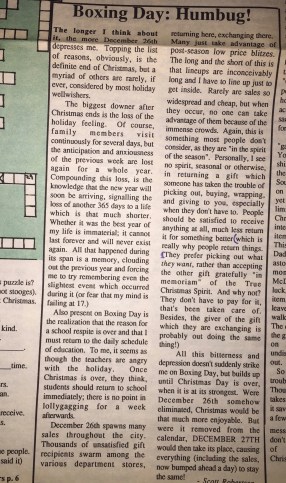 The first was a few months before, this Boxing Day editorial for the December edition, although officially my class hadn’t switched over yet – you either went from Journalism to Creative Writing in January, or you were vice-versa like us. Admittedly, neither piece is rocket science, much less brain surgery, but hey, every piece does more than just fill its own space in the puzzle. A curiosity, like I said.
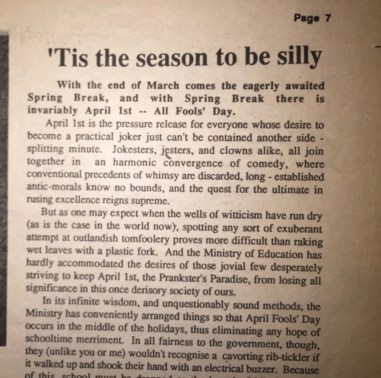 exuberant attempt at outlandish tomfoolery proves more difficult than raking wet leaves with a plastic fork. And the Ministry of Education has hardly accommodated the desires of those jovial few desperately striving to keep April 1st, the Prankster’s Paradise, from losing all significance in this once derisory society of ours.

 The Rhetorical WHY