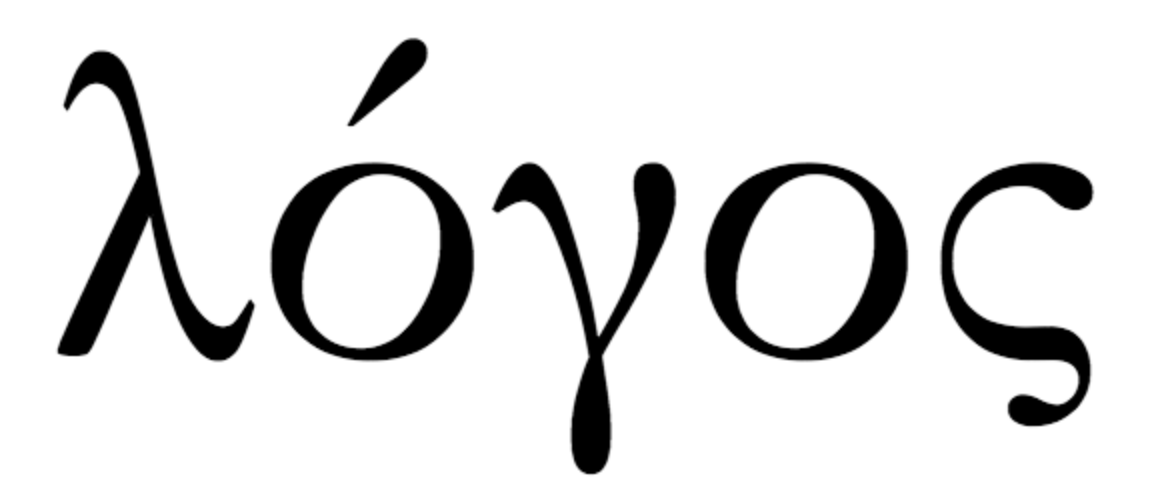
Conceptualising the In-Between: II. Logos

Featured Image Credit by Mladifilozof & Aristeas: Own work, CC BY-SA 3.0 https://commons.wikimedia.org/w/index.php?curid=5957893

Click here to read Part I. Language

Something obvious, to start: our use of language directed to others and prompted by others is intended for others and received by others.[1] This is equally plain to see from the Rhetorical WHY’s foundation, the Rhetorical Model of Communication:

  • a message-as-conceived and -as-conveyed
  • a message-as-received and -as-interpreted
  • a message’s connotations and resonance
  • small-‘t’ “truth”

Small-‘t’ “truth”[2] at the center denotes the weight of responsibility we bear for our beliefs, the meanings we claim as “true” in the presence of everyone else doing the same thing. Language, then, seems as vital to our common well-being as the air we breathe and the water we drink.[3]

As to Gadamer’s Biblical comparison, introduced in Part I… from the Greek of the New Testament, “Word” translates as λóγος (logos), and language – logos, the Word – within us reflects the imago Dei of Creation. From this root issues a robust etymological lineage: word, speech, discourse, logic, reason, rational thinking – traits in the 21st century that seem so empirical, dependable, reliable, and antithetical to faith. Yet, for having language, we still have no supernatural facility to claim as our own – no omnipotent glory – that might make eternally creative use of it. We have but vaulting ambition – sinful pride – that frustrates our use of what feels somehow essential yet lies somewhere beyond our finite capability.

Thus we misconstrue our essence as instrumentality and our existence as authority… again that hazy distinction between essence and aim: imagine the world where hubris is surpassed only by vanity. We do in fact bicker endlessly over alternative facts, and our shared understanding – a shared estrangement – does in fact increase. And thus (again with added emphasis), in light of Heidegger – in light with Heidegger, in the clearing – I might read the opening verses of the Gospel of John as descriptive and readily spot both real and figurative IB:

In the beginning was the Word, and the Word was with God, and the Word was God. He was with God in the beginning. Through him all things were made; without him nothing was made that has been made. In him was life, and that life was the light of all mankind. The light shines in the darkness…

(John 1:1–5)

The darkness is an image also invoked by Taylor, certainly bearing a negative tone, to describe our bids at imposing our own light within Heidegger’s clearing. John counters the darkness with two essential claims: (i) God is logos, and not in some protean way but definitively, while (ii) the Word is the underlying source of ‘making’ and ‘made’, of light and life, with our goodwill or human essence being but an image of His.

One final detail from Arthos is worth adding to this spiritual aspect of IB, for two reasons: first, to credit Gadamer’s “fusion of horizons” as a way to describe IB, and second, to acknowledge Gadamer’s concept of “conversation” as something spontaneous, emergent, and unpredictable. Of the spiritual footing for Gadamer’s hermeneutical approach, Arthos says this:

For Gadamer, Christian incarnation “is strangely different from” the manifestations of pagan gods in human form (TM, 418/WM, 422). In Christology, the spirit made flesh is “not the kind of becoming in which something turns into something else” (TM, 420/WM, 424). This strong enigma places the credal[4] faith apart, and upends the normal relation of the spiritual and the material. The indivisible bond between the word and the person is a fuller ontological relation than simply the unity of the spiritual and material. The relation between word and person is no bloodless, conceptual abstraction. The constancy of the person in the word represents a concentration or fullness of meaning and an increase of being. We can see this, for instance, in the idea of a promise, in which a person stands behind the word that is given, since it is they as much as the word that is at stake, and the fulfillment of the promise strengthens the person who made it and the community it forms. The innovation of the doctrine of the word is to reverse the trend set in motion with the Greeks that the reasoning faculty distills the mind’s work from the accidents of the flesh. Logos is rather the fully embodied medium of human community.

(Arthos, 2009, p. 2)

Earlier in the chapter of Truth and Method that Arthos quotes, Gadamer explains that our diverse world of languages and their associated cultures have this in common: when speaking of the Word, none is able to express its true positive being:

The greater miracle of language lies not in the fact that the Word becomes flesh and emerges in external being, but that that which emerges and externalizes itself in utterance is always already a word.

(Gadamer, 2004, p. 419)

The Word “[being] always already a word” I liken to a simultaneous positive ‘freedom to…‘ and negative ‘freedom from…‘, an autonomy we can observe and describe but not impede or control. This “externality” oddly serves as a great equalizer across cultures, if we let it – that is, if we heed Taylor and seek not “to impose our light [in its place and] close ourselves off to [others]” (Taylor, 2005, p. 448). As compared to something in between us that enjoins, Gadamer describes something among us that joins.

To take all this spiritually, or else not, is up to each person – as apparently it must be. I can only express my words, here and now, for you to take or leave, as you will. Yet this much for all seems undeniable: each one of us might cast our self in this role of creator, as such: “If it were up to me… if I were the one in charge… if only we did things my way… .” Is it little wonder if the world and life and history seem defined by our multitudinous disagreements? And if saying so seems obvious, or pessimistic, consider too that Heidegger’s entire point seems to be an imperative to “Listen,” advice most infamously needed when it’s not happening.

One final analogy for IB departs from philosophy and the spiritual for natural science, which I include here on account of wonder. I take it from physicist Dr. Robbert Dijkgraaf during a 2015 appearance on PBS Nova:

“In this very simple formula, the whole geometry of the universe is hidden.… It’s also a signature formula for Einstein. The true mark of his genius is that he combines two elements that actually live in different universes. The left hand side lives in the world of geometry, of mathematics. The right-hand side lives in the world of physics, of matter and movement. And-- so perhaps the most powerful ingredient of the equation is this very symbol, equals sign, here: these two lines that actually are connecting the two worlds. And it’s quite appropriate they’re two lines because it’s two-way traffic: matter tells space-and-time to curve; space-and-time tells matter to move.
“You know, you have the huge universe, and it obeys certain laws of nature. But where in the universe are these laws actually discovered? Where are they studied? And then you go to this tiny planet, and there’s this one individual, Einstein, who captures it. And now there’s a small group of people walking in his footsteps and trying to push it further. And I often feel, Well, you know, there’s a small part of the universe that actually is reflecting upon itself, that tries to understand itself.”

I can imagine Dijkgraaf granting to Einstein a cosmic generosity, the goodwill to have made room in the clearing for others, e.g. a “small group of people walking in his footsteps.”

Some people get spiritual about cosmology, and physics too, so offering this analogy in the wake of Heidegger’s cosmic spirit seems more à propos than non sequitur. Personally, I think science and spirituality would find plenty to talk about together, if they would willingly join forces and listen to each other, and perceive expressions of interest, and develop some basis of shared understanding.

Besides its temporal implications, the second part of Dijkgraaf’s remark resembles a concept I have elsewhere called mirroring: briefly, an effect of interaction where the response provoked in Person ‘A’ by the prompt of Person ‘B’ serves as a reflection of Person ‘B’, as if Person ‘A’ were a mirror for Person ‘B’ to see themselves. Re-action reflecting action implicates both participants, and of course, the mirroring effect is simultaneously mutual, travelling both ways at once: between people, IB is a compelling imperative to listen and also respond – it suggests our joint interaction. By Dijkgraaf’s Einstein analogy, mirroring might also suggest that equals sign.

In all these concepts of mutual relatedness – philosophical, spiritual, cosmological – IB is a kind of setting, albeit not a literal physical location. Where ‘one’ thing ends and ‘another’ begins is an abstract third space between the two in relation. That said, IB is temporally present – each moment figuratively here and literally now, continuously underway and under continual renovation, forever in adjustment, always resembling, never quite remaining. This third space may overlap, such as when two people share something in common, or it may be a gap, such as when two people have nothing in common. Either way, it’s IB’s dynamic that is defining their relationship.

Click here for Part III. Relationships


[1] By “others,” we might also include “self,” in the more straightforward matter of defining the “audience.”

[2] Subsequently, any resultant small-‘t’ truth offers some capital-‘A’ Assurance, even if capital-‘T’ Truth remains beyond certainty or else relies on some kind of faith. Whether we even call this consensus the capital-‘T’ “Truth” would seem to depend on how well we get along together.

[3] Exactly how Heidegger came to understand language as this vital is the focus of Taylor’s essay although, admittedly, I am still pondering his overall discussion. But, again, I broaden “language” – as well as “text” – to comprise all our communicative efforts, and as I often said to students, “If it’s done by people, it’s rhetoric,” by which I meant, “it’s persuasive,” i.e. it’s something inherently communicative.

[4] An alternative definition for agenda is “things to be done,” originally theological, “matters of practice, as distinguished from belief or theory”; as opposed to credenda “things to be believed, matters of faith, propositions forming or belonging to a system” from which we derive creed. Thus I note with interest Arthos’s reference here to “credal faith.”

Conceptualising the In-Between: I. Language

Over the years, I have made many inspired allusions here on The Rhetorical WHY to a concept called the in-between (IB), often by describing the overlap imagery of the IB space as “the place where ‘one’ ends and ‘another’ begins.” For me, IB is the crux of education, the capstone, because it describes the simultaneous multiple perspective of our interaction.

The in-between concept is key to the separate works of storied philosophical educators, Ted Aoki and Gert Biesta. Aoki explores IB from the Heideggarian clearing (Lichtung), a space reserved between us for disclosure and understanding, and Biesta from the pragmatism of Dewey. Each emphasises shared experiences and communication between teachers and students, and both locate inter-relational curricular dynamics in the figurative “in-between” space that arises as Person ‘A’ and Person ‘B’ (+ ‘C’, ‘D’, ‘E’…) relate to – and, typically, take up interest in – each other.

As I conceptualise IB in my doctoral work, the relatedness we find in between is holistic, as much an emotional or empathetic consideration of one person for another as it is some intellectual coming-together. This holism comprises as much or as little of whatever is shared by the people involved. However, IB is even more still than this ‘place’ of joint interaction; it is an energetic interface where we find the back-and-forth dynamism of ‘process’ in process – a kind of underway-ness that our cultural eyes seem trained to not see. For being figurative, IB is yet very real.

A brief foray into philosophy can help illustrate how or why Aoki, or Biesta, or you or me or anyone might decide to take up interest in the IB concept, beginning with a study by Charles Taylor of Heidegger:

“The human agent is here an emanation of cosmic spirit.… [T]he idea of expression itself can nudge us toward a third way of locating the clearing. It gives us a notion of the clearing which is essentially Dasein-related… [b]ut it doesn’t place the clearing simply inside us as a representation; it puts it instead in a new space constituted by expression. And in some versions it can acknowledge that the constituting of this space is not simply our doing.”

(Taylor, 2005, p. 445, added emphasis)

Taylor’s broader focus here is language. He describes what he believes Heidegger felt was the nature or aim of a cosmic spirit – although whether that’s either or both nature or aim is harder to discern. In any case, he describes a composite recognition of reality, negotiated between beings (Seiendes), that is not “placed ‘within’ minds, but… out between the interlocutors” (p. 445, added emphasis). As one person expresses, another perceives, and between them occurs an understanding – that is, from continuous perceived expressions arises continual or on-going understanding.

Imagine, for instance, while dressing for Halloween, how you might react not only to your own reflection in a mirror but also to your friend’s reflection as they stand next to you: at once, you are able to take in both of your reactions. Expressions thus perceived are Heidegger’s clearing / light (Lichtung), and “its locus is the speech community” (p. 446), within which I also include non-verbal communication, such as facial expression or body language. We might imagine all our joint interactions, in person or separated, as some living demonstration of this imagery. For each at once, by both in turn, something comes simultaneously to light for each as well as for both. That simultaneity is important yet, as I would argue, more frequently missed, if not ignored.

What Taylor calls an emanating cosmic spirit seems to be some kind of tacit consensus or settlement between two (or more) peoples’ expressions that, when combined, connote some additional ‘something’, something diachronic,[1] like when scientists weigh evidence with theory in order to draw conclusions. All these continuous perceived expressions amalgamate,[2] as we might describe the gradual renovation of a building or the refitting of a ship, right down to the labour contributed by each worker: upon a pre-existing frame we each contribute to building – or rebuilding – something different, something new, something else.

The more people involved, the more potentially complex becomes the consensus that arises from all these amalgamating contributions. Such tacit consensus occurs time-upon-time between us: here and now between you and me as (currently) displaced interlocutors as well as between each of us with [ whomever ] across space and time. Within all our combinations, we are indeed “caught in an inescapable network of mutuality… .” As such, the more people involved – and preferably the more sincere our exchanges – the better. And, to paraphrase Heidegger (with added emphasis), let our consensus set a more stable foundation of shared clarity or enlightenment; let us reach a shared understanding. Otherwise, in rather more chaotic spirit, we may concede to misunderstand and bicker endlessly over fake news and alternative facts.

Rather than a will to power or a will to control, the emanating cosmic spirit aims for something more patient: a shared understanding, an on-going will to live and let live. I call it a will, which suggests vitality, but maybe it is a motive or a desire, some reason-for-being – that starts to seem more teleological, whether inherent or imbued. And I do not mean some platitude, “the will to live and let live,” like a bumper sticker. I mean literally goodwill, and here now is that hazy distinction between nature and aim: a mutually respectful sharing of existence[3] that is…

  • humble in expression
  • appreciative in community
  • inclusive of all whom we accept as well as tolerate, like as well as dislike

… and by which all our interaction and negotiating sets to thriving. As goodwill, this spirit’s thriving welcomes more than any one’s selection of some but is inclusive of all – the preferred, the desirable, the undesirable, the unfamiliar, the outcast, and all the rest as well. And where not everybody’s will is prepared to be so generous, perhaps instead seeking some need to force or to control, well hey… here’s at least one educational objective for anyone humble enough to embrace it.

And how humble are we? As compared to how certain we are about the expressions we offer to others, how generous are we willing to be? And how aware are we of our simultaneity, those expressions that others continuously receive from us while we continuously receive from them? And, in between all these, how anchored are we to the stable foundation upon which we claim the consensus of shared understanding between us, here and now as well as across space and time?

As it happens, all this concurs with Gadamer’s (2004) impression of Dasein as analogous to the Holy Spirit of the Biblical Trinity. This is not to suggest that Dasein is Biblical per se but that Dasein somehow transcends us; as a topic, then, spiritualism seems able to accommodate it. So, to continue (though not yet finish) the Biblical point, a triune impression of Dasein also squares Taylor’s assessment of Nietzsche, Leibniz, Sartre, and others whose work, he says, eventually “leads to our conceiving reality itself as emanating from will” (Taylor, 2005, p. 444). I am no expert on these particular philosophers, but theirs seems generally a branch of thinking that is, from a Biblical understanding, bound for idolatry “in the service of a triumphant will to will” (Taylor, 2005, p. 448). Theirs would supplant with human will the will of God, which created all by His utterances to “Let things be so-and-so.” In such a philosophy…

“… we come to see language as our instrument, and [Heidegger’s] clearing as something which happens in us [i.e. inherently selfish within us, not in the clearing negotiated between interlocutors].… At the end of this road is the reduction of everything to standing reserve in the service of a triumphant will to will. In the attempt to impose our light, we cover the sources of the clearing [i.e. other people and their expressions] in darkness. We close ourselves off to them [and]… the total mobilization of everything as standing reserve threatens the human essence.”

(Taylor, 2005, p. 448)

Existing between us, Taylor’s “human essence” corresponds to the goodwill mentioned above and refers to Heidegger’s “cosmic spirit” that opens this post.

In short, some wilful effort by one person to create and declare “so-and-so” frustrates the shared cosmic spirit of all the rest, by which we might otherwise negotiate a common consensus of… the way things are? … the way we perceive them to be? … the way we contribute to each other’s perceptions and understandings? Regardless, for any one person to declare “reality” is for that person to play God, which undermines all the rest,[4] even while another person might be attempting the very same thing: a battle of wills.

Conversely, if we think of reality as already created and underway, as something of which we are a part, not from which we are apart, then the warning is as dire as the promise is a marvel: communication, and language specifically – verbal, non-verbal, whichever kind – is no mere instrument to our being but the essence of our being, you and me and everyone, at once together: being here and now.

Click here for Part II. Logos


[1] For something diachronic, imagine a film montage: the director edits particular shots into a sequence, e.g. first, the shot of a car approaching a railway crossing; second, the shot of a steaming locomotive barrelling down the track. The two shots might actually have been filmed days, or even years, apart. But presented in sequence to an audience watching the film, they suggest the danger of a collision, especially since film audiences are accustomed to such devastating drama.

[2] In my dissertation, I imagine the accretion of rocks and gases that formed the planets around the Sun as a metaphor for the gradual historical assemblage of teachers who comprise the continuity of the on-going profession. From accretion to assemblage to amalgamation, I develop the imagery toward something of deepening significance or value.

[3] Note here the mutuality of people whose overlapping lives construct the complexity of a “real world” for which education is purported to prepare us, only now I highlight the feature of this mutuality that transcends time: we all live together, just not all at once.

[4] … the assumption here being that all people and their decisions and dignity are equal in stature, value, and worth. History, of course, would have us believe otherwise, which I think is Taylor’s point as well as the reason Gadamer might invoke a Biblical perspective, i.e. our inherited sinful nature – more on that in the next post.

Of Memories in Motion

Elsewhere – and, come to think of it, (sort of) elsewhere – I’ve mentioned Martha Nussbaum’s exploration of memory.

For her part, what she’s suggesting connects our emotions, which help us respond to the world, with our memories, which arise as a flood of perceptions that she calls emotional habits. Essentially, in our day-to-day living, the purpose of our emotions is to help us make sense of it all by recalling previous times when we felt such-and-such a way; the purpose of our memories is to supply those emotions with substance – and not with just any old substance but with invested value. If Nussbaum is on to something, then this is why we’re moved to say about [ your life here ] that “we care.”

Nussbaum refers to neuroscientist, Joseph LeDoux, who suggests that memories are not individual items but composite outcomes of our physiological network – in one sense, like how a check-up isn’t just your doctor and a stethoscope but all their years and training, and this upon centuries of practice, which now includes you, the patient; in another sense, like how a bridge isn’t just an edifice of concrete, cable, and steel but an intentional span engineered to overcome the gulf that precluded any link between two separated sides.

Iconic

One idea suggested by memory is that, with something going on inside everybody, we can still only respond from our current perspective. That means some parts of our lives will remain unseen from others and maybe even subconsciously from ourselves – we can never really completely know what’s happening with anybody. Occasionally, I’ve seen people apparently lose sight of this and press ahead with someone else, despite what seemed to be signals to hold up – yet as this is merely something I remember seeing from my perspective, here’s me doing it, myself, right now! A lot of our shared living is guesswork, and if it seems like I’ve suddenly departed from the topic of memory, I wonder if it’s fair to say I’m still in the ballpark.

In the ballpark, I guess, if just a little off-base…

Memories remind us of when we were other places, doing things, which all contributes to describing who we are now although, of course, not completely since nobody remembers everything, much less remembers anything perfectly. Maybe let’s say what gets remembered is what we take to be most important, which could be rather selective and self-serving, as we might decide to ‘remember’ only what helps us out the most. That’s a pretty blanket statement, though, and I can’t blame your eye-roll just now. As to what we do remember, we can decide whether a memory is something from the past to which we’re attached, or something in the past from which to distance ourselves. But either way, the past is always there, all of it, and that’s affecting all of us.

As to memories being fallible, this takes me back to guesswork, of a kind, as we try to recall exactly this-or-that detail. But since we can only remember from our current perspective, there’s a great deal of our lives that goes never seen by others, and even grows fuzzy and inexact to us – like I said, we can never really completely know what’s happening with anybody, selves included. If each person’s memories can only acknowledge their own cross-sections of the past, and this but partially, then over time I imagine this would cause a bit of collective amnesia, eventually having a kind of atomizing effect as certain details were highlighted while others were finally lost forever.

Certainly our culture seems to embrace the individual, has done ever since the Enlightenment sort of introduced the world to itself, as it were. What crawled from those Platonic caves of religious obeisance and feudal sovereignty eventually separated into an oddly homogeneous heterogeneity of individualism, which today we venerate with slogans like “Liberty, Happiness, and that other one – slips my mind. If we’ve actually been killing off cultural memory and swapping in some individuated substitute… well, in that case, I’d say cultural memory is becoming a rather haphazard assemblage of whatever coincides between us. Which, hey, might work for a while, but… life-by-coincidence I just feel like can’t be good.

That brings something else to mind… for all our enlightenment, we seem awfully susceptible to uncertainty. Weren’t we a lot longer chained up to those cave walls… yet now it’s like we can’t even remember what certainty is. Maybe our uncertainty – what the kids these days call narratives – whether spun by someone or spun by us, whether in our favour or in our face, maybe our uncertainty lies in its doctor’s motives. And of course, the better the storytelling, and the sharper the hook, the more we’ll feel we can relate – which is something else I mentioned of Martha Nussbaum although, this time, I’d say let’s take heed as a cautionary word. Yes, the more precise the object, the sharper that vision, and the more certainty we’re likely to feel, but no trust will exceed the worthiness, the value, of its object. Stick to the healthy objects, I guess is what I’m saying, objects not just inherently potent but of the greatest worthiness… your most highly treasured value.

In that sense, memories – remember this was all about memories? – in that sense, memories implicate, or are they implicated by, our present circumstances and our future objectives. As we presently look back to our memories, our memories are prompting our attention forward, into the future. We don’t remember anything perfectly, but we also don’t forget everything utterly. I’m not necessarily saying we spin solely what we remember; rather, I’m saying let’s not spin solely to remember. Just like words matter because, once spoken, their consequences flow, our memories matter too, for the same dynamic reason. They need to be as genuine as we can recall them. “And then,” Nussbaum concludes, perhaps with a touch of whimsy, “it remains to be seen what the world will let us do about them” (p. 135). Whether their flow will be placid, mundane, inconsequential, or anything beyond is beside the point that their flow is indisputably certain. What is past is having a very real effect right now and will thus see its effect realised in what is yet to come, come what may.

“Okay,” you say, “but what happened to that imaginary bridge – what was it, spanning the gulf between here and memory, or something? I mean, here you are, now, going on about time and spin and worth? Has this post lost its way? Another batch of mixed metaphors?”

Is that really even a “bridge”… ?

Fair. OK, well, besides piecemeal memories inciting ad hoc futures for atomized individual persons, what all this seems to implicate, for me, is the sincerity of relationships, of care. Our continued honest attempts to communicate with each other are like an antidote, and in their absence we risk sullying or undoing whatever may have been true of us beforehand. Of course, though – and here I go again! – that last sentence was written through an altruistic lens, not really allowing for someone with, say, more practical motives. Meanwhile, as to any less-than-honest attempts at communication, well, they’re obviously no antidote at all but really pollutants. As only real engineers build bridges, so only real physicians administer antidotes, and only real spin doctors spin.

… OK, this one counts

One last thing… I think maybe what’s most potent about our memories – in their pointing us toward objects ahead – is the nature of their absence, like travelling into the city and saying, “Look where there used to be trees.” As we take hold of a memory and turn it over in our fingers… with the curiosity that brought it back, we acknowledge a kind of respectful past-that-was as we find it within us-as-is. There’s a bit of healthy mutuality in that, for without that memory, we could only make less of ourselves while, without us, the memory wouldn’t be recalled at all. I suppose that’s all a bit banal, but still… it seems important, a kind of respectfulness that authorizes both the memory and ourselves at once, however inexact our memories may actually be.

But we need to be careful. Any respectful authorization of memory and ourselves at once is us doing both, which is tantamount to saying “I am history,” as in “Whatever I declare now is now what happened then,” which of course would be delusional. And not in the sense of claiming to be God, who controlled it all back then as now but, rather, in the sense of looking inward to ourselves, like a doctor prescribing an antidote without remembering what it was for.

Someone very practical once told me there are plenty of good memories to be made and happy events to experience wherever one resides. Practical health in this object, practical wisdom, a beautiful radiance such as might alight you from the bridge deck with delight since now you want to see where it’s landed you, over here on the other side. As I recall, my reply was something along the lines to say, yes, that’s definitely true although it ain’t where you’re at so much as it’s who you’re with.

In the gulf beneath, a mighty flood rolls on, and you still hold your dearest treasures to heart. And from the shore you understand a wee bit better why somebody decided to build that bridge.

Photo by Kyle Fiori on Unsplash