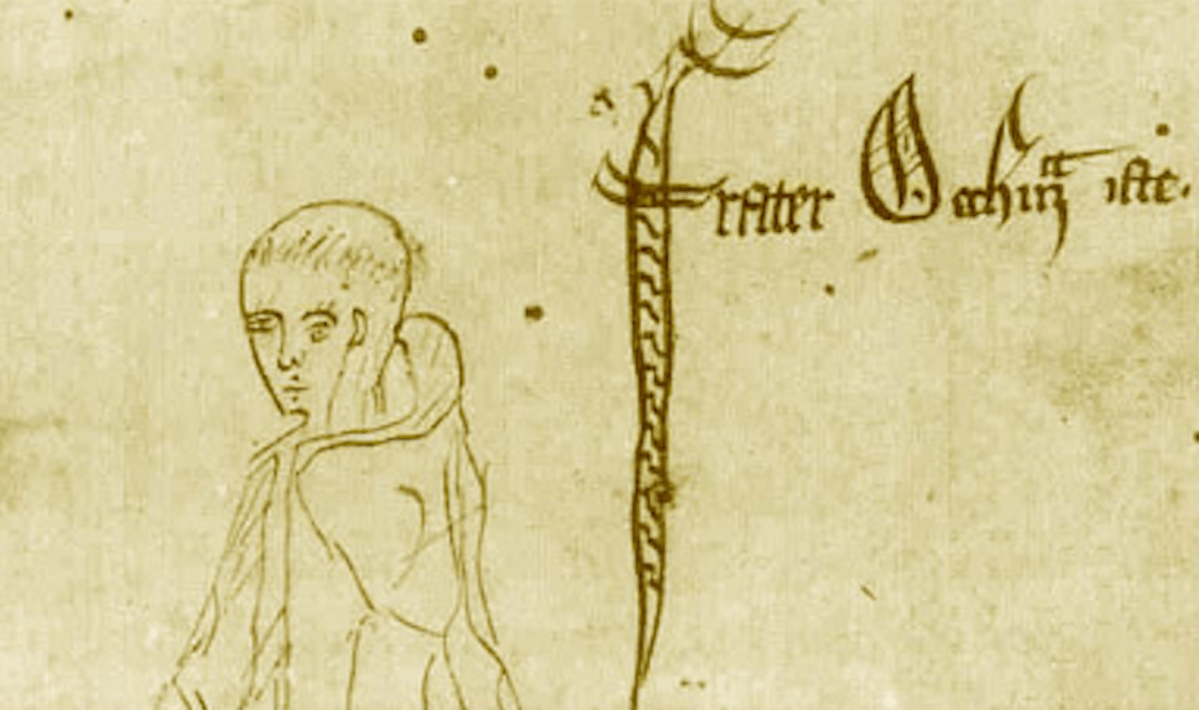
Featured Image Credit (edited) by William of Ockham – from a manuscipt of Ockham’s Summa Logicae, MS Gonville and Caius College, Cambridge, 464/571, fol. 69r}, Public Domain via Wikimedia Commons
On Teleology: I. Efficiency
Teleology is the study of final causes or, put another way, the fulfillment of inherent purpose or, even more simply, completion. As a quality or trait, we can call this τέλος, or telos.
An analogy I use in Teacher Ed to illustrate telos is shipbuilding… what kind of ‘ship’ – or maybe better in plural, what kinds of ‘ships’ – have school teachers been aiming to build? One warrant for this shipbuilding comparison, my thinking goes, is our culture’s hankering obsession with efficiency, i.e. what ocean-going vessel ever gets built except to fill some function or purpose?
By analogy, what function or purpose do teachers envisage or intend for K-12 graduates – what kind(s) of people do we want K-12 graduates to become? How closely does this resemble the kind(s) of people the Curriculum has in mind? And then, maybe more importantly, what kind(s) of people do teachers actually end up ‘building’? Alternatively, from the student perspective, what kinds of influence have teachers brought to bear upon their telos? What kinds of people finally cross that stage for their diploma?
No analogy being perfect – sort of the point with analogies – we can then make broader comparisons and contrasts between students and ships and gain a bit of insight about the intentions around which we approach the ‘building’ of each one.
Looks to be Grade 11 or 12ish Image Credit by Manne1953 on Pixabay
But if ships don’t float your boat, try framing telos in the natural world… by analogy, imagine bacteria, forever on the hunt to feed and survive, yet to what end? Do bacteria literally just feed because they already live and will procreate, or do they need to survive in order to fulfill some further function or purpose?
Likewise, consider the cells in our bodies. Controlled as they are by genes, proteins, and nuclei, each has a specific function that elicits some somatic or physiological consequence. By analogy, we might even stretch the description as far as saying cells seem to operate with some kind of ‘intention’ although that’s not to invoke ‘awareness’ or ‘sentience’… none as far as we know, anyway, not like the awareness a shipbuilder has while building ships or the intent a teacher has while teaching students.
Hmm… could telos be more inherent or instinctive than intentional, some mere effect of causes, which fall like dominos? Possibly, but for now let’s defer that question on the basis, as noted above, that our culture prefers to ply the Road of Efficiency, towards which ‘a purpose for everything’ definitely fills the bill. Of course, it’s no secret who else plies Efficiency Road – plies it like a wide-load truck – and it’s no outlander who believes that Science embraces teleology.
Along that Road, ‘a purpose for everything’ might also convey ‘nothing wasted’… think Occam’s Razor and a cut-to-the-chase sentiment that we might dare to call “relentless” although maybe let’s amend this to something kinder and gentler, like “persistent” – still sharp, just not so cutting.
Occam’s Razor would keep matters simplistic by having us ignore or dismiss whichever details and data don’t suit some preferred belief or objective. In other words…
‘That which is easier to understand’
equals
‘That which is therefore more likely to be true’
equals
‘I’ll not be wasting my precious time with all that thinking, testing, wondering crap’
equals
‘I don’t agree with you’ ‘I don’t want to agree with you, and, for that reason, you are wrong, plus Occam’s Razor is Sciencey; ipso facto, I am invincible’
William of Ockham would have us avoid leaping to conclusions or posing explanations beyond what can be justified by careful reasoning, yet with exceptions for what is self-evident, what is known to experience, and what might be “… proved by the authority of Sacred Scripture.” [William of Ockham, you understand, was a devout pre-Protestant friar and scholar who, thereby, viewed God as the sole ontological necessity.] In other words…
Proffer something because reason can warrant or justify its addition
equals
Don’t let your egowrite cheques that Science can’t cash
And how come? Because something straightforward is and ought to remain distinct from something simple just as something complex is and ought to remain distinct from something complicated.
The razor imagery, meanwhile, is metaphor for scraping away the ink you spilled from writing (or thinking) unnecessarily.
OK, let’s recap: Telos thus far = Ships, Cells, Bacteria, Science, and two kinds of Razors… up next – you guessed it: Acorns!
If the engine or dynamic force of the In-Between (IB) is purpose, the fuel is surely motive. Together, purpose and motive suggest more about the IB dynamic than mere cause-and-effect, which is a fitting place to refocus upon students and teachers.
For instance, a student’s ownership of their learning and a teacher’s duty to help students learn are overlapping facets of their joint relationship, e.g. “Finding myself involved with [this other person], what is the situation asking [e.g. of me, of them, of us]?” What a teacher purposes alongside a student[1]Aoki characterises not as “instrumental action” but as “situational praxis” (p. 40).[2] From a “bureaucratic device,” he reconceives curriculum enactment into being “a form of communicative action and reflection set within a community of professionals” (p. 40) and, I would add, students too. And he recasts discrete instruction of mandated Curriculum, e.g. ‘covering Chapter 9’ or ‘going over the Study Questions’, as something holistic and shared, e.g. interpreting the relevance for each student of a History text, a Math equation, a Science lab, or a Shakespearean play.
The work that students do alongside teachers, typically (but not solely) daily and face-to-face, is a dynamic that occurs in the shared IB space. The ensuing dynamic interaction of that student-teacher relationship (STR) I conceptualise as relational curriculum, the dynamics of which are pedagogical: lessons planned, activities tried, questions asked, decisions made, and a buzz that enlivens the classroom. Aoki describes students and teachers as travelling back and forth across a “bridge” (Irwin, p. 41) that spans a gap between two ‘places’: curriculum-as-planned and curriculum-as-lived, or as I alternatively label them, mandated Curriculum-as-designed and relationalcurricula-as-occurring.
While crossing that bridge, it falls to the teacher to decide how best to guide a student, to know whether, when, and from which angle in the clearing they might cast any shadow and obscure a student’s light. So while they cross that bridge, how much better that a student and teacher have come to know their together selves before deciding upon some purpose or destination, i.e. some assessment outcome? This is the gist of relational curriculum.
The relational notion of ‘curricula-as-occurring’ can apply as well in the world beyond as within the classroom, making the IB space a temporal concept as much as a spatial one, i.e. we can only ever be one place at a time. Teaching, then – inclusive of the past, motivated by the future – (and thus, presumably, learning too) is presently spatio-temporal: both at once. Teaching is Aoki’s multiplicitous curricular landscape (Irwin, p. 41, added emphasis) that helps students to reconsider ‘what has been’ in order to renovate ‘what now is’ into ‘what may be’:
… entering back… in full reciprocity by re-including [what has been] once again as active participant in [what now is].
In this way, the IB dynamic can bear influence upon our very identity – not by reaching for it to grasp hold but by reaching out to grapple and grow.
For one as for all, identity comprises coinciding constituents: the past-present-future of one’s been-being-becoming and, simultaneously, the suffusion upon oneself of others’ influences. Identity is an endless chorus by which we share ever more constituencies: this-or-that ‘other’ plus however many ‘others’ besides. To grapple with such concerted complexity, Irwin denotes concurrent possibilities by way of Aoki’s graphic slash symbol [ / ]: a giving-way of the simplistic false dichotomy, either/or, to more intricate “transformative possibilities” (Aoki, p. 406) that weave and intertwine between us: and/not and.
Being “neither strictly vertical nor strictly horizontal” (p. 420), a place both to the left and to the right, the slash symbolises an angle or perspective that is somehow in between. And/not and is a scope in which we might find connection/opposition, concurrence/challenge, or cooperation/competition. The range of what is possible in between is plausible, negotiable, and available to the imaginative decision-making of those involved, e.g. to teachers and students yet also to people paired up in any number of imaginable ways. In between [ / ] is choice, x/not x.
However, the qualification that relational curriculum poses an ethical choice between desirable alternatives makes curricular enactment an empowering decision. So let’s understand relational curriculum as a scope and scale not in the negative, x/not x, but rather in the positive, x/y. In this way, each or both alternatives make possible something new, something more, something different.
In between, we help each other to make decisions, choose directions, and set courses to uncharted places. In a shared IB space, where students and teachers reciprocate, the prescription-paralysis of either/or dualism can give way to the reconciliatory presence/absence of x/y dialogue:
… not in the sense of a verbal exchange, but to denote a process in which there are interacting parties and where what is ‘at stake’ is for all parties to ‘appear’.
Rather than the instrumentality of Curricular implementation as some coarse techno-logicality, IB is conversational process in a ‘place’ where what it means to dwell “in between” is compellingly inclusive. IB is dialogue with those present and with those tangibly absent; it is listening to voices as well as seeking voices that are heard and not heard.
In the back-and-forth of x/y dialogue, the more-than-one constitutes one: in a word, a ‘unit’ or ‘united’. Dialogue sustains the past, to keep it alive and well and with us each present moment. Fuelled not simply by what just happened but also by what could happen, by what could be, IB is a compelling imperative for people to listen and respond, not just as joint actors but also as contributors.
With respect to others, with respect for others, we can reiterate, disagree, misunderstand, or absorb in muted silence, or we can contribute and propel others from this present moment into the next, and the next, and the next thereafter. Remembering the past in the present dresses the future for its arrival.
[1] Note the syntax and structure of the sentence describing the dynamic of the STR: “What a teacher purposes alongside the student… .” To have written “What a teacher purposes between themselves and the student…” would betray teacher-centered bias, ill suited to IB. Moreover, although the sentence as-is takes a teacher’s perspective, it remains honest since I am a teacher and cannot assume a student perspective. What I can do is empathise and respect the student perspective; if I have earned any genuine respect from students, then – hopefully! – they will empathise and respect my perspective in return.
[2]Praxis is “the aspect which ‘resides in’ the knowledgeable actor or knowing subject” (Carr & Kemmis, p. 44), an “‘informed, committed action’” (Robertson, p. 14) that feeds the dynamic of joint action, like fuel to an engine.
Something obvious, to start: our use of language directed to others and prompted by others is intended for others and received by others.[1] This is equally plain to see from the Rhetorical WHY’s foundation, the Rhetorical Model of Communication:
a message-as-conceived and -as-conveyed
a message-as-received and -as-interpreted
a message’s connotations and resonance
small-‘t’ “truth”
Small-‘t’ “truth”[2] at the center denotes the weight of responsibility we bear for our beliefs, the meanings we claim as “true” in the presence of everyone else doing the same thing. Language, then, seems as vital to our common well-being as the air we breathe and the water we drink.[3]
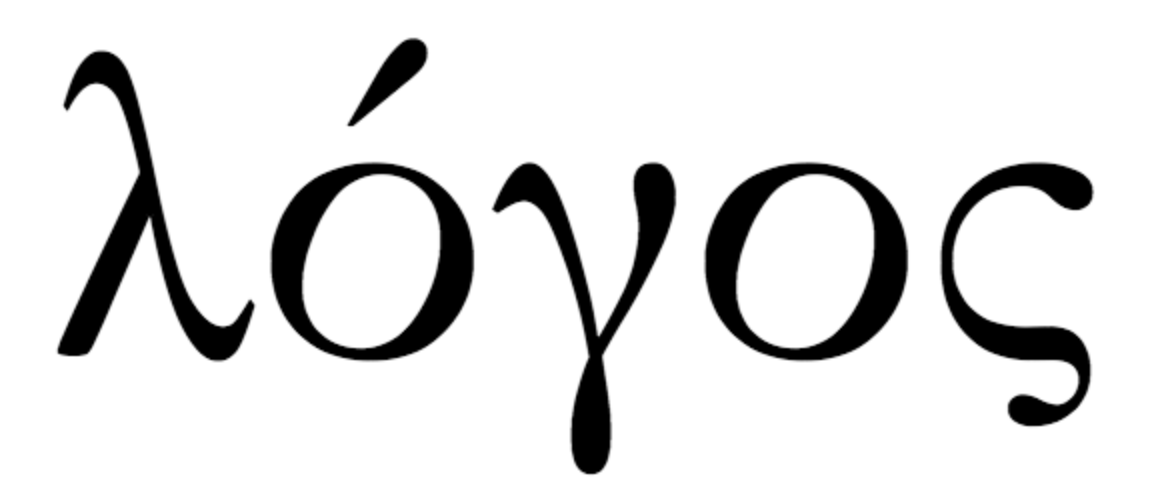
As to Gadamer’s Biblical comparison, introduced in Part I… from the Greek of the New Testament, “Word” translates as λóγος (logos), and language – logos, the Word – within us reflects the imago Dei of Creation. From this root issues a robust etymological lineage: word, speech, discourse, logic, reason, rational thinking – traits in the 21st century that seem so empirical, dependable, reliable, and antithetical to faith. Yet, for having language, we still have no supernatural facility to claim as our own – no omnipotent glory – that might make eternally creative use of it. We have but vaulting ambition – sinful pride – that frustrates our use of what feels somehow essential yet lies somewhere beyond our finite capability.
Thus we misconstrue our essence as instrumentality and our existence as authority… again that hazy distinction between essence and aim: imagine the world where hubris is surpassed only by vanity. We do in fact bicker endlessly over alternative facts, and our shared understanding – a shared estrangement – does in fact increase. And thus (again with added emphasis), in light of Heidegger – in light with Heidegger, in the clearing – I might read the opening verses of the Gospel of John as descriptive and readily spot both real and figurative IB:
In the beginning was the Word, and the Word was with God, and the Word was God. He was with God in the beginning. Through him all things were made; without him nothing was made that has been made. In him was life, and that life was the light of all mankind. The light shines in the darkness…

(John 1:1–5)
The darkness is an image also invoked by Taylor, certainly bearing a negative tone, to describe our bids at imposing our own light within Heidegger’s clearing. John counters the darkness with two essential claims: (i) God is logos, and not in some protean way but definitively, while (ii) the Word is the underlying source of ‘making’ and ‘made’, of light and life, with our goodwill or human essence being but an image of His.
One final detail from Arthos is worth adding to this spiritual aspect of IB, for two reasons: first, to credit Gadamer’s “fusion of horizons” as a way to describe IB, and second, to acknowledge Gadamer’s concept of “conversation” as something spontaneous, emergent, and unpredictable. Of the spiritual footing for Gadamer’s hermeneutical approach, Arthos says this:
For Gadamer, Christian incarnation “is strangely different from” the manifestations of pagan gods in human form (TM, 418/WM, 422). In Christology, the spirit made flesh is “not the kind of becoming in which something turns into something else” (TM, 420/WM, 424). This strong enigma places the credal[4] faith apart, and upends the normal relation of the spiritual and the material. The indivisible bond between the word and the person is a fuller ontological relation than simply the unity of the spiritual and material. The relation between word and person is no bloodless, conceptual abstraction. The constancy of the person in the word represents a concentration or fullness of meaning and an increase of being. We can see this, for instance, in the idea of a promise, in which a person stands behind the word that is given, since it is they as much as the word that is at stake, and the fulfillment of the promise strengthens the person who made it and the community it forms. The innovation of the doctrine of the word is to reverse the trend set in motion with the Greeks that the reasoning faculty distills the mind’s work from the accidents of the flesh. Logos is rather the fully embodied medium of human community.

(Arthos, 2009, p. 2)
Earlier in the chapter of Truth and Method that Arthos quotes, Gadamer explains that our diverse world of languages and their associated cultures have this in common: when speaking of the Word, none is able to express its true positive being:
The greater miracle of language lies not in the fact that the Word becomes flesh and emerges in external being, but that that which emerges and externalizes itself in utterance is always already a word.

(Gadamer, 2004, p. 419)
The Word “[being] always already a word” I liken to a simultaneous positive ‘freedom to…‘ and negative ‘freedom from…‘, an autonomy we can observe and describe but not impede or control. This “externality” oddly serves as a great equalizer across cultures, if we let it – that is, if we heed Taylor and seek not “to impose our light [in its place and] close ourselves off to [others]” (Taylor, 2005, p. 448). As compared to something in between us that enjoins, Gadamer describes something among us that joins.
To take all this spiritually, or else not, is up to each person – as apparently it must be. I can only express my words, here and now, for you to take or leave, as you will. Yet this much for all seems undeniable: each one of us might cast our self in this role of creator, as such: “If it were up to me… if I were the one in charge… if only we did things my way… .” Is it little wonder if the world and life and history seem defined by our multitudinous disagreements? And if saying so seems obvious, or pessimistic, consider too that Heidegger’s entire point seems to be an imperative to “Listen,” advice most infamously needed when it’s not happening.
One final analogy for IB departs from philosophy and the spiritual for natural science, which I include here on account of wonder. I take it from physicist Dr. Robbert Dijkgraaf during a 2015 appearance on PBS Nova:
“In this very simple formula, the whole geometry of the universe is hidden.… It’s also a signature formula for Einstein. The true mark of his genius is that he combines two elements that actually live in different universes. The left hand side lives in the world of geometry, of mathematics. The right-hand side lives in the world of physics, of matter and movement. And-- so perhaps the most powerful ingredient of the equation is this very symbol, equals sign, here: these two lines that actually are connecting the two worlds. And it’s quite appropriate they’re two lines because it’s two-way traffic: matter tells space-and-time to curve; space-and-time tells matter to move.
“You know, you have the huge universe, and it obeys certain laws of nature. But where in the universe are these laws actually discovered? Where are they studied? And then you go to this tiny planet, and there’s this one individual, Einstein, who captures it. And now there’s a small group of people walking in his footsteps and trying to push it further. And I often feel, Well, you know, there’s a small part of the universe that actually is reflecting upon itself, that tries to understand itself.”
I can imagine Dijkgraaf granting to Einstein a cosmic generosity, the goodwill to have made room in the clearing for others, e.g. a “small group of people walking in his footsteps.”
Some people get spiritual about cosmology, and physics too, so offering this analogy in the wake of Heidegger’s cosmic spirit seems more à propos than non sequitur. Personally, I think science and spirituality would find plenty to talk about together, if they would willingly join forces and listen to each other, and perceive expressions of interest, and develop some basis of shared understanding.
Besides its temporal implications, the second part of Dijkgraaf’s remark resembles a concept I have elsewhere called mirroring: briefly, an effect of interaction where the response provoked in Person ‘A’ by the prompt of Person ‘B’ serves as a reflection of Person ‘B’, as if Person ‘A’ were a mirror for Person ‘B’ to see themselves. Re-action reflecting action implicates both participants, and of course, the mirroring effect is simultaneously mutual, travelling both ways at once: between people, IB is a compelling imperative to listen and also respond – it suggests our joint interaction. By Dijkgraaf’s Einstein analogy, mirroring might also suggest that equals sign.
In all these concepts of mutual relatedness – philosophical, spiritual, cosmological – IB is a kind of setting, albeit not a literal physical location. Where ‘one’ thing ends and ‘another’ begins is an abstract third space between the two in relation. That said, IB is temporally present – each moment figuratively here and literally now, continuously underway and under continual renovation, forever in adjustment, always resembling, never quite remaining. This third space may overlap, such as when two people share something in common, or it may be a gap, such as when two people have nothing in common. Either way, it’s IB’s dynamic that is defining their relationship.
[1] By “others,” we might also include “self,” in the more straightforward matter of defining the “audience.”
[2] Subsequently, any resultant small-‘t’ truth offers some capital-‘A’ Assurance, even if capital-‘T’ Truth remains beyond certainty or else relies on some kind of faith. Whether we even call this consensus the capital-‘T’ “Truth” would seem to depend on how well we get along together.
[3] Exactly how Heidegger came to understand language as this vital is the focus of Taylor’s essay although, admittedly, I am still pondering his overall discussion. But, again, I broaden “language” – as well as “text” – to comprise all our communicative efforts, and as I often said to students, “If it’s done by people, it’s rhetoric,” by which I meant, “it’s persuasive,” i.e. it’s something inherently communicative.
[4] An alternative definition for agenda is “things to be done,” originally theological, “matters of practice, as distinguished from belief or theory”; as opposed to credenda “things to be believed, matters of faith, propositions forming or belonging to a system” from which we derive creed. Thus I note with interest Arthos’s reference here to “credal faith.”






 The Rhetorical WHY