On Bias: III. Fun with Dialectics

Click here to read On Bias: II. Wrong Bias?

On Bias: III. Fun with Dialectics

Above-below, up-down, in-out… let’s understand these as some basic opposite pairings in English vocabulary.

Some pairings seem as rooted in tradition as opposition – love-hate, war-peace, success-failure – while some pairings automatically imply something else – just as ‘landlord’ pays its dues to ‘tenant’, so ‘parent’ only makes sense alongside ‘child’. Along the same line, as surely as ‘zenith’ is joined to ‘nadir’, something ‘ahead’ is followed by something ‘behind’. Conversely, it goes literally without saying that a ‘turn’ to face Thing 2 is the same pivot away from facing Thing 1. Being a duality, two moves at once, maybe this is why one good turn deserves another – after that, on we go.
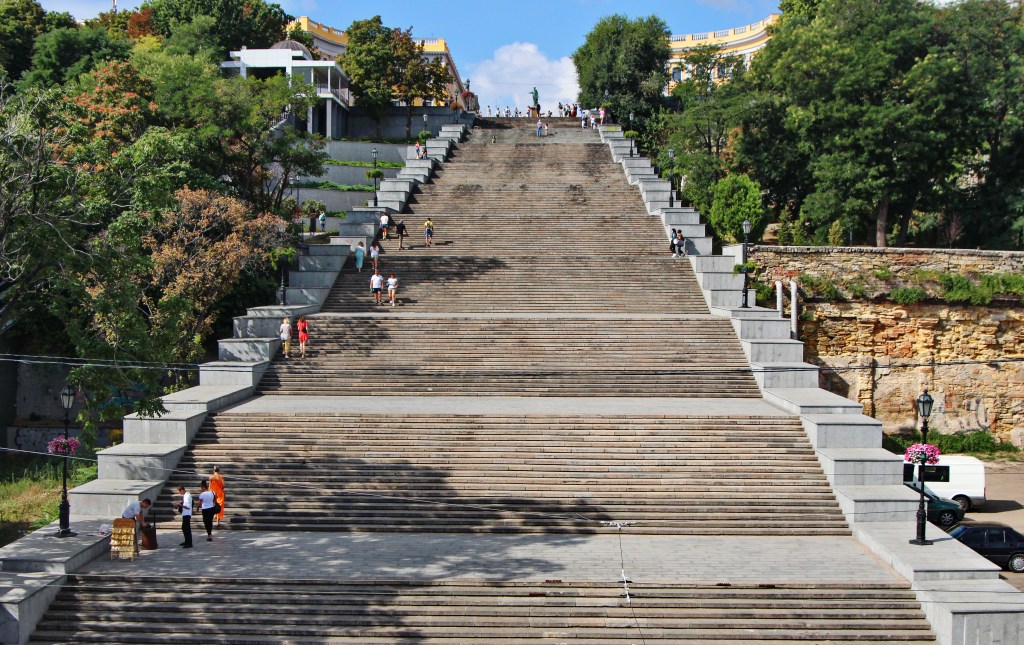

Looking up the Odesa Steps… not the Eisenstein montage today
Looking down the Odesa Steps… only the landings are visible

Photo Credits by Oleksandr Malyon – Own work, CC BY-SA 4.0, https://commons.wikimedia.org/w/index.php?curid=94182671 https://commons.wikimedia.org/w/index.php?curid=94182670

But our vocabulary is not always so obvious or easily taken for granted… something ‘ancient’ by contrast might only suggest something… well, less ancient: ‘modern’, ‘current’, ‘contemporary’, how about ‘fashionable’ – now we’re talking connotation as much as denotation. And with plenty of other word-pairings – ground-air, hard-soft, strong-weak, first-last – if any of these are less automatic than good-evil, to-from, wet-dry… well, they still seem just as opposite. Funny, though, a word like ‘moon’ implies ‘planet’, yet no planet requires a moon.

Actually, this post isn’t some attempt at anything formal although, if you’re up for it, knock yourself out.

Theory-practice, reflection-action, curriculum-pedagogy, classroom-real life, content-skill, teacher-student… education is all about such pairings. For the sake here, let’s consider these as ‘dialectical pairings’, where each concept is not merely reciprocal to the other but inextricably indispensible, such that the two concepts together comprise not a united opposition but a concerted reciprocity. And from the two arises something further, something more.

Matter tells space-and-time to curve; space-and-time tells matter to move: their fearful passage is the two-way traffic of our stage.

Maybe that’s a bit much. Let’s just stick with ‘dialectical pairings’, in a loosely Hegelian way that says, “You complete me.”

Here’s one we all know from education… ‘fairness’ balanced in concert with ‘unfairness’… in accordance to circumstance, fairness being the treatment of people without discrimination, marked by impartially, as conversely distinct from unfairness, discrimination marked by partiality. But without circumstances specified, this distinction remains ambiguous, such that one could argue fairness – treating every person impartially – as being equality, treating everyone the same, rendering unfairness as inequality. More recently has a distinction also been emphasised between (in)equality and (un)fairness such that the resultant outcome of specific treatment is considered (un)equal while the ongoing act of treating is described as a measure of (in)equity, the specific measure evidently being human rights, typically as these rights have been defined by some authority.

Anyway, let’s consider fairness-unfairness as having arisen from something else we’ll call ‘bias’ although that may actually be more of a Hegelian reversal, if you see what I did there. OK, so we consider this, but on what basis? What I’m suggesting is twofold…

(i) Bias is an always-thing, and utterly inescapable
(ii) No matter how exactly we do something, bias instils every decision with unintended consequences

As a result of everybody’s overlapping biases, i.e. that system of forces made real by everybody’s ongoing decisions, somebody somewhere along the way incurs some cost in payment of an outcome

Sidebar #1: We’ve been facing a lot of absolutes, thus far… inextricable, indispensible, utterly inescapable – let’s consider these inexorable. As for absolutes, let’s consider them unlimited by anything besides themselves.

Somebody pays a cost… I call it a cost, and depending on the circumstances, maybe we call it fallout, or unintended consequences, or collateral damage. Depending on the circumstances, maybe we call it a trade-off. But what it’s called doesn’t negate the truism that there is a cost to everything, which is sometimes described in education as the hidden curriculum.

Sidebar #2: Ivan Illich is often credited with coining the term, ‘hidden curriculum’, and his meaning actually took to far wider critique than just education. Illich argued for the disestablishment of schools, comparable to the separation of church and state, on the basis that our most insidiously aberrant institution is compulsory schooling, which proliferates “the alienating institutionalization of life by teaching the need to be taught” (p. 34). Illich critiqued compulsory schooling’s duplicity, in which learning is ritualised myth-making, “something for which you need a process within which you acquire it” (p. 67), a problem defined by a self-justifyingly selfless solution:

“… other people told me [schooling] was… the most practical arrangement for imparting education, or for creating equality, [yet] I saw that most people were stupefied by this procedure, were actually told that they couldn’t learn on their own and became disabled and crippled… a new kind of self-inflicted injustice… a liturgy [for generating] the belief that this is a social enterprise that has some kind of autonomy from the law.… If the rain dance doesn’t work, you can blame yourself for having danced it wrongly.” (p. 66)

For Illich, words like ‘planning’ and ‘development’, ‘class and ‘equality’, ‘system’ and ‘assessment’, all central to North American schooling, are anathema to ‘knowledge as an intrinsic good’ and ‘coming to know things as inalienable living’ – those absolutes again.

And what it’s called doesn’t negate the responsibility to consider more than one perspective, on behalf of others, while weighing or enacting our decisions. If anything, bias demands responsibility unless, of course, your concerns lie elsewhere than somebody somewhere paying some cost. This, if you ask me, definitely falls to a matter of character, as does a sense of whether this post seems to have abandoned the whole ‘dialectical pairing’ thing.

Click here to read On Bias: IV. Right Bias?

On Bias: II. Wrong Bias?

Featured Photo Credit (edited): Jonathan Pendleton on Unsplash

Click here to read On Bias: I. Disparate Bias

On Bias: II. Wrong Bias?

The school must conduct its affairs in some way or other; the curriculum must include some areas of human experience and omit others. In doing so the school thereby commits itself on these issues, often without proper, or any, consideration of alternative possibilities.

Mackenzie, 1997 (p. 499)

The first half of Mackenzie’s remark, a priori, I accept: school must conduct its affairs in some way or other, and the curriculum must include some areas of human experience and omit others.

As to the second half… hey, we all have opinions, and as we take each other to be informed to greater and lesser degrees, we agree and disagree. So, where I can imagine the dearth of “any” consideration of alternative possibilities, I’m still uncertain what Mackenzie means by “proper.”

So long as an attempt is made, wouldn’t literally any consideration leave us free to judge school’s conduct of its affairs… unless, of course, somebody’s gone and figured it all out on behalf of the rest of us. Did some school back in ’97 really manage to offer it all in one go? Who were the teachers and administrators demonstrating that kind of wisdom? Who sat for that District Board, staffed that government ministry? By all of which I’m really asking, who gets to say what’s proper and, thereby, what’s improper? You? Me? Mackenzie? Further still, who even gets to say who gets to say? Don’t say “Mackenzie’s parents.”

To be fair, “proper” in this case could be interpreted more procedurally than substantively, as some generic curriculum development protocol – a proper approach to considering alternatives versus proper alternatives per se. Yet similar questions remain about who sits as part of that process, and who chooses who sits, and who chooses who chooses, and on it goes, the politics of education.

If you ask me, i.e. thanks for reading, a conscientious teacher faces questions analogous to these every single day while enacting curriculum many times a day, balancing their own perspective with how they interpret each student’s needs and interests. And I say “each” student, but of course we all know things are sometimes less individuated than the world of idealism. Teaching anybody, much less young people, much less 2–3 dozen at once, is no singular thing, which the gerund “teaching” hardly conveys.

By the same turn, though, teaching is no crap-shoot, or maybe better to say it can’t afford to be. Isn’t the real trick of teaching learning to live with uncertainty? And isn’t that last sentence funny for juxtaposing teaching so cavalierly with learning? Teachers learning? as in, don’t they have it all already figured out – aren’t teachers already supposed to know things?

Don’t be misled as to what you imagine teaching to be, despite any time you may already have spent in a classroom.

Teachers owe a duty of care to meet people (if not each person) where they’re at, then help them along. So… how does a teacher balance their own knowledge and awareness with what matters to their own self? That’s a real distinction, by the way. And if they can balance this, how next do they balance this with their duty to help students learn what students feel matters to students? Trust me, that last sentence is even harder to do than it is to read because, sometimes, students just don’t know yet what matters to themselves – the same can be said of some teachers I’ve met, too, since we’re on the subject.

Convolutedly, the reverse is also true – for some other teachers, their politics is inherently part of their classroom curriculum, something I’ve heard insisted to be not only good teaching but moral teaching. This opens an always nuanced and often contentious discussion – he said from experience – such as precluding an opportunity for students to reach moral ground on their own terms in their own time. Rather than discuss it further here, though, I’ll suggest another way to ask my question about teachers balancing self with students: how might education be made “simultaneously both responsible and free” – it’s something Dr. Shulman wondered as far back as 1983. I gather he was leaning more towards teachers acting on behalf of students whereas I’m definitely asking on behalf of everybody in the classroom. For me, this ultimately seems a question of autonomy, the heart of which is bias.

Oh boy, I know this is a series on bias, but really? Always ‘bias’? It may be safe to say, or else totally ironic, that the principal curricular consideration we face is What is most worth teaching? That’s a collective ‘we’, by the way, not the royal one, and fair play if you disagree. In any case, this infamous question inevitably leads to an even bigger one, What is school for? What’s the purpose of this thing we call K12 education? Lately, though, as we’ve particularly hitched our wagons to constructivism, I wonder if these are the wrong questions.

Lately, I’ve been trying out something different, and just to be clear, I’m not referring to subject-specific curricular anything. To be clearer still, I’m considering what teachers bring with them through the classroom door each day because they’ll be bringing it, whatever question we ask. And what are we asking?

Up til now, where someone may have been asking, What is school for? I’m asking Who participates? and further, What are some suitable attitudes or expectations for participants? How best to proceed in K-12 with this thing called ‘constructivism’… I mean, if we’re genuinely committed to living it out, because I don’t yet see that we are – not even when we think we are. Yeah, long question.

And yes, still collective, not royal, only now I wonder if anyone’s upset with me lumping them into the collective. In responding to these questions about school and curriculum, I’ve obviously been considering neither content nor skill but people. So, as we’ve hitched our wagons to constructivism, I wonder whether people might be the purpose of school, making the principle curricular consideration not ‘what’ we teach but ‘who’ we teach, alongside which both ‘how’ and ‘why’ we teach find appropriate kinship.

If you disagree thus far, please don’t let your bias run away with you while, if you agree, please don’t go clicking ‘Like’ and ‘Share’ just yet – he said with smug presumption – because this is still far more nuanced than I’ve offered just yet.

I think it’s fair to say this idea is something I’ve wondered more broadly across The Rhetorical WHY, primarily as a facet of curriculum since teaching and coaching and mentoring are some things I’ve come to know fairly well – and, hey, write what you know.

There’s a common distinction between curriculum, mandated documentation about what to teach and learn in K-12 schooling, and pedagogy, the manner in which curriculum’s taught to this or that class of students. Both lack nuance for being oversimplified. From all my pondering, I’m lately gathering that an ill-advised separation of this dialectical pairing may be an ongoing source of trouble faced by teachers, students, and education in general. I think curriculum and pedagogy may be better considered one concept, and I think so because of bias, and I wish I had something more substantive to offer – as I say, it’s threaded throughout this blog, but that’s a lot to synthesise.

I’m no longer certain that school’s the place for any superseding authority, either the kind we commonly associate with curriculum or the kind we commonly associate with pedagogy.

I think how or why we’ve made this separation is an issue of a higher order; for now, suffice to say I suspect Illich was on to something. The bottom line is that I’m no longer certain that school’s the place for any superseding authority, either the kind we commonly associate with curriculum or the kind we commonly associate with pedagogy… what I mean by school is the sort of experience I had, where the superseding authority was largely into ‘telling’ and ‘explaining’ things – maybe that resonates for you, too. On the other hand, what I mean by “no longer certain” may not be what you think, so bear with me.

“… are we doing this right?”

We all come away from ‘school’ with an idea about what it is and how it works because we all went through those years, ourselves. Honestly, though, in this era of constructivist halos, I still see plenty of telling ‘how it is’ and explaining ‘how it’s done’, and ‘this is what’ and ‘here’s how’ and just all sorts of expectation and behaviour from teachers and instructors and professors that suggest, to me, how little has actually changed.

We find all sorts of ‘student-centred’ this and ‘self-regulated’ that in today’s educational circles, and we call it constructivism, but I’ve felt far less certain about the constructivist perspective since it came to, er… rule the day dominate the landscape become so popular since we adopted it. Apparently, we tend to repeat what ‘school’ is and how it works, even when we say we’re changing… is this because we all went through those years, ourselves?

But hey, changes take time and patience, and people who spend their time waiting to arrive miss that time spent. And I can only judge from my own perspective, but in the classrooms I know, what I take Mackenzie to mean by “proper” for schools may finally be gradually changing.

I say so with some unfinal gradual assurance because what I’ve been seeing is only four or five years old while institutional changes seem to be generational – did you notice, above, I chose a quote that’s twenty-five years old? Someone else might have embellished those twenty-five years for effect – “more than two decades” or “a quarter-century ago” – but I didn’t want any rhetorical ‘why’ to diminish all the teachers and students whose efforts at change over twenty-five years have arisen and are having effects all their own.

So fair play to all the teachers and students in schools I know. Also noteworthy… the roots of their change seem to reach well beyond any teen angst, or that world-conquering spirit of twenty-somethings. Their changes also seem to be found in more than one institution, even one as ubiquitous as school. It’s the cultural shift we’ve all been experiencing for a few years now, a stand-out willingness to confront assumption and habit and bias, and behaviour, and prejudice and bigotry and hatred. And it’s the determination against all these to assert an alternative superseding authority – although whether as a challenge or as an equal seems dependent on circumstance. I won’t label this change since most people probably call it something for themselves, but the overwhelming sentiment has seemed to be that this time is different.

As for me – and of this I’ve had far longer to be convinced… the greatest obstacle to change is the force of habit, which can manifest any number of ways and which is maybe just another way of saying bias. If I have one analysis to offer, it’s to be conscious of bias as its perceived by an audience, something along these lines: “… to the creatures outside looking in from pig to man, and from man to pig, and from pig to man again, it was already impossible to say which was which.” So for me, anyway, not sure for you, I’d say we have a ways to go before we’re okay characterising any “changes” as thorough or convincingly different just yet.

Still, things sure seem different this time around.

Click here to read On Bias: III. Fun With Dialectics

On Free Speech: II. The Speech of Free Speakers – “A Delusion of Certitude”?

Featured Image by Lynn Melchiori from Pixabay

Click here to read Pt I. The Free Speakers of Speech – “Strands in the Web of Freedom”

II. The Speech of Free Speakers

“A Delusion of Certitude”?

“I think what we’re learning is that, particularly when they get a choice, a lot of people decide to believe what’s more comfortable for them, even if it’s not the truth.”

– Ellis Cose

Is any look at speech, free or otherwise, fairly completed before considering the listening and the thinking that the speech provokes?

From the context of his interview, Ellis Cose’s statement above seems less about how freely people do or don’t speak than about how the rest listen, and cope, and think. It’s about how readily people arrive at some assurance and, from that position, rest in acceptance of only certain other perspectives.

As I mentioned in Part I, his statement (for me) is about bias, as in what was learned from the speaker’s education that now prompts the message they speak aloud. And hey, from any given perspective, as we can never be two places at once, so we can only utter (or write) one thing at a time. “Perspective” has to mean something. So maybe what Cose calls “more comfortable” we might term less generously as “lazy” or “narrow-minded,” as in Hey, if you plan to see from any other perspective, you need to get up and move.

And now I can imagine the anti-them us-approving fist-pumps spurred by the previous sentence. Is it some “immediate overwhelming interest which appeals to the feelings and distorts the judgment”? Rather than wholeheartedly agreeing, from your current perspective, that the prescription to get up and move is antidote for others, consider how well it applies to any perspective at all. Consider that it may well be directed at you as directed by you… which is not to challenge anyone’s morality so much as note that morality can be challenged.

Surely, though, getting up and moving yourself is more humble and accommodating than expecting or demanding it of others – isn’t it? It’s the difference between being humble and being humbled, and I think we’d all prefer the former, if that choice were all we had.

I suppose what I’m advocating is a thorough investigation of alternatives, even the ones we might have thought objectionable, before we opt for anything more drastic. And look, nobody needs to invite their opponents over for nachos and board games just yet. Even so, ask yourself, “What small space can I clear for people that, up til now, I just haven’t allowed?” Is such space even conceivable?

On the other hand, if we’re flat-out convinced, and some other perspective feels equally immovably justified, and there’s no recourse but to fight it out, well… it has been known to happen.

Judgment [of free speech] is… solicited on a conflict of interests of the utmost concern to the wellbeing of the country. This conflict of interests cannot be resolved by a dogmatic preference for one or the other, nor by a sonorous formula which is, in fact, only a euphemistic disguise for an unresolved conflict. If adjudication is to be a rational process, we cannot escape a candid examination of the conflicting claims with full recognition that both are supported by weighty title-deeds.… Full responsibility for the choice [belongs] not to the courts [but] to Congress.

Dennis vs United States, 341 U.S. 494 (1951)

For me, though, what Cose elucidates above all else is nuance. Its laced throughout his interview. He himself has an informed take on the history and the context of an issue that, on its face, we call “free speech.” It bears mentioning that “free” is not meant in the sense of getting a free burger at McDonald’s but, rather, getting a public opportunity to say or write what you believe, unhindered by government on the basis of content. What is prohibited is the act of government censorship, with some qualification reserved for government to negotiate with the speaker (via judicial systems) on such bases as common obscenity, so-called “fighting words” of hatred, malicious defamation of public officials, and more generally the balance in likelihood between the “gravity of the ‘evil’” and whatever “invasion of free speech” might be deemed necessary, say if someone were inciting others toward government overthrow.

Of course, neither government nor citizen has full and unbridled ability to act. The balance is contextual, and it’s usually lawyers who argue before judges and juries who decide. Here is a good discussion on that note.


Image by Venita Oberholster from Pixabay

And of course, in the Cose interview anyway, the entire topic is steeped in the conflated history of America’s socio-economic politics, including other Constitutional concerns such as citizenship, due process, and equal protection under the law, which fall under the Fourteenth Amendment. As Cose explains, “free speech” today and historic First Amendment protected speech aren’t necessarily the same thing.

As for me, I’m no expert lawyer, I just watch them on television. So I fear my attempted definition here is hardly precise enough. But how else can we discuss such topics unless we try to be more than just forthcoming? We must also try to be more thorough. In fact, that’s one reason, maybe the main reason, why I started this blog. But my mono-blog is only one voice in our dialogue, so please offer to this discussion whatever informed-slash-substantive insight you have.

As every one has a right to be heard, let us hear from every one, that we might hear from everyone.

Click here to read Pt. III Craft Displacement