The Rhetorical Which

Should we maximise our capabilities, based on our limits?

Or maximise our limits, based on our capabilities?

As to the basic message, here, I actually don’t see too much hair-splitting. Both are aimed at action constrained by circumstance. The difference, I think a lot of people would propose, is the optimism or pessimism found between the two phrases although, even saying that, I think we blend within ourselves attitudes from both.

As for me, I feel more given to the second phrase, maximising our limits based on our capabilities, for its seeming more empirical, more driven by circumstance. Let’s take stock of our resources, and get on with it. Limits that exist will obviously present themselves as obstacles or else, well, they wouldn’t exist. And not only can those limits be reached, maybe they can even be stretched or, if not overcome, at least managed. This then becomes the task, and thank goodness for capabilities – and there’s the blending. Even empiricists have that esoteric side.

In the first phrase, similarly, something must exist – capabilities – or else they wouldn’t exist! So they must be maximisible (a word I just invented) in a way that hasn’t yet been, well, maximised. The first phrase is all about potential, what could be, if we just find a way to maximise our capabilities. Fist pump, exclamation point. In the culture I’m most familiar with, I suspect people – at least initially – would consider this first phrase a kind of optimism.

Okay, maybe not, since its basis is limitation, and that hardly sounds all warm and cozy. Still… in the first phrase, limits are a mystery to be solved, a challenge to overcome, an adventure: you can do or be anything you want, if you just believe in things. Set some goals, too, obviously – you can’t just go through life living on hope alone. Maybe I’m giving myself away; remember, I feel more given to the second phrase.

If the first phrase is optimism, the second could only be blunt, blanketing, clinical pessimism. But, like I said, I think we tend to blend, and I know I seldom feel satisfied with polarised options. So, even feeling more given to the second phrase, I won’t call myself a pessimist or even lean in that direction. And, yes, that means I won’t call myself an optimist either. Regardless, as I feel more given to the second phrase, I feel good about it for a couple reasons… relying on my capabilities means I have them and can use them, exclamation point, which means my limits can be pushed and stretched, if not overcome. Fist pump! In neither phrase is there any lack of opportunity. In fact, each leaves room for the other.

For me, optimism and pessimism aren’t found in phrasing. Sure, we can play with words and come up with ways to objectify our capabilities or our limits. We can arrange syntax a certain way and suggest some interpretations, as I’ve just been doing. But, like I said, the basic message in both phrases is simply action constrained by circumstance. Attitude, tone – these are traits, and traits we find in people. Words describe, and tools are helpful. But it’s people who do the living.

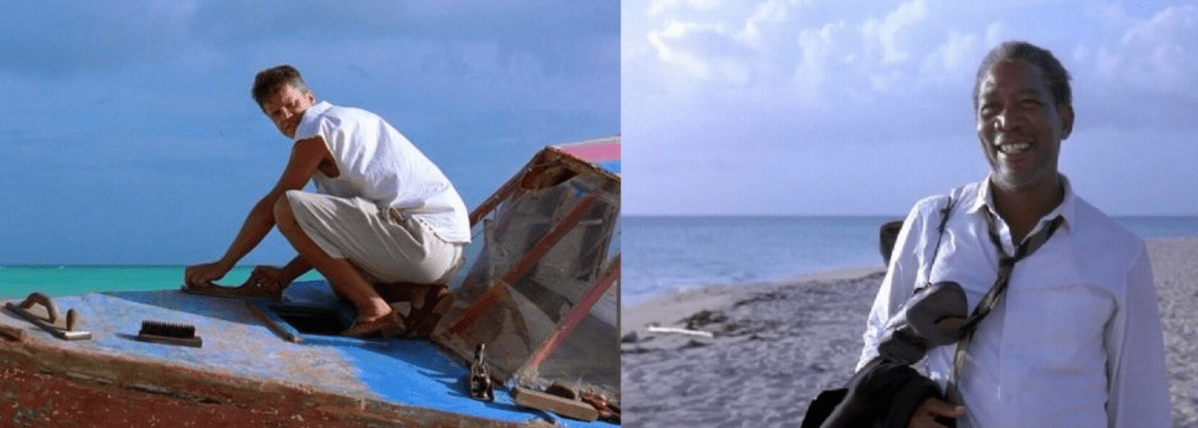
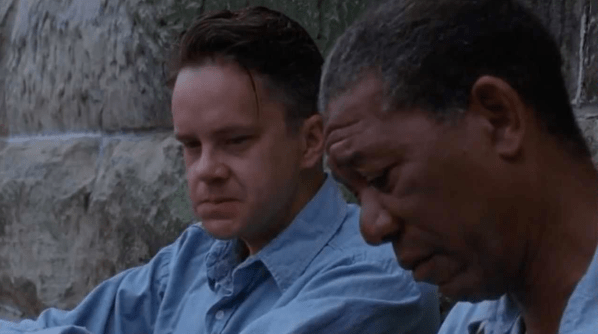
Life has got to be about the verb.
Gettin' Busy Livin'.png

What it Was is What it Is: I Don’t Know What Else to Say

At the same school, in the same department, for so long… eventually I found what seemed to be some effective teaching strategies and stuck with those, but boy it took a while. There’s been more than one teacher to have offered something like an apology, half-joking, half rueful, to all those early students, who were basically guinea pigs while we figured ourselves out in the classroom. I mentioned this in a paper for a graduate course and earned the critique of “triumphalism” – feedback from the professor, which I took as a suggestion to go ahead and “problematize my assumptions,” to use the lingo. In the moment, I bristled, the new kid in town learning how to be part of the academy, wondering what exactly had prompted my professor to claim with such certainty the question of my certainty.

Maybe I’ll just mention, since I’ve brought it up… I’ve since found the academy has an endemic logical pitfall all its own, an oddly hypocritical veneer of uncertainty: “All knowledge is provisional.” Post-modernism at its finest? Indeed, who can really say.

In all seriousness, though, and fairness, I grant the aim of the sceptical outlook. Heck, I try to possess one – healthy scepticism, to guard against arrogance and narrow thinking (… and innovation too, come to think of it, although that one maybe for another time). I value Socratic humility, which I ultimately decided not to call Socratic ignorance, and try to model it although how successfully I can’t say – especially not *joking-slash-rueful* back in those early days. So when someone with expertise in curriculum and teaching theory lay triumphalism at my feet, I thought to myself, Well, at least I ought to consider it. And I did.

And I do, and I still am. That reflective side of critique, the side you get from being on the receiving end, it can help us spot our assumptions and our shortcomings. I suspect the whole point was simply to light a fire within me. And hey, I’ve gone and written this, haven’t I? And hey, if settling into some effective teaching strategies weren’t triumphalist and undesirable, that would probably encourage complacency among teachers, or possibly even stagnation. On the other hand, after so long teaching in the same department at the same school, I suspect there’s more than one teacher who’s ended up feeling like part of the woodwork. Certainly, for me, as I’m sure for the students, there was a marked difference between me, the new guy, and me five, ten, fifteen years later. Then again–

Looking back, now, at what I called “effective”… it rounds out as, well, effective because what happened happened that way – nothing’s perfect, but all considered, my students seemed broadly to have learned what they felt were some useful things. The classroom years I spent, developing as I did to reach the point I reached, came about from the feedback I received each day, each term, as students and I came together lesson upon lesson, class after class. Details along the way, course evaluations I asked students to complete each June, reports back from post-secondary adventuring… there are always issues to address along with encouragements to appreciate, and I admit: no grand theory did I have in mind, as though I were contributing to the historical record. I just wanted to make things better for kids the following year, which eventually I think I was able to do.

Where I gave thought to improving my teaching was (a) relative to myself, (b) on behalf of my students, (c) in the context of my school. At least, that was what I thought when I was teaching. In that respect, what can I possibly say now, looking back, as to what might have been apart from what did be? I had to do something. And my life was never going to be any less full or busy or complicated than it turned out to be, so in all sincerity I did what I could. Eventually, it seemed to work out pretty well. Effectively.

Look, if somebody did celebrate triumphantly, in the classroom, facing the students, day in day out… ? What an ass! As it was, for those students who did find my teaching effective in this way or that – or worse, for those who didn’t – did I leave them with some suggestion that I basked in triumphant glow? I hope not. Like I said, I eventually found and stuck with what I thought worked, and that took years. Meanwhile, that’s the job. Isn’t it?

For me, the professor’s criticism, in whatever light it was offered, reflects more upon her embrace of uncertainty (presumably the academic embrace I described above) than it does upon my curricular relationships when I was teaching. And I heed the lesson, not for the first time in my career, that sitting in judgment of others can be a difficult perch.

The Burden of Sacrifice

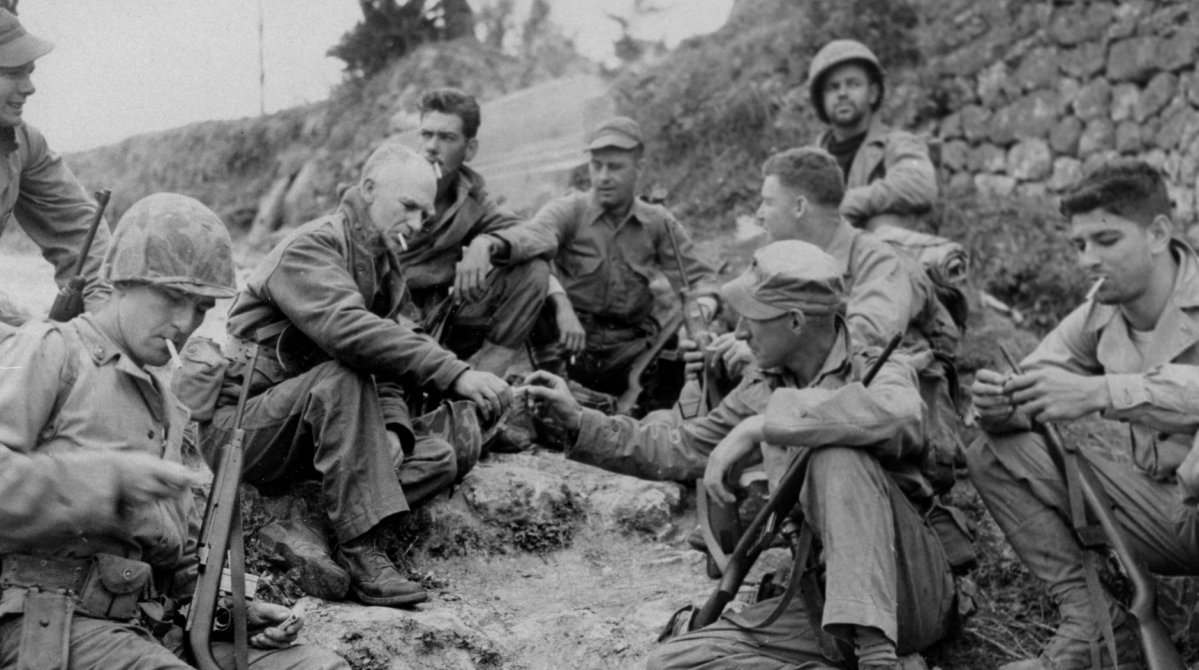
My students will recognize war correspondent, Ernie Pyle, and his accounts of World War II, including a series of three columns that describe with stark intimacy the aftermath of the Normandy invasion. This week, all three will be reprinted by members of the Pennsylvania NewsMedia Association in commemoration of the 75th anniversary of D-Day.

Also well worth reading is this article from The New York Times, a tribute by David Chrisinger to Pyle, the man who told America the truth about D-Day, and the soldiers he commemorated, whose sacrifices in war leave us all indebted.

Controversy arose over whether or not to publish a photo of Ernie Pyle in death. In this article, a different war correspondent named Pyle, the late Richard Pyle, quotes Ernie Pyle biographer, James E. Tobin…

“It’s a striking and painful image, but Ernie Pyle wanted people to see and understand the sacrifices that soldiers had to make, so it’s fitting, in a way, that this photo of his own death… drives home the reality and the finality of that sacrifice.”

Indiana University has a great repository of Ernie Pyle’s wartime stories – click here to see them

In addition to soldiers, I would add, casualties of war include the child with no parent, the home with an empty room, the people with nowhere to live and nobody willing who is able to help them. Families might live in separation as a consequence of war. Civilians can be caught or placed into the path of chilling technology and lethal weaponry. People left alive find themselves rudely displaced and nakedly vulnerable. We have seen pride and duty elapse into jingoism, internment, and genocide. War is fought and casualties suffer in many different ways.

Our historical record is clear for its brutality and the dispensing of lives, and any disdain for the politics that incite war might well be justified. We have so much to answer for. Yet flatly shaming war as foolhardy or inhumane is simplistic. By the same turn, dismissing observances of war as banal or romanticised might overlook the personal roots that inspired them. How do we reconcile this? Pyle is clear: despite its cruelty, war is sometimes necessary.

And when it is unnecessary? Well, we have the liberty to have our say. But no matter our opinions or our politics, to live “in the joyousness of high spirits it is so easy for us to forget the dead.” Is this the imposthume of wealth and peace or the world of rights and freedoms? I can’t cover it all, or know every angle. For people like me, removed from war, what compels us into political debate differently than those facing imminent threat?

Beyond what I think of each war, anguish is real to those for whom war has meant sacrifice. Separate to written accounts, troubling memories are not easily and often never shared, but they are memories because those things really happened. Certainty of loss, uncertainty of fate: each is frightening, and both leave scars. Pain does not necessarily subside for no longer being inflicted. To disregard the sacrifices of war is to risk dishonoring, and nullifying, the people who made them, even as they might already be dead and gone.

Particularly on an anniversary such as this, we carry the cost of their service to us. Yet their sacrifices will never amount to nothing because the debt we owe is one we can never repay. For this reason, let us value and earn our debt. As the sacrifices of war are permanent, the onus for us to honour them is everlasting.

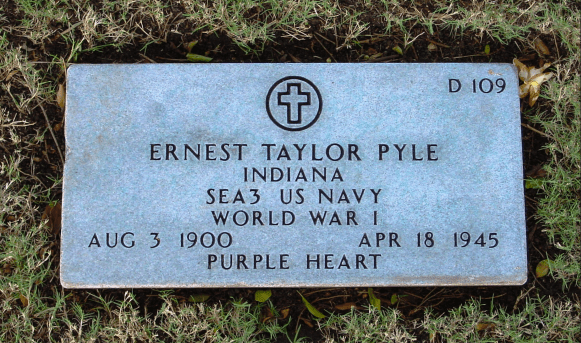
Ernie Pyle's Gravestone
Ernie Pyle’s gravestone, at the National Memorial Cemetery of the Pacific at Punchbowl Crater in Honolulu, HI

On July 23rd 2019, the Wright Museum of World War II hosted a symposium on D-Day – click here for more information

This post proved difficult to compose although, with reflection, I think the answer we need is somehow to be found in what we share – not our differences but our similarities.