‘Tis the Season to be Silly!

Here’s a curiosity… I wrote this thirty years ago in Grade 12 for – wow! wee! – the high school newspaper. Good lord, thirty years. When you’re able to say such-and-such happened thirty years ago, and remember it…

!!!!!

Sigh. Beats not remembering, I suppose. While we’re at it, how about a wow-wee for thirty-year anniversaries: diamonds, pearls… joy buzzers? Better watch your back at the reunion, folks.

So what do I remember? My Journalism teacher, Mrs Sullings, had been waiting for me to overcome writers’ block and finally granted me an extension until the following issue, figuring I’d never make the deadline for end-of-March.

I really appreciated that from her but now felt all the more determined (and a bit guilty…) to meet the deadline the next morning. I remember sitting on my bed later that afternoon, struggling woe-is-me, and finally just flipping through the thesaurus as some desperate chance-worthy way of inspiring an idea. I think it was “rapscallions” that got the ball rolling, and from there, as the saying goes, the thing just wrote itself! Then it got buried on page 7 because every newspaper has a layout crew. Joke’s on me, I suppose.

Fringe benefit, though… the next time I nearly missed a deadline, for the June edition, Mrs Sullings wasn’t nearly so concerned. She left that to me, that time.

I’m pretty sure this is the second piece I ever wrote for a public audience, as in something actually published somewhere, out of my hands. Boxing Day - Humbug!.jpgThe first was a few months before, this Boxing Day editorial for the December edition, although officially my class hadn’t switched over yet – you either went from Journalism to Creative Writing in January, or you were vice-versa like us. Admittedly, neither piece is rocket science, much less brain surgery, but hey, every piece does more than just fill its own space in the puzzle. A curiosity, like I said.
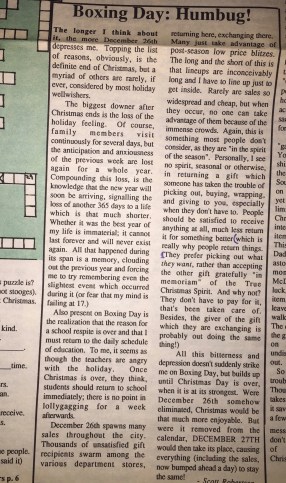
So here ‘tis! a piece from the past, yet as much for posterity inspired! O Come, all ye Jokesters, unite!

(If you’re interested, click here, here, or here to learn a little more about the history of April Fools’ Day.)


‘Tis the Season to be Silly

March 1989

With the end of March comes the eagerly awaited Spring Break, and with Spring Break there is invariably April 1st – All Fools’ Day.

April 1st is the pressure release for everyone whose desire to become a practical joker just can’t be contained another side-splitting minute. Jokesters, jesters, and clowns alike all join together in an harmonic convergence of comedy, where conventional precedents of whimsy are discarded, long-established antic-morals know no bounds, and the quest for the ultimate in rusing excellence reigns supreme.

But as one may expect when the wells of witticism have run dry (as is the case in the world now), spotting any sort of Page 7.jpgexuberant attempt at outlandish tomfoolery proves more difficult than raking wet leaves with a plastic fork. And the Ministry of Education has hardly accommodated the desires of those jovial few desperately striving to keep April 1st, the Prankster’s Paradise, from losing all significance in this once derisory society of ours.
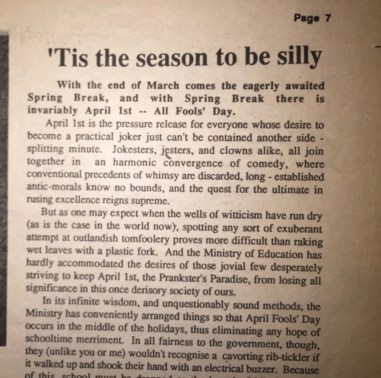
In its infinite wisdom, and unquestionably sound methods, the Ministry has conveniently arranged things so that April Fools’ Day occurs in the middle of the holidays, thus eliminating any hope of school-time merriment. In all fairness to the government, though, they (unlike you or me) wouldn’t recognise a cavorting rib-tickler if it walked up and shook their hand with an electric buzzer. Because of this, school must be dropped as the hostel of hilarious high-jinks.

Where, then, can one perform those pie-in-the-eye shenanigans and still achieve slapstick perfection? Home seems a logical place to start. And why not? For the abundance of potential targets, direct family ties keep anger broiling at a constant low, which is a major determining factor when dealing with the art of rabble-rousing, as are the many options open to the aspiring mischief-maker while on a mission of mirth.

There are the obvious escapades like exploding cigars and fake barf, or such monkey tricks as switching the salt and sugar, baking chocolate EX-LAX brownies, or stretching Saran Wrap over the toilet seat. As well, there are some old favourites to fall back on during instances of carefree nostalgia, like the bucket perched above the half-open door, or replacing the shampoo with NEET. Even the family car isn’t immune, as some skylarking rapscallions decide that switching on the radio to full volume, the windshield wipers to maximum speed, the air-conditioning to its coldest setting, and just about anything else located on the dashboard before the ignition is started, can provide for boisterous buffoonery in the highest degree.

Frozen Bunny.jpg

If this doesn’t tickle your fancy, then send someone you know a letter filled with sneezing powder – make sure it’s post-dated April 1st. You may try soaking your mother’s underpants and then freezing them overnight. Or remove the Sani-flush from the toilet and put green food colouring in the toilet bowl. When the shocked victim flushes the apparent “algae,” it is replaced by red-stained water from the toilet tank, which you have surreptitiously prepared the night before, in the name of all that is hallowed and holy amongst the flamboyant heroes of comedy whose Day you’re helping to celebrate.

Obviously, April 1st – All Fools’ Day – is one of the most important events of an otherwise blasé year, breaking the cat-gut tension with its relaxed, devil-may-care attitude. It is a time for everyone to get, get gotten, and be a good sport about it, either way.

Enjoy your April 1st this year, and if you’re one of the fortunate few to succeed in your sally – CONGRATULATIONS! You can appreciate the hearty effort undertaken by all those looking for an April Fools’ Fest.

And if you’re one of the unlucky targets of this annually occurring “puerile idiocy,” just grin and bear it, because half the joke is watching the victim’s reaction. Stay calm, laugh along with them… and then start plotting for next year.
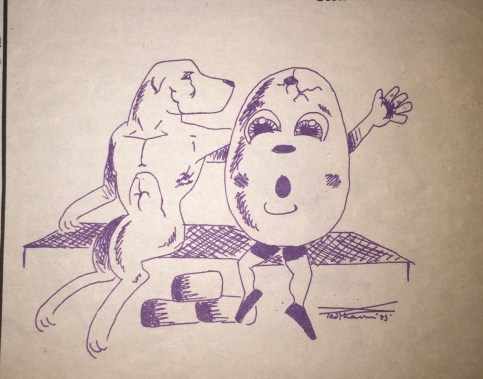
Thu Pham.jpg

… of Robbie Burns Day

The best-laid schemes o’ Mice an’ Men
Gang aft agley…”

In observance of Robbie Burns Day and, thereby, of John Steinbeck’s novella, Of Mice And Men, I highlight this thoughtful character study of Curley’s wife, by Leighton Meester for The Huffington Post, based upon her own stage portrayal of that character.

Perhaps above all I appreciate Meester’s nuanced intuition about the audiences who judge Curley’s wife which, beyond their relationships to the characters in the story, might suggest something about their own – our own – blind spots and hypocrisies. How often we live with daily nonchalance, oblivious to the interiority of those we encounter, and of those beyond. How much we rely on our affirmed belief of our selves.

If confronting ourselves is art’s great authenticity, then Meester’s perception is spot-on: in Curley’s wife, Steinbeck subverts our conceit – whether he intended to or not. Indeed, the best-laid schemes…

Teaching Open-Mindedly in the Post-Truth Era

[Originally published June 16, 2017]

A year on, and this one, sadly, only seems more relevant…


I had brilliant students, can’t say enough about them, won’t stop trying. I happened to be in touch with one alumna – as sharp a thinker as I’ve ever met, and a beautiful writer – in the wake of the 2016 U.S. election campaign and wrote the following piece in response to a question she posed:

How do you teach open-mindedly in the post-truth era?

I was pleased that she asked, doubly so at having a challenging question to consider. And I thoroughly enjoyed the chance to compose a thoughtful reply.

I’ve revised things a little, for a broader audience, but the substance remains unchanged.


How do you teach open-mindedly in the post-truth era?

Good heavens. Hmm… with respect for peoples’ dignity, is my most immediate response. But such a question.

Ultimately, it takes two because any kind of teaching is a relationship – better still, a rapport, listening and speaking in turn, and willingly. Listening, not just hearing. But if listening (and speaking) is interpreting, then bias is inescapable, and there needs to be continual back-and-forth efforts to clarify, motivated by incentives to want to understand: that means mutual trust and respect, and both sides openly committed. So one question I’d pose back to this question pertains to the motives and incentives for teaching (or learning) ‘X’ in the first place. Maybe this question needs a scenario, to really illustrate details, but trust and respect seem generally clear enough.

Without trust and respect, Side ‘A’ is left to say, “Well, maybe some day they’ll come around to our way of thinking” (… that being a kind portrayal) and simply walks away. This, I think, is closed-minded to the degree that ‘A’ hasn’t sought to reach a thorough understanding (although maybe ‘A’ has). Whatever the case, it’s not necessarily mean-spirited that someone might say this. With the best intentions, ‘A’ might conclude that ‘B’ is just not ready for the “truth.” More broadly, I’d consider ‘A’s attitude more akin to quitting than teaching, which is to say a total failure to “teach”, as far as I define it from your question. It would differ somewhat if ‘A’ were the learner saying this vs being the teacher. In that case, we might conclude that the learner lacked motivation or confidence, for some reason, or perhaps felt alone or unsupported, but again… scenarios.

Another thing to say is, “Well, you just can’t argue with stupid,” as in we can’t even agree on facts, but saying this is certainly passing judgment on ol’ stupid over there, and perhaps also less than open-minded. To be clear… personally, I’d never say bias precludes truth, only that we’ll never escape our biases. The real trouble is having bias at all, which I think is what necessitates trust and respect because the less of these is all the more turmoil. I figure any person’s incentive to listen arises from whatever they think will be to their own benefit for having listened. But “benefit” you could define to infinity, and that’s where the post-truth bit is really the troublesome bit because all you have is to trust the other person’s interpretation, and they yours, or else not. The more ‘truth’ gets tailored or personalised, the more quickly we run out of things to talk about.

Yeah, I see “post-truth” as “anti-trust,” and that’s a powderkeg, the most ominous outcome arisen of late. People need incentives to listen, but if treating them with dignity and respect isn’t reaching them, then a positive relationship with me wasn’t likely what they wanted to begin with. That’s telling of the one side, if not both sides, which in your question means ‘the teacher’ and ‘the learner’. At the same time, it’s harder to say in my experience that students have no incentives to listen or that, on account of some broader post-truth culture, they don’t trust teachers – that might be changing, who knows, but I hope not.

But I’m leaving some of your question behind, and I don’t want to lose sight of where it’s directed more towards the person doing the teaching (you asked, how do you teach open-mindedly…).

That part of the question was also in my immediate reaction: respect peoples’ dignity. For me, when I’m teaching, if I’m to have any hope of being open-minded, I intentionally need to respect the other person’s dignity. I need to be more self-aware, on a sliding scale, as to how open- or closed-minded I’m being just now, on this-or-that issue. So even while that’s empathy, it’s also self aware, and it’s intentional. It’s not “me” and “the other.” It’s “us.”

Me being me, though – irony intended – I’d still be the realist and say you just can never really know what that other person’s motive truly is – whether it’s a pre-truth or post-truth world doesn’t matter. But whether or not you trust the other, or they you, the real valuable skill is being able to discern flaws of reason, which is what I always said about you – you’ve always been one to see through the bull shit and get to the core of something. I’m no guru or icon, I’m just me, but as I see it just now, the zeitgeist is an emotional one more than a rational one. And there’s plenty to understand why that might be the case. And given that emotional dominance, I do think post-truth makes the world potentially far more dangerous, as a result.

Whichever incentives people are identifying for themselves, these days, are pretty distinct, and that’s a hard one for unity. That saying about partisan politics – “We want the same things; we just differ how to get there” – that doesn’t apply as widely right now. So, by virtue of the other side being “the other” side, neither side’s even able to be open-minded beyond themselves because trust and respect are encased in the echo chambers. More than I’ve ever known, things have become distinctly divisive – partisan politics, I mean – and I wonder how much more deeply those divisions have room to cut. Selfish incentives cut the deepest. Trust and respect guard us from deep cuts.

So, for instance, lately I find with my Dad that I listen and may not always agree, but where I don’t always agree, he’s still my Dad, and I find myself considering what he says based on his longevity – he’s seen the historic cycle, lived through history repeating itself. And I obviously trust and respect my Dad, figuring, on certain issues, that he must know more than me. On other issues, he claims to know more. On others still, I presume he does. Based on trust and respect, I give him the benefit of the doubt, through and through. One of us has to give, when we disagree, or else we’d just continually argue over every disagreement. If you want peace, someone has to give, right? Better that both share it, but eventually one must acquiesce to their “doubt” and make their own “benefit” finite, stop the cutting, compromise themselves, if they’re to see an end to the debate. Be bigger by making yourself smaller. So should I trust my Dad? I respect him because he’s given me plenty good reason after such a long time. Certainly I’m familiar with his bias, grown accustomed to it – how many times over my life have I simply taken his bias for granted? Too bad the rest of the world don’t get along as well as my Dad and I do.

I see it even more clearly with my daughter, now, who trusts me on account of (i) her vulnerability yet (ii) my love. The more she lives and learns alongside me, as time passes by, the more cyclically her outlook is reiterated, a bit like self-fulfilling prophecy. Other parents have warned me that the day’s coming when she’ll become the cynical teenager, and I’m sure it will – I remember going through it, myself. But I’m older, now, and back to respecting my Dad, so at least for some relationships, the benefit of the doubt returns. My Dad preceded me, kept different circles than me, and lived through two or three very different generations than me. Even as we see the same world, we kind of don’t. So this is what I wonder about that deep cut of division, reaching the level of family – and, further than one given family, right across the entire population. Do I fact-check my Dad, or myself, or maybe both? Should I? Even if I do, neither one of us is infallible, and we’re only as trustworthy as our fact-checking proficiency.

Anyway, the child of the parent, it’s as good an example as I can think of for questioning what it means to learn with an open mind because there’s no such thing as “unbiased.” Yet love, trust, and respect are hardly what we’d call “closed-minded,” except that they are, just in a positive way. Love, trust, and respect leave no room for scepticism, wariness, and such traits as we consider acceptable in healthy proportions (for reasons about motive that I explained above).

But “teaching” with an open-mind takes on so much more baggage, I think, because the teacher occupies the de facto as well as the de jure seat-of-power, at least early on – school is not a democracy (although that now seems to be changing, too). Yet teachers are no more or less trustworthy on the face of it than any other person. That’s probably most of all why I reduce my response to respecting human dignity because where it’s closed-minded, for all its “positive,” it’s also a do-no-harm approach.

That jibes with everything I’ve learned about good teaching, as in good teaching ultimately reduces to strong, healthy relationships. Short-term fear vs long-term respect – it’s obvious which has more lasting positive influence. And since influencing others with our bias is inevitable, we ought to take responsibility for pursuing constructive outcomes, or else it’s all just so much gambling. At the core, something has to matter to everybody, or we’re done.