Life in the Classroom

Featured Image Credit: Image by sunil kargwal from Pixabay

The irony is not lost on me – and neither on you, I hope, as you read – that this was my last post before the arrival of Covid-19, worldwide lockdowns, and a new life of pandemic restrictions, including remote teaching in on-line classrooms.

People often say that school is a training ground, or a practice session, a rehearsal for life, which usually means career. This whole “real-life” authentic learning stuff basically privileges the work place over the school classroom.

If the flipside to words like “real” and “authentic” is words like “fake,” “false,” or “contrived,” then maybe we’re just being sloppy with our words. Unless that’s actually what we think of school. Well, I’m probably just being too fussy because none of this is what’s meant by real-life authentic learning, is it?

Or, if it is, wouldn’t it mean that no one’s keeping score until “real life” happens, and no one’s getting paid in school since results are pretend, and no one’s responsible because, hey, it’s all just theoretical? School the Great Training Ground implies that school is not really a place that matters because it only teaches about life or career, which comes later…

And hey, wait, that’s just fine, isn’t it? School does teach stuff for later, for when things matter, for when it really counts.

But hey, wait.

Hands up if you think school actually is part of life. Part of kids’ lives, and teachers’ lives. Kids and teachers are alive. School is not some neverland of make-believe. School is real. It has real, live people in it.

A classroom is an authentic place. Say it with me: “C l a s s r o o m.” What goes on in school is plenty real and means more than “Yeah, this doesn’t really count.” Laughter and friendship matter. Anxiety and stress matter. Living affects us. Learning is meaningful. Here you go, how about this: if classrooms were inauthentic, if learning were just practice for later, if school weren’t real, then why are we grading people? Shouldn’t we save that for the regular season, when it really matters?

Students are young people who live a huge chunk of their lives every day in a classroom. For them, school is every bit as real as any other place they go.

Gratisography Pexels red-school-blur-factory-451
Image by Gratisography from Pexels

It has ups and downs, friendship and rivalry, anxiety and stress and reward and good times. Calling school “sheltered” essentially discounts being there because a kid’s life, relative to themselves and their own experience, is all they have. Kind of like any other point in our lives. Our lives are real, and we don’t just switch on like a light bulb after leaving some unreal, inauthentic place – there is no such place.

School being this pretend place is adult condescension – oh-so well-intentioned, of course, on that infamous and overcrowded road to hell. Sure, kids have limited experience. Sure, they might be sheltered according to someone else’s perspective – fine, then that’s how big a kid’s world is. So be it. It remains that kid’s perspective. It’s not pretend.

How big someone’s life is becomes how much that person can cope. School life, family life, sports, hobbies, friends, on and on – all of these teach us something about living. Are none of these other parts of life somehow sheltered, too, like school? Who decided that school takes that prize? How about piano lessons? Those are something like school… teachers, practice, grades. Tests, recitals, performances. How about sports… with competitors, and winning and losing, with coaches and referees who hold us accountable… these are somehow less unreal or inauthentic, or pretend, than a teacher? …these offer some kind of real life learning that school does not? We often compare sport to life, and value the life lessons it teaches, but when do we short-change sport by saying it’s less real or some kind of shelter?

In fact, there’s a subtle difference to what we say about sport: affirming, valuable, such a boon. “Such great preparation for life!” In my experience, the attitude bestowed by adults upon the value of youth sport is nothing but positive, as compared to school…

Which parts of life is nobody grading? If school is so sheltered, aren’t we actually handcuffing teachers who attempt to teach accountability? I suppose it’s not ironic that kids live in “the real world” every minute they’re not in school.

Take the kid who sees school as sheltered preparation for the real world. When that kid argues with their friend on Saturday, what has school really prepared them for: how to argue with friends, or how to be sheltered?

Telling kids that school shelters them from the harsh world out there is misleading.

Teacher: “You need to do better on your homework. If this were a job and I were your boss, you’d never get away with this.”

Student: Right, and since it’s not a job…

What’s the chance this kid did a less-than-stellar job on homework because they’ve learned school is sheltered? Hey, if it’s all just rehearsal, why bother? If it’s only my teacher telling me off, not a real boss, then who cares? Duly noted: someday it will matter. But not here in school, not today. If we constantly send the message that school doesn’t really matter because the real world is still out there, what will young people grow to understand from their time in school?

But if kids were told and shown that school matters, just like the rest of life, maybe they’d understand it more respectfully, value it more meaningfully. Adults like to say that life is about learning and that we should all be lifelong learners. Seems to me this would make school a place to practise learning. And if the focus in school were simply solely on learning, then focusing on doing your homework, on careers and jobs, on “If the teacher were your boss…,” on whichever-whatever details… then all the details would just be mere details, as in not really all that important.

If life is about learning – lifelong learning – then what possible sense does it make to shelter anybody from anything? Shouldn’t we just live, and learn all the way through? At school, learn at school. At work, learn at work. With family, learn with family, and so in every circumstance. When life happens, you learn about it, and now you know a little more than before. If learning is what matters, then how about we learn not just ‘how to learn’ but also ‘when to learn’ and ‘why learning matters’? And then learn, in every possible situation. Life’s going to happen, anyway.


The Bridge to Hell…

Peter Benson’s article, “Francis Fukuyama and the Perils of Identity,” in Philosophy Now (Issue 136), got me thinking again about multiculturalism. I’ve had plenty to say about multiculturalism – seldom positive – although none of it here on The Rhetorical WHY.

If you haven’t yet leaped to conclusions about me, I’ll point out that the full title of this post is “The Bridge to Hell is Paved with Problematic Intention.” It’s meant to be a little satirical, a little disparaging. It’s a wordy mash-up of axioms, cultural and academic. I’m okay with wordy this time.

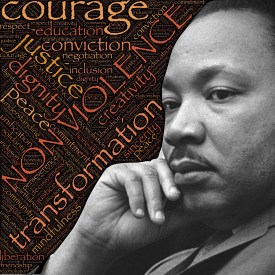
I’m also conscious of the juxtaposition of my crude title and the wisdom of Dr. King. I’m less okay with this but felt the contrast worth any shock, ambiguity, or misapprehension.

Read on, and take issue as you must or as you will.


The Bridge to Hell is Paved with Problematic Intention

Has the trumpeting of multiculturalism taken itself so literally that even individualism (… multipersonism?) is insufficient?

Taking itself, as I say, more literally, multiculturalism sets one culture at equal stature with the rest – seems fair enough – apparently, a shift in meaning from diversity to inclusion, which implies that diversity wasn’t working on account of exclusion.

So, within Culture X or Culture Y, as we might imagine an individual being equal alongside other members, we can imagine across the two cultures potential impasse: “… unresolvable conflicts between mutually exclusive viewpoints [that] dominate the political landscape” (Benson, 2020). I still grant here individual differences, but I have in mind some divide between distinct communities of individuals, i.e. a divide between cultures.

In relation to Culture Y, for example, Culture X might deem its equality mere lip-service and feel de facto unequal: “How are we in Culture X obliged to consider those in Culture Y as ‘equal’ if our culture is not equal to theirs?

Image by MetsikGarden from Pixabay

“How can we treat them as equals, much less be treated as equals, if our larger culture is not equal – that is, if Culture Y does not accept us on equal terms?” Culture Y might declare all individuals equal to begin with and counter that Culture X only perceives inequality. Yet this simply compounds the same injustice for Culture X, who will hardly waive their due consideration.

In any case, equality of cultures seems not the same thing and unable to play out to the same effect as equality of individuals – even more so since an individual who identifies with more than one culture might feel strewn across their own intersections. (Curiously, this assumes one’s identity to be chosen as much as bestowed, which echoes individualism as much as collectivism.) In fact, if equating cultures equates individuals, then equality rests further upon equity, a mantle of justice issuing from a superior authority.

Perhaps Culture Y lives by some unproblematic axiom, such as ‘might makes right’, ‘stay the course’, or even just ‘common sense’ while Culture X lives by ‘power to the people’, ‘diversity is strength’, or ‘revolution is no dinner party’. Can they bridge their divide? Is one culture responsible to reach across, as it were, halfway? We might define an obligation to come any distance according to power of authority. To be sure, imbalanced authority does seem a constant throughout history; for exactly this reason, though, would we expect the side with authority to yield?

I turn to Dr. King. In his time, a generation or two before mine, Dr. King sought and fought for equality and “the cause of peace and brotherhood,” there surely being little more equal than “a single garment of destiny” (King, 1963). As we are all, he claimed, paradoxically yet beautifully this makes us one. Standing upon the authority of centuries, of historical proclamation and practice, and there resting in long studied philosophy and lived experiences of spiritual belief, Dr. King challenged his brothers to bear witness upon themselves. Such authority remains as stable for those to come as for those preceding – that is, unless or until those to come decide to wrest authority someplace else.

Image by John Hain from Pixabay

In our time, justice supersedes civility, and restitution tinges redress. The zeitgeist these days is emotional, distinctly angry. Individuals possess rights, and cultures bear responsibilities. “The politics of identity,” Benson says, “multiply conflicts and divisions.” As we ostensibly advocate for the equality of all individuals, identity politics fights a culture war, a battle for equity across cultures-of-particular-individuals, which actually precludes a wider equity. Cultural equity has supplanted individual equality because, where there is axiomatic ‘strength in numbers’, multiculturalism can only ever be ‘us vs them’. If so, is it still defensible? Is multiculturalism a way to ensure that our outcomes match our aims? Or are the aims of those with authority forever destined to pre-empt the aims of those without it? Indeed, what is the way to ensure that no one of all will ever be marginalised?

For one final point I turn to Benson (2020), not in comparison to Dr. King but out of respect for all being one: “Only when we stop having identities in the group-defined sense can we return to being individuals” (original emphasis). We may discover too late the folly of burning a bridge-too-far while crossing it.

Washington, DC (March 2014) - Day 4 - 101

The Rhetorical Which

Should we maximise our capabilities, based on our limits?

Or maximise our limits, based on our capabilities?

As to the basic message, here, I actually don’t see too much hair-splitting. Both are aimed at action constrained by circumstance. The difference, I think a lot of people would propose, is the optimism or pessimism found between the two phrases although, even saying that, I think we blend within ourselves attitudes from both.

As for me, I feel more given to the second phrase, maximising our limits based on our capabilities, for its seeming more empirical, more driven by circumstance. Let’s take stock of our resources, and get on with it. Limits that exist will obviously present themselves as obstacles or else, well, they wouldn’t exist. And not only can those limits be reached, maybe they can even be stretched or, if not overcome, at least managed. This then becomes the task, and thank goodness for capabilities – and there’s the blending. Even empiricists have that esoteric side.

In the first phrase, similarly, something must exist – capabilities – or else they wouldn’t exist! So they must be maximisible (a word I just invented) in a way that hasn’t yet been, well, maximised. The first phrase is all about potential, what could be, if we just find a way to maximise our capabilities. Fist pump, exclamation point. In the culture I’m most familiar with, I suspect people – at least initially – would consider this first phrase a kind of optimism.

Okay, maybe not, since its basis is limitation, and that hardly sounds all warm and cozy. Still… in the first phrase, limits are a mystery to be solved, a challenge to overcome, an adventure: you can do or be anything you want, if you just believe in things. Set some goals, too, obviously – you can’t just go through life living on hope alone. Maybe I’m giving myself away; remember, I feel more given to the second phrase.

If the first phrase is optimism, the second could only be blunt, blanketing, clinical pessimism. But, like I said, I think we tend to blend, and I know I seldom feel satisfied with polarised options. So, even feeling more given to the second phrase, I won’t call myself a pessimist or even lean in that direction. And, yes, that means I won’t call myself an optimist either. Regardless, as I feel more given to the second phrase, I feel good about it for a couple reasons… relying on my capabilities means I have them and can use them, exclamation point, which means my limits can be pushed and stretched, if not overcome. Fist pump! In neither phrase is there any lack of opportunity. In fact, each leaves room for the other.

For me, optimism and pessimism aren’t found in phrasing. Sure, we can play with words and come up with ways to objectify our capabilities or our limits. We can arrange syntax a certain way and suggest some interpretations, as I’ve just been doing. But, like I said, the basic message in both phrases is simply action constrained by circumstance. Attitude, tone – these are traits, and traits we find in people. Words describe, and tools are helpful. But it’s people who do the living.

Life has got to be about the verb.

Gettin' Busy Livin'.png