Crossed Purposes

Featured Photo Credit: Jeremy Bezanger on Unsplash

Click here to read Mixed Metaphors

If learning is a kind of renovation, does that make teaching hard hats, tool belts, and construction sites?

A teacher is a person in your neighbourhood although, no, this isn’t him.
Image Credit: PNGItem

No… for me, construction is definitely the wrong metaphor for teaching. That’s probably a good thing because renovations always end up being way more work than anyone planned, and anyway, I’ve got a whole roster of students to teach.

My own notion of teaching is about persuading people. And by persuasion, I mean presenting a sincere offer.

And what, you ask, makes a sincere offer?

No, not him either.

Humility, for starters, and simplicity… I found this meaningful, so I thought I’d share it because maybe you will too. Of course, the wellspring here is trust: the learner trusts the teacher, just like a teacher needs the learner’s trust if they’re to hold sincere attention. In education yet really in any circumstance, trust is the crux of relationships.

One way to imagine relationships is two-way traffic, which animates the familiar “two-way street.” The dynamics of transit – cars and pedestrians, movement and flow through intersections and traffic lights – it’s hardly a flawless metaphor for communication, but it gets the point across.

Photo Credit: Barcelona on Unsplash

And again, what flows beneath is trust. At a pedestrian-controlled stoplight, awaiting the signal, we eventually step off the curb, relying on drivers to halt their vehicles rather than driving through and running us down. Even naming these ‘pedestrian-controlled’ stoplights is an embellishment – a deferral, perhaps, to those really favoured in the equation. But surely a pedestrian who steps off the curb commits an act of faith by abrogating whatever control they had over their safety, first, to the signal’s proper functioning, second, to the driver’s respect for signals, and third, to the driver’s responsible operation of their vehicle. For that brief moment, a pedestrian entrusts their well-being to the driver’s motives and capabilities.

Great disciplinarian, or persuasive sophist? Surely no green light is just a friendly smile
Photo Credit: Eliobed Suarez on Unsplash

Revise that sentence a bit, and pedestrians might be students with their teacher in a classroom. And if the image is neither here nor there to learning-as-renovation and constructivism, it’s still all about trust because what’s really being put to the test by the student in that sentence are the motives and capabilities of the teacher in that classroom. Somewhere along the way, a teacher fosters in a student the inclination to like or dislike, heed or dismiss, trust or distrust.

“… fosters the inclination” – I had to sit for a minute to come up with that one because I would have otherwise just said “persuade.” We can use the same word, but it can mean different things: the distinction I made about persuasion being a sincere offer… a teacher persuades, i.e. presents a sincere offer, each day, each class, each lesson. Then over time, as this happens again and again, that teacher persuades, i.e. fosters an inclination, in the student, which essentially becomes the essence of their ongoing relationship. Of course, two-way traffic is heading the other direction, too, as students foster inclinations in their teachers – there’s a post for another day because this one’s about teaching-as-persuasion.

In another classroom on another day, some teacher may have reason to teach less persuasively, not by sincere offer but by direct imperative, or whatever. Let this be since who’s so high-minded as to think they’ve figured things out for people in another classroom, and who’s so adamant as to levy their judgment upon the rest? Where’s your badge, traffic cop?

Giving the green-light, or the benediction?
Image Credit: wpclipart

And hey, I readily accede to ‘time and place’ – we all have our judgment. But as compared to telling and ordering and explaining and demanding, I’ve generally taken to communicating persuasively in my teaching because I’ve found, long-term, it helps to establish and maintain trust.

Alright then, communicating persuasively… what exactly is that? Well, for instance, I try to speak conscientiously, using a more precise vocabulary…

  • offer… instead of delivering a lesson, I offer a lesson
  • respond… as compared to answers, I offer and ask for responses
  • address… rather than solve a problem, I address an issue

Yeah, these seem kind of fluffy, but then again I usually keep all this to myself. A few more examples…

  • study rather than learn
  • meaningful as compared to effective
  • a quest instead of a journey
  • “I wonder” instead of “I think

If it all seems contrived and pretty pedantic – yes, well, it is definitely contrived. Over many years of life and teaching, I’ve begun to appreciate how the language we use not only reflects our thoughts but renovates them. If it follows from this that growth takes time and patience, then so must teaching take its time and be patient. Because sure, a word used once, today, will hardly make a difference beyond alienating yourself as a punctilious twit. But how about once today, this moment in time, every single time? On the road to becoming who we are, how becoming is a prolonged conscientious use of language?

…process… [product] …process…
…time… [careful usage] …patience
becoming… who we are …becoming

Is it ever too late to start? That might better be stated, “It’s never too late to try” because it follows that “it’s never too late to change.”

– sorry, I know, this was about teaching-as-persuasion. Didn’t mean to get existential. Don’t get me wrong, I like learning and applying philosophy to my teaching. But when I’m busy in a classroom, with all those students renovating themselves, I’m in the driver’s seat, and my own tool belt is in the backseat, and I think reaching back for it is probably distracted driving… well, it’s hardly perfect trying to map out mixed metaphors with a word processor.

One last thing… I try to phrase things positively – so, for example, rather than “Don’t do this,” which is negative, I’d say, “Avoid doing this.” Again, it seems pedantic to a fault, but strictly solely for me, it amounts to discipline, practising and setting a frame-of-mind, and I don’t usually make a show of it.

Or actually, I have made a show of it, but in a context, ‘time and place’, because yes, I agree… it’s just so much tedious pedantry when asked of others. But it’s not like I’m out correcting people everywhere I go… no, that I reserved for students, on the basis of (a) trust and (b) See (a). I even warned them each September that I was setting out to brainwash them, but benevolently, and fairly, too, since here I was letting them know in advance. Plus, by encouraging them to agree or disagree, come what may, we’d both at least have something new to think about. Dare I say a few may actually have come to understand the point by June although, to what extent or meaning, I can only leave with them to decide.

The same goes for this here… I encourage each and every one to take it or leave it as you have and as you will. If teaching is about persuasion, then that’s about trust, and we’re probably right to understand education – that is, teaching + learning – as a collaboration: as you do your part and not mine, the same goes for me, and then let’s see where that gets us.

Click here to read Common Ground
Mixed Metaphors

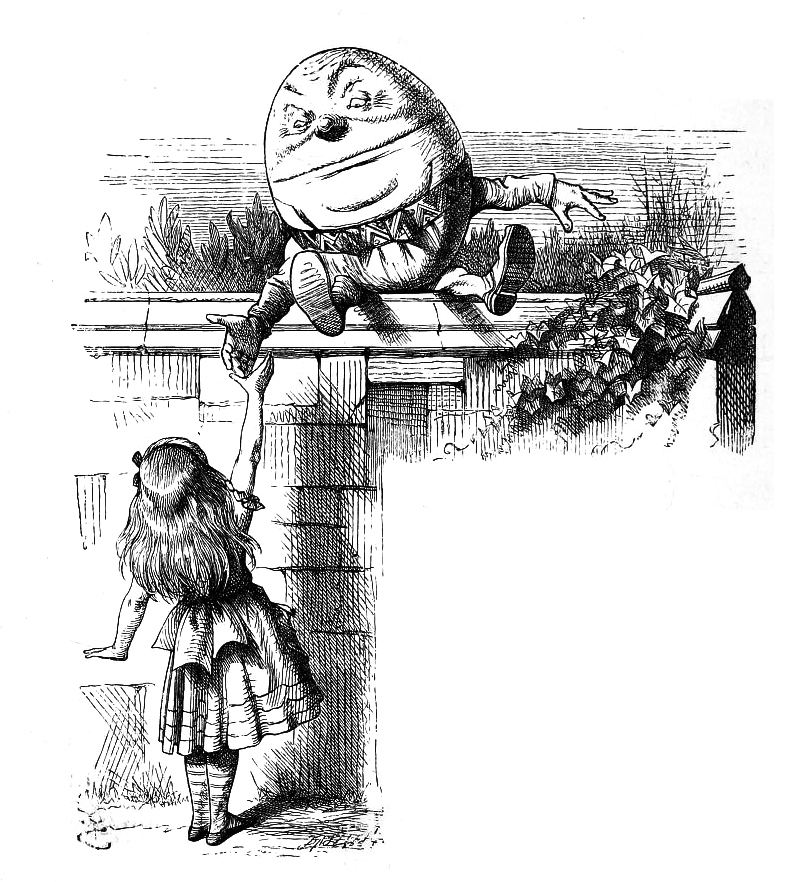
Featured Image Credit: “Humpty Dumpty from Through the Looking Glass, by John Tenniel, 1871” in the Public Domain: https://commons.wikimedia.org/w/index.php?curid=238447

Our collective world comprises interactive individuals, and upon this belief lies the basis for accepting constructivist accounts of knowledge and knowing. That our knowledge is “personally constructed, socially mediated, and inherently situated” (Clarke, 1998, p. 48) does not preclude an external reality – not for me, anyway!

My own ontological perspective seems more post-positivist: what we interpret doesnt preclude a reality that exists ‘when nobody is looking’.

Were prone to making what might better be called falsifiable statements than statements of “truth,” in such a way that our descriptions merely symbolise what we think weve interpreted. For me, bias is a fact and, as we account for it, not necessarily pejorative. We value and strive to keep an open mind precisely because we do not have an empty mind but, rather, a finite mind.

If you’re curious to learn more, Avenier and Thomas (2015) make a fascinating distinction between the epistemic assumption of pragmatic constructivism, in which inquirer and inquired are inseparably intertwined, and Guba and Lincoln’s (1989) more commonly known constructivist perspective.


For years now, I’ve wondered whether learning is a metaphorical renovation. It’s no perfect comparison – no metaphor could be – but I like renovation for suggesting that something original remains, upon which we build, and rebuild.

… plenty of work ahead, though isn’t that kind of the point?
Photo Credit: Stefan Lehner on Unsplash

As it happens, renovation suits a perspective on learning called constructivism, which regards learning as an active process by which a person integrates new experiences with what they already know. This distinction between known and new knowledge has been an avenue for critiquing constructivism’s overwhelming predominance, as has the general notion that active learners mean passive teachers, as has the nuance of what ‘active’ even means – thinking about stuff or doing stuff. Other nuances distinguish something learned from something experienced, or something internal – uniquely derived – from something external that is accepted – belatedly – as consensus.

All of this implicates haves and have-nots: access to knowledge and experience, to schools and teachers. And all of this raises more profound questions, such as whether someone’s constructed knowledge interprets a shared cultural understanding or sets their own personally valid reality. If you’d told me all of this a few years ago, my metaphor would have just said thanks and carried on none the wiser. And I suspect that’s still the case for some people, at least for those who don’t read past third paragraphs.

In case you weren’t aware… constructivism is often paired in opposition to what are called ‘traditional’ perspectives of learning – typically though not only K12 perspectives – evidently as a response to teaching deemed too instructive and knowledge deemed too intrinsic. Deemed by whom exactly? Well, given constructivism’s widespread observance nowadays, that question may have fallen away from any one’s assessment to everyone’s assent. Take me, for instance, the renovationist – surely I’m embracing the current outlook, right, even just out of convenience, if not expediency? Anyway, what self-respecting teacher even breathes traditional approaches anymore, e.g. constructivism’s lowly precursor, cognitive development, or education’s arch-nemesis, behaviourism? Surely, for teachers, constructivism is simply unquestionable common sense.

For me anyway, not sure for you, this pairing of perspectives is presented in a way that suggests an oddly false dichotomy, as if the sole alternative to the progress and change of singular constructivism is the oblivious rote bundled up in ‘traditional’ approaches: either the one or the other(s). Some teachers I know might rather say the one now is the other, the student-centred model of constructivism being no less standardized than the didactic teacher-driven system it supplants. Facing this either-or stipulation, some teachers I know might also detect no small antipathy for the traditional bundle, as if every teaching moment throughout the limitless bygone era preceding ‘today’ could only have been nothing but defective. It’s a miracle we’re even here to tell the tale– er, I mean ‘spin the narrative’– er, ‘speak your truth’. And if all these absolutes lay it on a bit thick, then I guess we agree that stark dichotomy makes for great fallacy.

OK, for good reason, I’m usually not too explicit, but just this once, let’s go:

Every person has a backstory that no one else can know completely, which means people’s lives are more complex than first glance suggests, which means an assumption made is an irresponsible leap to conclusions.

Every teacher has a unique perspective on learning because you’re not me just like I’m not you. And just like me, you apply your perspective in a classroom, at a school, with students you know better than I do.

If we’re able to grant each other a unique perspective and backstory, as any good constructivist ought to be doing, then how do we explain antipathy toward anything? The one appropriate response for a teacher would seem to be patient understanding.

Anyone in education today who’s been noticing fewer and fewer teachers learning to teach any differently, any one from another, may also have noticed that it’s all constructivism all the time, a clean sweep. Teachers today, like students of old, receive Freire-ian bank deposits to “Teach ‘this’ way – are you teaching ‘this’ way?” At the same time, these same teachers are told to “eliminate their bias,” at which point… I guess? may every unique perspective shine, as… creative? as they want to be, helping students become – wait for it – self-regulated critical thinkers. It’s irony on toast.

Back in the day, before my self-declared renovationism, teacher educators took strides to inculcate in me and my cohort a constructivist perspective on learning. It probably helped me that I teach humanities and social sciences rather than natural sciences or math although I’m pretty sure I have a post-positivist streak somewhere inside me. In any case, I’m also willing to accept [ your perspective here ] because whatever a student and teacher decide between them to suit their circumstances… just who am I to say? The most I’d offer is my two cents, and respect their place to decide responsibly for themselves.

Does hatching an idea mean thinking outside the box? Photo Credit: cottonbro on Pexels

… which, by the way, is why I avoid being explicit: I’m not out to ‘explain’ anything, plus honestly, the cryptic stuff can be fun.

As a teacher, I’ll offer, propose, opine, draw attention to particulars. Where appropriate, I’ll be a skill instructor, which is actually a principal focus across my subject areas. Skill practice can suit more direct teaching – demonstration, progression, feedback – yet even then I like questions that draw student awareness towards refining their own performance. Elsewhere, I’ve put it this way: help people make thinking a habit because we test and refine ideas by discussion and reflection, which are the purview of thinking. Thinking is the labour that helps set at least some part of an idea’s value, and good thinking is informed by knowledge, practised with discipline, and weighed by healthy scepticism.

My teaching tries to help students to learn two things: (i) that they can think, and (ii) that their own thinking is a step toward their own decision-making.

Good thinking is informed by knowledge, practised with discipline, and weighed by healthy scepticism.

… which is why, to me, the humanities and social science renovationist, all this makes ‘explain’ a four-letter word.

Explanation is deficit-based, elevating the one who knows and diminishing the one who needs. At its core, this is neither shared inquiry nor the inherent practice of thinking but an untenable decoupling of one from the other. When the aim is thinking, explanation engenders no humility on the part of either person but ego and dependency on the part of both, enabling the one’s listening to the other’s telling. All this underscores ‘student-centred constructivism’ by virtue of the trust and rapport to be found, or at least to be founded, at the core of a meaningful student-teacher relationship.

Like I said to open, well and good to label my renovation metaphor as constructivism, if it helps someone characterise my teacher’s perspective on learning. As for me, setting aside overt social philosophy and acknowledging real concern over power and authority, the one –ism I can readily associate with the kind of learning I try to stir up is egalitarianism (… still working on the metaphor). As learning necessarily means teaching, even if it’s the same person doing both, we ought to ask from the constructivist perspective on learning what we think about its associated teaching.

That thing I’ve been noticing the past how-many-years about fewer teachers learning to teach any differently, one to another… maybe it’s intentional, and constructivism was only meant for K12 learning. Maybe telling candidates ‘how to teach’ somehow better suits their learning how to teach, especially in a brief, intensely packed 11-month program. I’ve literally watched instructors tell candidates, “Not like ‘this’. Like ‘this’. Teach like ‘this’.” Still, for me, not sure for you, telling isn’t teaching, telling is telling. And teaching is teaching, and as each will have its place according to circumstance, if they meant the same thing, we’d use the same word. So if the candidate who will someday perform my surgery or land my flight needs to be told something, then somebody better damn well tell them.

To professing constructivists worldwide, but really, to anyone staking a claim: proudly wearing the t-shirt promotes the brand label. If constructivism was intended strictly for K12 learning, not teacher candidate learning… that’s something to clarify, and soon. And not just one way or the other but both ways because, until then, one outcome of telling people ‘how to teach’ will continue to be the negation of opportunity for them to learn ‘how to teach’, on their own terms in their own time in their own contexts.

Metaphorically speaking, of course… what here is the learning, and what is the teaching? Photo Credit: Stefan Lehner on Unsplash

Nearly as often, to be fair, I’ve also been noticing how-many-candidates with similar expectation: to be taught ‘how to teach’. It’s a passive perspective on learning that – no surprise – is unable to speak for itself, except maybe a little frustration: “Why do you always answer questions with a question? Why is the answer to everything ‘It depends’?” So here’s maybe another indication of people’s past experiences with teaching that takes somewhat less account of learning.

Wow, and all this from a renovationist… you won’t likely hear from anyone else that constructivism isn’t part of the landscape, a huge part – even “hegemonic,” although also “absurd” – and growing. In fact, that’s been something else to make me wonder… whether twenty years hence, enough time will have passed for an espoused perspective on learning to actually inform our teaching. By the time they’re old enough to be teacher candidates, today’s K12 students may finally have brought with them the changes we like to tell each other we’re making on their behalf.

Click here to read Crossed Purposes

The Latest Visual WHY

Click here to read the latest Visual Why

Liubov Popova, “Space-Force Construction” (1921). Oil on plywood, 64 x 60 cm. State Tretyakov Gallery Moscow, gift of George Costakis.

The story behind Eddie Van Halen’s signature guitar art is pretty well known and well documented, as far as when and how and perhaps why he did it. So when I saw this 100 year-old painting, “Space-Force Construction,” by Russian constructivist Liubov Popova, it stopped me short. And I just wondered. Maybe you’re a little taken aback, too.

Seeing this painting lead me to Tate and this article, “Aleksandr Rodchenko’s Lines of Force,” by Brandon Taylor, and I wondered a little more, then added all that wondering to the Visual WHY – you’ll need to scroll down to the Van Halen piece because I still haven’t figured out WP anchor links.


The word “text” derives from Latin, texere, meaning to weave or fit together. For me, text connotes far more than just the printed word – photography, movies, music, sculpture, architecture, the list goes on. The Visual WHY offers a specific look at paintings, texts with no less substance and arguably far more aesthetic. But underpinning the textuality of art altogether is its human endeavour. And beyond weaving something together for the sake of weaving, a weaver – an artist, a person – has a further end: communication.

Artists across all media are people with influences and motives for expressing themselves. Conjointly, texts of all kinds are also plenty human: provocative and reflective. Whether rich and symbolic for a global audience, or doodled sketches for your own amusement, art is text, and text has purpose. As we try to understand it more thoroughly, we can’t help but raise the level of discourse. Who knows, someday maybe art will save the world…

For those who’ve been wondering about the painting featured on this site’s front page, the latest Visual WHY may help explain that, too.