Assessment as Analogy

Photo by Dave Mullen on Unsplash

We teachers like to talk about teacher stuff, like assessment and curriculum. But shop talk can leave them yawning in the aisles, so sometimes I like to try using analogies. Analogies are great because, since they’re not exact, that can actually help shine more light on what your trying to understand.

Here’s an analogy: I walk into a theatre and sit down behind somebody. Seeing the back of his head, I now know what it looks like – his hairstyle, for instance, or the shape of his head. I have no idea what his face looks like since that I cannot see from behind. Something else I notice is his height – even sitting down, he’s obviously going to block my view of the screen and, since I’ve been waiting a long time to see this movie, I decide to change seats.

So I move ahead into his row. Now I sit almost beside this tall stranger, just a few seats away. Now, from the side, I can see the profile of his face – eyebrows, nose, chin. At one point, he turns to face me, looking out for his friend who went for popcorn, and I can fully take in his face. Now I know what he looks like from the front. Except it’s probably clearer to say, Now I’ve seen him from the front and remember what his face looks like – I make this distinction because it’s not like he turned to look for his friend, then stayed that way. He turned, briefly, then turned back toward the screen, facing forward again, and I’m left seeing his profile once more.

Sitting a few seats away, to say that I know what his profile looks like, side-on, or that I remember what his face looks like, just as I remember what the back of his head looks like – this is probably most accurate. In this theatre situation, nothing’s too hard to remember, anyway, since the whole experience only takes a minute or two and, besides, we’re sitting near enough to remind me of those other views, even though I can only see him from one of three perspectives at a time: either behind, or beside, or facing.

An analogy, remember? This one’s kind of dumb, I guess, but I think it gets the point across. The point I’m comparing is assessment, how we test for stuff we’ve learned.

As I understand the shift from traditional education (positivist knowledge-based curricula, teacher-led instruction, transactional testing) to what’s being called “the New Education” (constructivist student-centred curricula, self-directed students, transformational learning), I’d liken traditional testing to trying to remember what the back of his head looked like after I switched seats. As I say, I might get some clues from his profile while sitting beside him. But once I’m no longer actually sitting behind him, then all I can really do is remember. “What can you remember?” = assessment-of-learning (AoL)

In the New Education, I wouldn’t need to remember the back of his head because that’s probably not what I’d be asked. Where I sit, now, is beside him, so an assessment would account for where I sit now, beside him, not where I used to sit, behind. That makes the assessment task no longer about remembering but more in line with something immediate, something now as I sit beside him, seeing his profile, or during that moment when he turns and I fully see his face. A test might ask me to illustrate what I was thinking or how I was feeling right at that moment. “What are you thinking?” = assessment-for-learning (AfL)

There’s also assessment-as-learning (AaL), which could be me and my friend assessing each other’s reactions, say, as we both watch this tall stranger beside us. In the New Education, AaL is the most valued assessment of all because it places students into a pseudo-teaching role by getting them thinking about how and why assessment is helpful.

When proponents of the New Education talk about authentic learning and real-life problems, what I think they mean – by analogy – are those things staring us in the face. Making something meaningful of my current perspective doesn’t necessarily require me to remember something specific. I might well remember something, but that’s not the test. The New Education is all about now for the future.

In fact, both so-called traditional education and the New Education favour a perspective that gives us some direction, heading into the future: traditional education is about the past perspective, what we remember from where we were then, while the New Education is about the present perspective, what we see now from where we are now. It’s a worthy side note that, traditional and contemporary alike, education is about perspective – where we are and where we focus.

By favouring the past, assessing what we remember, the result is that traditional education implies continuation of the past into the future. Sure, it might pay lip service to the future, but that’s not as potent as what comes about from stressing remembrance of the past. Meanwhile, lying in between, the present is little more than a vehicle or conveyance for getting from back then to later on. You’re only “in the moment,” as it were, as you work to reach that next place. But this is ironic because, as we perceive living and life chronologically, we’re always in the moment, looking back to the past and ahead to the future. So it must seem like the future never arrives – pretty frustrating.

The New Education looks to the future, too, asking us to speculate or imagine from someplace we might later be. But, by favouring the present, assessing what we think and feel, and what we imagine might be, the New Education trades away the frustration of awaiting the future for a more satisfying “living in the moment.” We seem to live in a cultural era right now that really values living in the moment, living for now – whether that’s cause or effect of the New Education, I don’t know. In any case, says the New Education, the future is where we’re headed, and the present is how we’re getting there, so sit back and let’s enjoy the ride.

As it regards the past, the New Education seems to pose at least two different attitudes. First, the New Education seems to embrace the past if that past meets the criterion that it was oppressive and is now in need of restoration. Maybe this is a coincidental occurrence of cultural change and curricular change that happen to suit each other. Or maybe this is what comes of living in the moment, focusing on the here-and-now: we’re able to take stock, assess for the future, and identify things, which have long been one way, that now we feel compelled to change. Second, the New Education seems dismissive of the past. Maybe this is also because of that past oppression, or maybe it’s leftover ill will for traditional education, which is kind of the same thing. What often swings a pendulum is vilification.

Whatever it is, we ought to remember that dismissing the past dismisses our plurality – we are all always only from the past, being ever-present as we are. We can’t time-travel. We are inescapably constrained by the past from the instant we’re born. What has happened is unalterable. The future arrives, and we take it each moment by moment. To dismiss the past is delusory because the past did happen – we exist as living proof.

For all its fondness and all its regret, the past is as undeniable as the future is unavoidable, for all its expectancy and all its anxiety. As we occupy the place we are, here, with the perspective it affords us, now, we need the courage to face the future along with the discipline to contextualise the past. As we live in the moment, we are bound and beholden to all three perspectives – past, present, future. Incidentally, that happens to be where my analogy broke down. In a theatre, we can only sit in one seat at a time. Let’s count our blessings that living and learning offer so much more.

“… Whose the Forest of Them All?” See What I Did There?

Imagine somebody offers you a friendly smile, but you snarl back. What might be their next reaction? Would they be amused and take it as a friendly jibe, just typical “you”? I suppose that would depend on how well they knew you. Would they be bemused because they don’t know you so well? Really, snarling at a friendly smile…? We’re perfect strangers, for goodness’ sake! Would they be confused because they’re not from around here and just can’t reckon the response in any way?

A person’s reaction to your snarl might conceivably be anything – it depends on so many factors, and even in these three suggestions, one can find how-many-more details, nuances, and possibilities that take things further. Any “next reaction,” you might finally conclude, just depends on the person.

That response, “it depends,” is often criticised as merely wishy-washy yet, apparently, there’s an ironic ring of absoluteness to it, like the postmodern clarion call that nothing is true except for this statement. The reason I pose the scenario at all is to consider who really provides us with our sense of self. Supposing this person smiled at me… I might snarl in the first way, as a jibe, because I’m sure they’ll get the joke. But what if they don’t get it? What if this person even knows me pretty well, and they just don’t get it, not this time? Or what if they feel this just wasn’t the time for joking around? Their next reaction will depend on these and/or plenty of other factors. But again, I raise the scenario to consider how we gather – or, no no, to consider who really provides us – with our sense of self.

And there you have it, the issue: do we each gather our own sense of self, internally, or do others provide us with our sense of self, externally?

I don’t want to revert simply to the nature-nurture argument or chicken-and-the-egg. We seem inescapably bound to considering these by degree – hence, the absolutism that it depends. So, then, to consider by degree… the metaphor I have in mind is that of a mirror. Something someone does induces a response from me. Subsequently, what I provoke in that other person can tell me something more about myself, so long as I’m willing (and able?) to discern my self – myself? – from what they reflect.

Whatever next reaction of theirs follows my snarl, this other person’s reaction serves as a mirrored reflection of me, at least insofar as this other person is concerned. If they laugh at my snarl, then hey, I guess they affirm me as a friend with an appropriate sense of humour; the jibe is appreciated, and maybe we’re even a little closer friends than before. Their positive reaction is my feedback, like looking at myself in a mirror, and my sense of self is in some way provoked on account of them by what they reflect.

I suppose there’s room to discuss a lack of empathy, here, even sociopathic behaviour – these seem also to be part of that endless list of details, nuances, and possibilities. But in acknowledging them, let’s leave them for another day.

If my snarl induces a frown from the other person, or some kind of puzzlement or disapproval, then what they affirm for me is less friendly or wonderful, yet may be just as clear – maybe they snarl back, even more fiercely, or maybe they stomp away with clenched fists. Maybe now I feel worried, in which case my sense of self could suffer from insecurity or dismay – oh dear, they didn’t get the joke! Or maybe they are saddened, and I feel smug – take that, you deserve it – or hostile – get lost, I never liked you anyway – which reinforces my sense of superiority, some kind of self-importance.

The list of possibilities goes on – it depends – but, in any case, I’m able to find myself reaffirmed by that other person’s reaction. I’m “able to” because my snarl clearly exposes my stake in how this other person influences the way I consider my sense of self: why would I even take notice of them in the first place, much less snarl, much less take concern of their next reaction, if they meant nothing to me? The point is that the other person’s reaction provides me a measure, a reason, a reflection by which to gauge my self as myself. Basically, thank you, because I couldn’t do it without you and everybody else, and you’re welcome because neither could you without me, or everybody else.

Now, pretend there are no other people – you, alone, exist as the sole human being. You happen to be walking through a grove of birch trees, say, obviously getting no reactions as we’ve just considered about smiles and snarls.

But as the wind whishes by, fluttering leaves and swaying branches, you take in the world around you with a relative means of judgment that wades through various combinations of reactors provoking reactions from reactees: Are the trees reacting to me? Is the wind reacting to me, or the trees to the wind? and so forth. You can see all sorts of things happening, but how can you be sure what provokes or reflects what else? Some songbirds are flitting about, high up in the branches: Are they chirping at me? You might not even call them “song” birds (that is, if you even had language – what need for language, really, as one sole person?) For all we know, the birds would actually scare you, and you might rightly call them “scarebirds” or something – in this pretend scenario, with you the sole human being, we’re also pretending that you know nothing in the way of biology or flora or fauna. Those are ways of understanding the world developed in the real life community of human beings, not in some pretend scenario of solo existence.

In that land of pretend, after weeks of sunshine, what might be your sense of self on the day it rained, or on the day the leaves yellowed and fell to the ground in heavier, colder winds? Would you even be considering your “self” apart from the entirety of what surrounds you? Here we are, again, at nature-nurture, only this time you might conceivably consider the two in synthesis: not as separately discrete influences – there is nature, and there is nurture – but as one-and-the-same, naturenurture, thereby placing you into the world of existence as part-of-a-greater-whole. Your sense of self could conceivably be more cosmic, in that literal sense of orderliness, and more holistic, in that sense of connectedness.

To mix metaphors, you might feel a mere cog in the wheel, a mere wheel of the gears, yet entirely necessary, just the same. Or how about this: I wonder how imperative my right hand feels, as compared to my left, when I write with a pen, but they’re both pretty important when I play golf.

We can conceivably warrant our selves to ourselves, but – as we step back into the land of real life and other people – we cannot live in total oblivion of the people around us. I grant the possibility of living within ourselves as our selves, which renders the responses and reactions of any one, with others alongside, as little more than colliding self-interests. Still, though… that other people can authorize our sense of self – your sense, my sense – seems as inescapable, as definite, as did nature-nurture or chicken-and-the-egg.

In this little thought experiment, I’ve been wondering whether we each sense our self as reflective of the reactions we induce. How much do we incorporate the feedback we get after snarling at a friendly smile? Do we see that other person as though staring at ourselves in a mirror? And, if so, does that mean we’re each of us necessarily, essentially, and thereby compellingly part of a greater whole… like trees of a forest, or cogs in a wheel, or limbs to a body?

Maybe it’s only an issue because we’re able to raise such questions, to begin with.

A Kind of Certainty: III. A Scripture of Truth

Click here to read Pt II. Curriculum, or What You Will


A Kind of Certainty

III. A Scripture of Truth

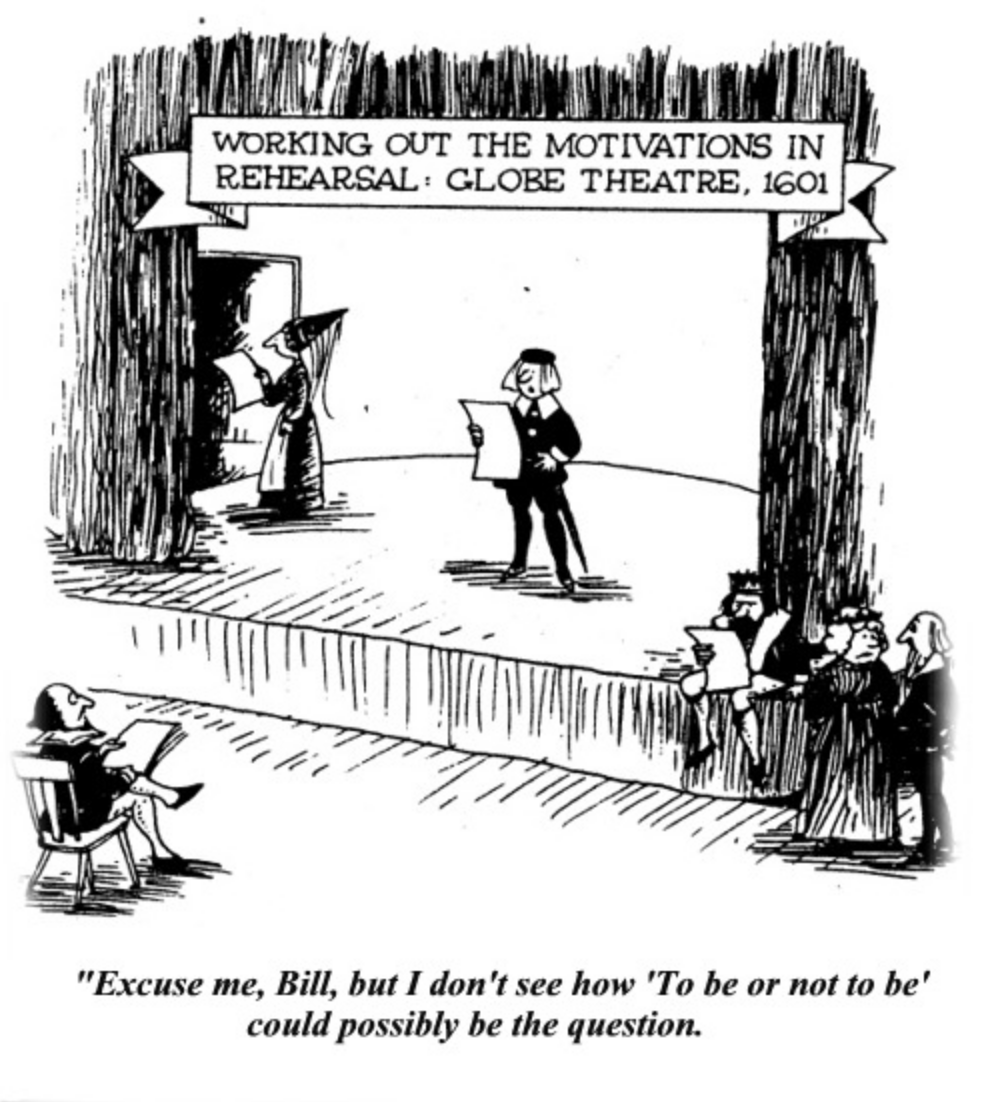
Motive is the key, I would suggest to students: to know motive is to know the truth. And I offered this suggestion knowing full-well the timeworn joke about the actor who asks, “What’s my motivation?” Whats the Motivation Just as we can never cover it all and must go with whatever we decide to include, we also cannot (nor should not) try to present it all, ask it all, or attempt it all in one go. Yes, the odd non sequitur can break the monotony – everyone needs a laugh, now and then. But as with all clever comedy, timing is everything, and curriculum is about more than good humour and bad logic. In that regard, given what has already been said about spotting pertinence, curriculum is about motives: to include, or not to include.

And we must try to comprehend this decision from more than one perspective; each in their own way, both teacher and student ponder what to include and what to disregard during any given lesson: “Teachers are problem-posing, not just in the obvious sense that they require students to doubt whether they know something… [but] implicitly [asking] them to question their understanding of what counts as knowledge” (Beckett, 2013, p. 54-55). People generally will not doubt themselves without good reason, or else with a lot of faith in whoever is asking. Challenged to reconstruct or reorganise an experience (Dewey, 1916), more than likely we will want to know why. Curriculum addresses ‘why’.

Why! take Hamlet, for instance… deigning to know a little something about role-playing, he offers some curricular particulars while lecturing the Players ahead of the Mousetrap performance, although really this is to say Shakespeare offered them. Writers famously cringe as rehearsing actors and directors dismember their carefully worked dialogue – or is that another hackneyed joke? In any case, Shakespeare opens Act 3 with some forty lines of advice from Hamlet to the Players, whose replies are little beyond short and polite (although ‘why’ has evidently been left for you and your theatre company to ascertain). These follow some forty lines in Act 2 during an exchange between Hamlet and Rosencrantz about theatre companies, all of which could simply be played as a dose of comic relief amidst the far “weightier matters” of the play (Guyton, 2013). Tried another way, Hamlet’s lines about acting embody the very perplexity of his prolonged tumult: he takes for granted that his listener will attempt to reconcile what he says with whatever uncertainty they might have. What better job description, a “teacher”? Otherwise, why even bother to open his mouth?

What need to teach when we trust that we are all alike, that all around is 100% certain? As it pertains to telling the Players about acting, Hamlet wants no assurance that his audience must bridge some gap of certainty over his trustworthiness, not so far as he is concerned.[1] Indeed, common to live productions that I have watched, he is as relaxed and certain in offering his advice as the Players are in hearing it, like preaching to the choir.[2] Their relationship, apparently going back some time, suggests mutual respect and a shared faith not merely to listen but to understand in listening. It suggests a kind of shared attunement, something mutual, like a kind of curriculum founded upon trust. For all we might want to trust those around us, for all we might want some certainty that we are respected by others – or, perhaps more so, that we are believed – what a torment life would be if our every utterance were considered a lie. Then the only certainty would be the assurance that no one ever believed you, and if that still counts for something, it is dreadfully cold comfort.[3]

We citizens of 21st century post-modernist [ your label here ] North America may not have descended nearly so low although Klein (2014) does presciently discuss politics, the national discourse, and an observed decline in public intellectualism (Byers, 2014; Coates, 2014; Herman, 2017; Mishra & Gregory, 2015). Where Klein encompasses individuals and the processes, systems, and institutions that they innervate while going about their daily lives, he describes Dewey’s “conjoint communicated experience” (Dewey, 1916, p. 101) and implicates “an extraordinarily complicated conversation” (Pinar, Reynolds, Slattery & Taubman, 2006, p. 848), one that occurs everyday and includes everybody.

But since we are forbidden to compel but only persuade the beliefs of free thinkers, we realise that all our perceived uncertainty can only be bridged by a kind of faith: we depend either upon others to see things as we do, or else we depend upon our rhetorical skill to persuade them toward our way. Or we live tense lives full of disagreement and antipathy. ’Swounds, but life would be a lot more stable and certain if we all just believed the same things!

Hamlet craves certainty, to the point where the dilemma of his doubt halts him so dead in his tracks that he is prompted to question existence itself. Where it comes to enacting vengeance – but, really, where it comes to everything we witness in the play – Hamlet – and, really, every character[4] – craves certainty and assurance while suffering from uncertainty and reluctance, which means, of course, that he craves and suffers from both ends. Indeed, a piece of him is certain. But comprising “one part wisdom and ever three parts coward” (4.4.42-43), he wages an unequal battle against himself. He wanders from room to room searching to free himself from his purgatorial tesseract, challenged not simply by one retrograde faith but by several, the consequence of conveying curriculum from Wittenberg back to Elsinore where, previously, he had received, to say the least, an impressionable upbringing. The upshot, given the conflicting decisions he faces, is that Hamlet would rather renounce any mutual faith of any sort and rely upon a certainty all his own: himself.

Yet he even doubts his ability to self-persuade, just as he holds no faith in anyone whose judgment he fears. As a result, he is rightly miserable and lives an exaggerated moment-to-moment existence, “…enraptured with, submerged in, the present, no longer a moment in but a suspension of time, absorbed by – fused with – the images in front of [his] face, oblivious to what might be beyond [him]” (Pinar, 2017, p. 12). Pinar describes a kairos moment of chronos time, as if Cecelia, while watching The Purple Rose of Cairo (Greenhut & Allen, 1985), could press ‘Pause’. He may not have been Woody Allen’s modernist contemporary, but Shakespeare still appeared to possess enough prescience to machinate a rather, shall we say, enlightened viewpoint; many consider The Tragedy of Hamlet, Prince of Denmark to be the Magnum Opus of English literature, not just Shakespeare. Evidently, he knew exactly how to craft such a rich and roundly individuated protagonist, one certain enough to persist for over 400 years. Certainty the Bard found within himself, and this he bestowed (albeit perversely) upon Prince Hamlet, who “[knows] not seems” (1.2.76). Faith he found within himself, too, but that he saved for his audience, trusting them, freeing them, to spot it as the time was right, rendering what they will get unto those who will get it.

By the same token, may the rest get whatever they will get. As far as curriculum is concerned, one size has never fit all, nor should it ever be so.

Click here for the Bibliography

Click here to read Pt IV. A Kind of Faith


Endnotes

[1] I always suspected a handful of my students were just humoring me – have I mentioned they were brilliant?

[2] Sometimes, these lines have even been cut, to help shorten the play from its typical four-hour length.

[3] Elsinore seems just such a place. But they are wise who “… give it welcome” (1.5.165) since at least, then, you can get on with functioning, knowing where you stand relative to all the other prevaricating liars and weasels who inhabit the place alongside you.

[4] Every character, that is, with the possible exceptions of the Gravedigger, who apparently is most cheerful and self-assured, and Fortinbras, who suffers perhaps not pains of doubt so much as loss, and then always with something up his sleeve. I might also include Horatio in this reflection, but I fear, then, the need for an endnote to the endnotes, to do him any justice.