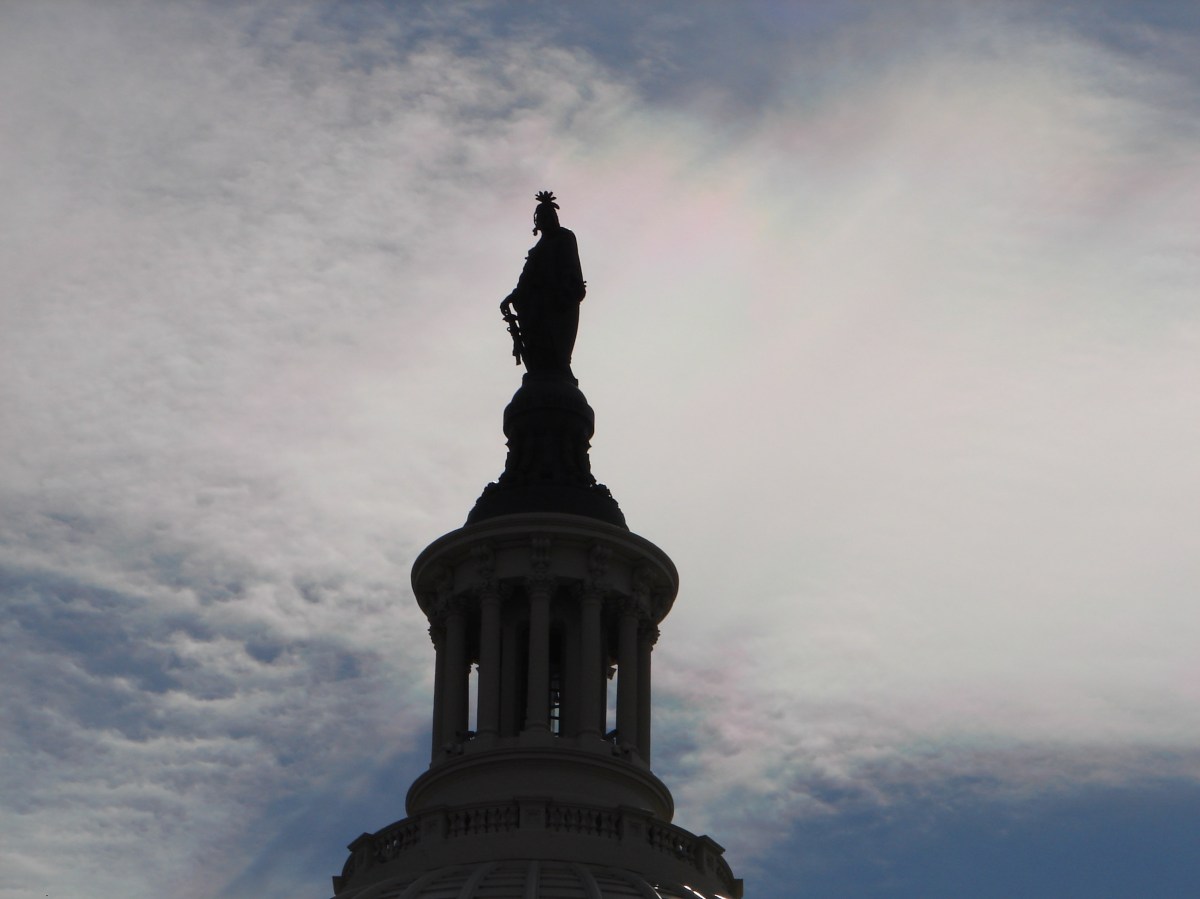
About the Featured Image: At 19’5” tall and 15,000 lbs, the bronze statue named Freedom, set atop the Capitol Dome in Washington DC, was created by architect Thomas Walter, sculptor Thomas Crawford, sculptor Clark Mills, and master craftsman Philip Reid, four men who well represent both a complex history and complicated symbolism.
I. The Free Speakers of Speech
“Strands in the Web of Freedom”
“I think what we’re learning is that, particularly when they get a choice, a lot of people decide to believe what’s more comfortable for them, even if it’s not the truth.”
– Ellis Cose
Before anyone starts rating Ellis Cose’s statement, “whereby phrases are made to do service for critical analysis by being turned into dogma” wielded against whomever they oppose… just stop and consider instead, against “the impregnating atmosphere of the times,” how neutrally this statement applies to anyone at all who might hold any position. Consider how anyone we oppose may wield this statement against us just as righteously as we may characterise it by using them.
There’s wisdom in this statement by journalist Ellis Cose, and an informed perspective that directs my attention toward a truer opponent facing all of us, which is to say all of us. It’s not so much a person, this opponent, but a tendency – a rather drastic tendency we have to skew our perspectives toward one outlook, one interpretation, one ‘side’ of… well, whatever we face.
[NB: what I call a ‘side’ can be populous or solitary. I’ve presented ‘side’ in single quotes because I know it’s a word loaded with partisan and polar connotations, none of which I want to suggest – not overtly, at least – besides which, I haven’t been able to decide on a more suitable word.]
This tendency is common of us. I’ve often maintained that we all land somewhere, starting with birth. As such, bias is inescapable and, as such, not pejorative but only descriptive. So, what to do about bias… ? Rather, what to do with bias. And how to do it.
The remark above Cose offers during an interview with Bill Moyers, in the context of considering free speech – specifically, its demise. In his recent book, Cose points out an overarching presumption about free speech – from a Supreme Court Judge, no less, Justice Louis Brandeis – a presumption that, ever since, has evidently grown roots:
“As Brandeis saw it, free speech was virtually a sacred right and an awesomely powerful force that would expose ‘falsehood and fallacies’ and ‘avert… evil by the processes of education.’ Hence, the remedy to bad speech was ‘more speech, not enforced silence.’

“That piece of writing has been deemed one of the most important commentaries ever crafted on the First Amendment. But Brandeis assumed something that has not been borne out by facts, which is that the better argument would generally win. He also assumed that relevant people on all sides of a question were equally capable of being heard and that skeptics were interested in listening.

“That fallacy continues to inform the thinking of those who see speech as inherently self-correcting.”

In this quotation, Cose gives me pause to stop and consider that the First Amendment – really any part of the U.S. Constitution – may have been written with a presumption that “people are basically rational and skilled in recognizing the better argument when they hear it,” or a presumption that “dialogue is dominated by real people with an interest in ideas, not by corporations and wealthy individuals hiding behind PACs and other creations, using trickery, appeals to base prejudice, and outright lies to gather gullible people to their side in the interest of commerce.” With such words, Cose gives me pause to wonder about some taken-for-granted assurance that tells itself, Well, of course anyone who reads this will understand what I mean because anyone who reads this will be just like me… We’re not just ready-made logical creatures. We’re susceptible to emotion and passion, and blind spots and presumption, which must be recognised before reasoned.
As I stop and consider all that… I consider myself. When I write posts for this blog and exercise my free speech with the ease of a mouse click, what is my thinking? I take such pains to write clearly, go such lengths to research thoroughly, in consideration of an audience that I’m largely unable to predict: a published blog post is a public blog post, and a reputation is as clean and thin and delicate as tissue paper. Yet I know I’ve been guilty of presuming a reasonable audience – you’re welcome? or my bad? The one question that can sum all my anxiety might simply be this: whose voice am I leaving out? It’s a version of a question I often asked my students, albeit in different context: whose voice is missing?
Maybe all this seems tangential to my initial idea: being prompted by Ellis Cose to write about free speech. Still, I can’t help but think, and feel, all this belongs.
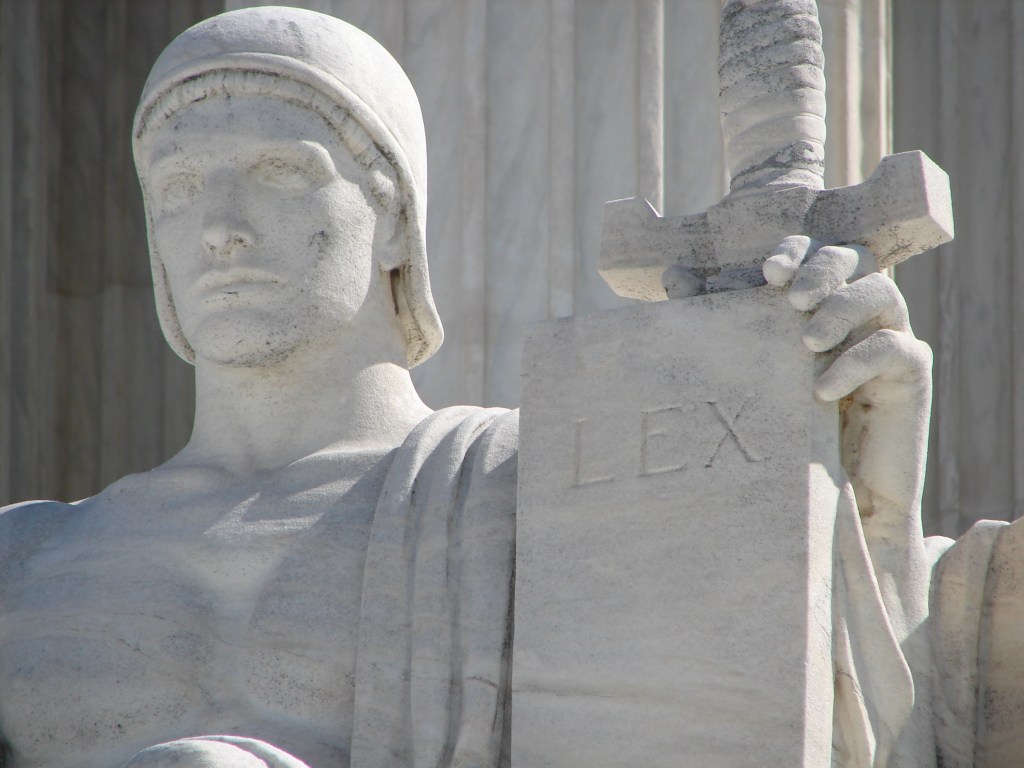
I agree with Cose, once more from his book, that “… the society [Brandeis] envisioned has never existed.” With hindsight to his vision, I see in Justice Brandeis’s statement something he likely didn’t mean: his vision of society, for me, is a bit like the statues and sculptures that adorn and accompany buildings all over Washington, DC… we recognise their symbolism, we (allegedly) aspire to what they represent, and by their very placement (and I don’t mean to invoke idolatry), we sort of revere them. They represent not a world we believe is possible but a way we can imagine it – a world we would prefer to see, at the risk of misapplying Northrop Frye. For a given statue or sculpture, such reverence implicates what any one person values, which of course has become the subject of recent concern, weighing historical brutality against present-day redress. Moreover, if we aspire to the symbolic idea, somehow knowing it is unattainable, that becomes something very different than aspiring to it because we actually think it’s within our power to create. My broader point here is simply to note the analogy, a presumption imagined like an audience taken for granted, presuming ideas about people, as Justice Brandeis apparently did, or presuming an outlook held by an audience that, of course, is just like me.
Coming back to relate all this to free speech… when someone declares “[whatever]” in their exercise of free speech, they conceivably make no direct presumption about you or me or anybody, perhaps beyond their own self-centredness: “You have to listen to me because I have my right to free speech.” Conversely, that speaker may presume or flat-out know something about their audience, by which they’re able to push buttons, raise hackles, inspire applause, or generally incite some calculated reaction. Elementary though it sounds, what a speaker presumes when exercising free speech is simply and plainly that they have an audience – indeed, what need otherwise to qualify “free” speech? Ultimately, it’s this connection to audience that I will try to consider about free speech.
First, though, I should clarify – however broadly – that the corollary to a speaker is a listener, i.e. if you’re not speaking, then consider yourself part of the audience. Naturally, we have to be exposed somehow to the speaker, in person or by way of some recording or text. Maybe these are punctilious distinctions, but they seem necessary for what comes next.
What I tend to notice when I hear people invoking “free speech” may also seem elementary: it’s only invoked when an audience doesn’t want to hear it. This is so obvious yet so crucial to appreciate because within lies a difference as to what free speech even means: to the speaker, as I’ve described, it amounts to listen to me, but to the audience, it refers more to the anticipated outcomes or effects of speech yet-to-come. This is not to say a speaker has no aims, but rather to say a speaker has a more immediate concern, i.e. being heard, i.e. being allowed to speak, as in “free” to speak. Meanwhile, the audience also has an aim although I can’t decide which side of the coin: to not hear, i.e. to not listen, or to not hear, i.e. to silence the speaker – hence, as I say above, the need to qualify free speech from any other kind.
What I’ve come to notice about an audience in disagreement seems more to be the option for silencing the speaker, maybe because outcomes can’t happen when speech is pre-empted. I get that, an ounce of prevention, maybe well justified in some cases – yet there, now… I’ve just done it too, approving (if not opting) to silence the speaker. In addressing free speech, is the audience obliged to consider a message in some way apart from the speaker? “Apart” from the speaker seems problematic since no speech can occur without a speaker.
As speech is the catalyst or cause of certain outcomes, if and when it’s spoken, so speech itself is a consequence of something learned – a reflection of the speaker – which seems to return this to an issue of bias; I might alternatively call this bias an “education” or a “belief” but, in any case, it’s something more individual or personal. Again, in the ways we might consider the cause or catalyst of speech, these remain inherent to the speaker. Okay, then what of the speaker?
There does exist today an overriding culture of the individual, of discounting convention, of not merely being but embracing “yourself.” And there does exist today a self-orientation that values personalised education, and critical thinking, and questioning and problematizing how and why the way things are. These are briefly some general details that bear at least some influence upon speakers today.
Okay, what of these details? For one thing, such a self-orientation only goes so far: take the school principal, boasting and flaunting empowered students and their critical thinking, that is until the students think something critical about how and why the way things are at school. “After all,” the students say, “you teach us to be critical thinkers.” What goes around may eventually come around, though not always without a struggle (… and maybe some parental involvement!)
To be fair, some initial resistance to such critical thinking-slash-questioning is hardly surprising, from any perspective. But given our own tendency to root perspectives in one-place for longer stretches of time, maybe the rest of us are wise to remember Socrates for being unique: his no-place was his place, an ironic kind of certainty, which is a bit of clever word-play. Where he seemed to land was “no place in particular” beyond perhaps “here, for long enough to ask some questions.”
Of course, it was also this freedom, taken to questioning things, that eventually helped to estrange the community from Socrates – which is also a bit of clever word-play – finally at the cost of his life. In our culture, which venerates the individual, maybe we should be thankful for slightly less orthodox individuality – we should be thankful for bias (instead of trying so hard to ‘eliminate’ it). Talk about integrity. Alternatively, imagine that world ruled by Socratic ignorance – free speech everywhere and many an ear to listen, just none finally willing to believe – how much worse, in that world, if might made right.
Individual rights, by definition, only make sense within a community, which was my cause to raise bias, which I likened to education though maybe I’d better call it “learning” – a post for another day. But more than this, more nuanced, is that individual rights only make sense as a community. If they cannot be shared, and respected, mutually, and tolerated, they can only come to a head. As to free speech… per se it remains only a concept because it is people who enact it, as speech – people make the concept felt. People ultimately make “free speech” something manifestly real; sometimes, especially lately, I feel like we don’t seem to get this, as if we view ourselves actually having the same idealistic glow as our ideologies. That would be fine if we all shared the same ideology.
Sometimes I feel like we view ourselves actually having the same idealistic glow as our ideologies. That would be fine if we all shared the same ideology.
A final word on bias-slash-education-slash-learning, paraphrasing my previous blog post… are lessons designed for a teacher to teach, or for a learner to learn? Or is it some mixture of both? If we’ve all been to school, even so, numerous learners still comprise an education system, just not all at once – this we end up calling “culture.” So how can education ever be singular, as in “personalised,” as in an education for you while another, separately, for me? How, that is, unless you want all sorts of cultures all walking around bumping into each other at every turn, and I don’t mean a “diversity-as-strength” kind of way because that still implies some rule of law conformity. I mean anarchy.
We all learn, yes, but being educated is a collective trait, found somewhere at once in between all learners and their teachers and anyone else involved. So, as to free speech… once somebody communicates via real speech, another listens and reflects, maybe responds, and somehow, somewhere in between them, occurs an understanding. If that understanding is “I don’t understand you,” well, at least your work is cut out for you.
If the catalysts and causes of someone’s speech are an issue of bias, then outcomes and effects seem an issue of endurance or, as the case may be, a lack of it – as Cose puts it, what’s “comfortable.” Unlike the so-called individualism of education and the extent one decides for oneself – so-called rights – I would argue that endurance is borne more widely, if not entirely, of culture and conscience, the degree we each conform irrespective of ourselves… would these be responsibilities or infringements? How would any dyed-in-the-wool individualist answer that? I think I know (… see what I did there?).
From having considered in some way the free speaker, I’ve ventured into the audience, whose ears may or may not be so permissive. Yes, it’s people who speak – it’s also people who listen, and both of these always from some position of bias: if we hope to address any concern arising over free speech, start with bias – or, as I referred to it above, education learning. Yes, education has its own raft of issues, but it’s still probably better to address causes over outcomes, if the aim is to restore our health.
Click here to read Pt. II The Speech of Free Speakers – “A Delusion of Certitude”?


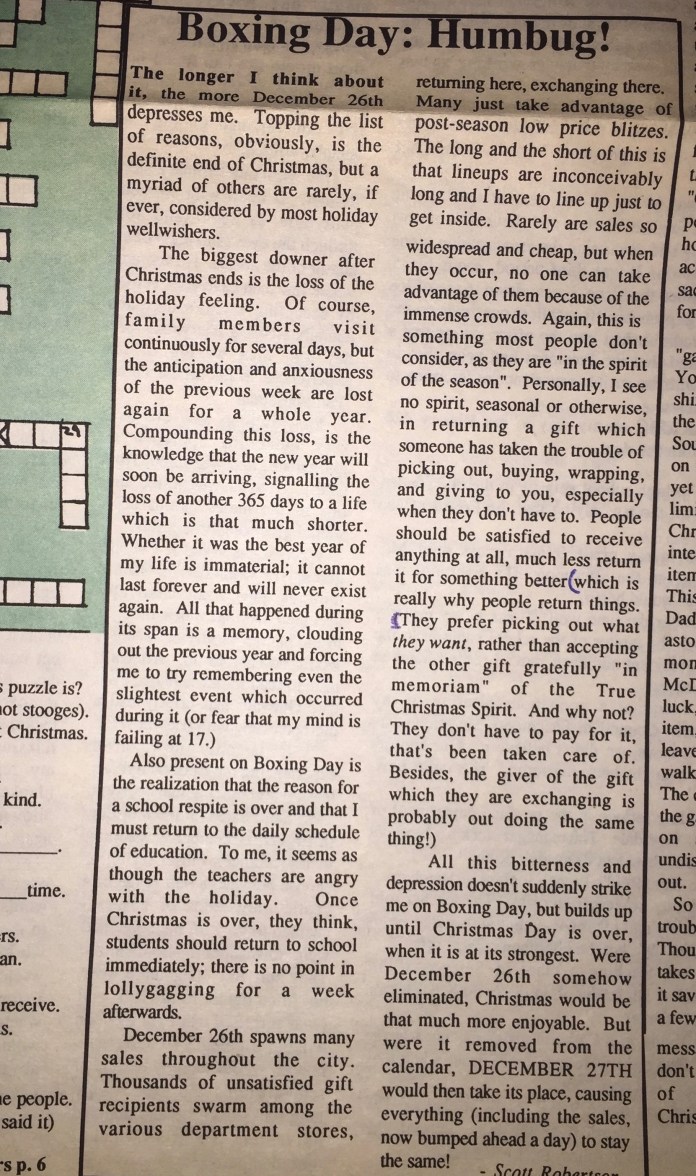 The first was a few months before, this Boxing Day editorial for the December edition, although officially my class hadn’t switched over yet – you either went from Journalism to Creative Writing in January, or you were vice-versa like us. Admittedly, neither piece is rocket science, much less brain surgery, but hey, every piece does more than just fill its own space in the puzzle. A curiosity, like I said.
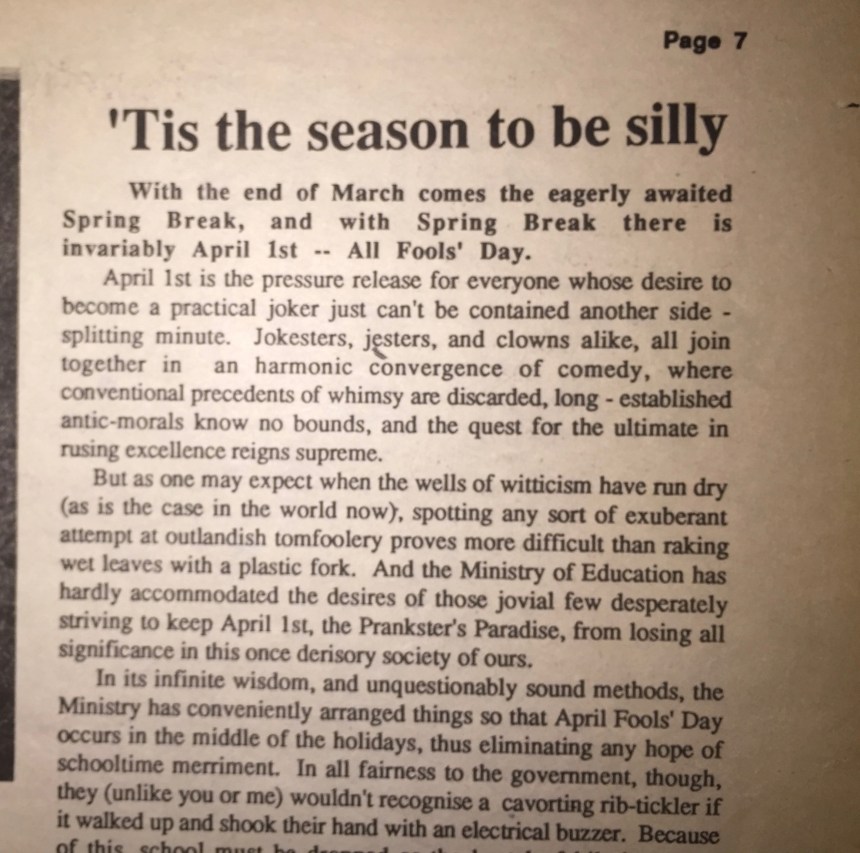 exuberant attempt at outlandish tomfoolery proves more difficult than raking wet leaves with a plastic fork. And the Ministry of Education has hardly accommodated the desires of those jovial few desperately striving to keep April 1st, the Prankster’s Paradise, from losing all significance in this once derisory society of ours.