“… Whose the Forest of Them All?” See What I Did There?

Imagine somebody offers you a friendly smile, but you snarl back. What might be their next reaction? Would they be amused and take it as a friendly jibe, just typical “you”? I suppose that would depend on how well they knew you. Would they be bemused because they don’t know you so well? Really, snarling at a friendly smile…? We’re perfect strangers, for goodness’ sake! Would they be confused because they’re not from around here and just can’t reckon the response in any way?

A person’s reaction to your snarl might conceivably be anything – it depends on so many factors, and even in these three suggestions, one can find how-many-more details, nuances, and possibilities that take things further. Any “next reaction,” you might finally conclude, just depends on the person.

That response, “it depends,” is often criticised as merely wishy-washy yet, apparently, there’s an ironic ring of absoluteness to it, like the postmodern clarion call that nothing is true except for this statement. The reason I pose the scenario at all is to consider who really provides us with our sense of self. Supposing this person smiled at me… I might snarl in the first way, as a jibe, because I’m sure they’ll get the joke. But what if they don’t get it? What if this person even knows me pretty well, and they just don’t get it, not this time? Or what if they feel this just wasn’t the time for joking around? Their next reaction will depend on these and/or plenty of other factors. But again, I raise the scenario to consider how we gather – or, no no, to consider who really provides us – with our sense of self.

And there you have it, the issue: do we each gather our own sense of self, internally, or do others provide us with our sense of self, externally?

I don’t want to revert simply to the nature-nurture argument or chicken-and-the-egg. We seem inescapably bound to considering these by degree – hence, the absolutism that it depends. So, then, to consider by degree… the metaphor I have in mind is that of a mirror. Something someone does induces a response from me. Subsequently, what I provoke in that other person can tell me something more about myself, so long as I’m willing (and able?) to discern my self – myself? – from what they reflect.

Whatever next reaction of theirs follows my snarl, this other person’s reaction serves as a mirrored reflection of me, at least insofar as this other person is concerned. If they laugh at my snarl, then hey, I guess they affirm me as a friend with an appropriate sense of humour; the jibe is appreciated, and maybe we’re even a little closer friends than before. Their positive reaction is my feedback, like looking at myself in a mirror, and my sense of self is in some way provoked on account of them by what they reflect.

I suppose there’s room to discuss a lack of empathy, here, even sociopathic behaviour – these seem also to be part of that endless list of details, nuances, and possibilities. But in acknowledging them, let’s leave them for another day.

If my snarl induces a frown from the other person, or some kind of puzzlement or disapproval, then what they affirm for me is less friendly or wonderful, yet may be just as clear – maybe they snarl back, even more fiercely, or maybe they stomp away with clenched fists. Maybe now I feel worried, in which case my sense of self could suffer from insecurity or dismay – oh dear, they didn’t get the joke! Or maybe they are saddened, and I feel smug – take that, you deserve it – or hostile – get lost, I never liked you anyway – which reinforces my sense of superiority, some kind of self-importance.

The list of possibilities goes on – it depends – but, in any case, I’m able to find myself reaffirmed by that other person’s reaction. I’m “able to” because my snarl clearly exposes my stake in how this other person influences the way I consider my sense of self: why would I even take notice of them in the first place, much less snarl, much less take concern of their next reaction, if they meant nothing to me? The point is that the other person’s reaction provides me a measure, a reason, a reflection by which to gauge my self as myself. Basically, thank you, because I couldn’t do it without you and everybody else, and you’re welcome because neither could you without me, or everybody else.

Now, pretend there are no other people – you, alone, exist as the sole human being. You happen to be walking through, say, a grove of birch trees, obviously getting no reactions as we’ve just considered about smiles and snarls.

But as the wind whishes by, fluttering leaves and swaying branches, you take in the world around you with a relative means of judgment that wades through various combinations of reactors provoking reactions from reactees: Are the trees reacting to me? Is the wind reacting to me, or the trees to the wind? and so forth. You can see all sorts of things happening, but how can you be sure what provokes or reflects what else? Some songbirds are flitting about, high up in the branches: Are they chirping at me? You might not even call them “song” birds (that is, if you even had language – what need for language, really, as one sole person?) For all we know, the birds would actually scare you, and you might rightly call them “scarebirds” or something – in this pretend scenario, with you the sole human being, we’re also pretending that you know nothing in the way of biology or flora or fauna. Those are ways of understanding the world developed in the real life community of human beings, not in some pretend scenario of solo existence.

In that land of pretend, after weeks of sunshine, what might be your sense of self on the day it rained, or on the day the leaves yellowed and fell to the ground in heavier, colder winds? Would you even be considering your “self” apart from the entirety of what surrounds you? Here we are, again, at nature-nurture, only this time you might conceivably consider the two in synthesis: not as separately discrete influences – there is nature, and there is nurture – but as one-and-the-same, naturenurture, thereby placing you into the world of existence as part-of-a-greater-whole. Your sense of self could conceivably be more cosmic, in that literal sense of orderliness, and more holistic, in that sense of connectedness.

To mix metaphors, you might feel a mere cog in the wheel, a mere wheel of the gears, yet entirely necessary, just the same. Or how about this: I wonder how imperative my right hand feels, as compared to my left, when I write with a pen, but they’re both pretty important when I play golf.

We can conceivably warrant our selves to ourselves, but – as we step back into the land of real life and other people – we cannot live in total oblivion of the people around us. I grant the possibility of living within ourselves as our selves, which renders the responses and reactions of any one, with others alongside, as little more than colliding self-interests. Still, though… that other people can authorize our sense of self – your sense, my sense – seems as inescapable, as definite, as did nature-nurture or chicken-and-the-egg.

In this little thought experiment, I’ve been wondering whether we each sense our self as reflective of the reactions we induce. How much do we incorporate the feedback we get after snarling at a friendly smile? Do we see that other person as though staring at ourselves in a mirror? And, if so, does that mean we’re each of us necessarily, essentially, and thereby compellingly part of a greater whole… like trees of a forest, or cogs in a wheel, or limbs to a body?

Maybe it’s only an issue because we’re able to raise such questions, to begin with.
Teaching’s Other Greatest Reward

“Texts are not the curriculum,” I was told during Pro-D by an administrator, the Director of Curriculum and Innovation. The session had been arranged to introduce a revised K–12 curriculum and was billed as a great unfolding at the onset of the 21st century. “Texts are a resource for implementing lessons and practising skills,” she concluded. By this, I took her to mean that notation, for example, is a resource for students to finger piano keys or pluck guitar strings, which is something music teachers might accept. I took her to mean that landscape is fodder for brushstrokes and blending, something art teachers might accept. I took her to mean that a poet’s intimate, inspired reveries, shared in careful verse, is raw material for students who are learning to analyse and write, which I grant English teachers might accept. I took her to mean that I should consider her remark a resource and that this issue was now settled, which some teachers in earshot seemed to accept. To this day, I wonder whether a musician, or a painter, or a poet might accept her remark, but in that moment, I let it go.

I suppose I should be more forthcoming: I used to joke with parents, on Meet the Teacher Night, that I could be teaching my coursework just as well using texts like Curious George and a recipe book. That I decided to use Shakespeare, or Sandra Cisneros, or Thomas King, and that I would in fact be asking students literally to stare out the window as part of a textual analysis exercise—all just as arbitrary—illustrated the point: I built my course around some particular themes that reflected me and what I believed important about life. This, in turn, was meant to illustrate to students, and now parents, how bias plays a noteworthy if subtly influential role in our lives and our learning.

My larger points were twofold: firstly, no, texts are not the curriculum per se and, secondly, our Department’s approach to English Language Arts (ELA) focused more on skill development, less on content consumption. For us, anyway, the revised curriculum was reaffirming. What I merely assumed in all this—and presumed that parents assumed it, too—was that our Department’s approach was commensurate with the school’s expectations, and the Ministry’s, as well as with our province’s educational history and the general ELA approach found in classrooms across North America, for which I had some albeit minimal evidence by which to make the claim. As a secondary ELA teacher, I chose my texts on the basis that they helped expedite my curricular responsibilities. I suppose it would be fair to say that, for me, texts were a resource for implementing lessons and practising skills.

What was it, then, that niggled me about the Director’s comment at the Pro-D session? Did it have to do with decision-making, as in who gets to decide what to teach, and how, and why? Would that make it about autonomy, some territorial drawing of lines in professional sand? Was it more my own personal confrontation, realising that musicians and painters and poets deserve better than to be considered lesson fodder? I had never approached my lessons so clinically or instrumentally before—had I? Maybe I was having my attention drawn into really considering curriculum, taking the time to puzzle out what that word means, and implies, and represents. And if I never really had puzzled it out, what kind of experience was I creating for my students? I’ve always felt that I have done right by students, but even so… how much better, still, to be done?

Months later, I sat at a table doing prep work next to a colleague, and a third sat down to join us. Eventually, as the conversation turned from incidents to editorials, the third teacher spread her hands wide and concluded, “But ultimately education is all about relationships.” In the next split-second moment, I was confronted by the entirety of my teaching philosophy, nearly a clarion call except I had nowhere to stand and run, so I just remained in my seat, quietly agreeing and chuckling at the truth of it all. We all did. That was my final year before returning as a student to a doctoral program. These days, I search and select texts to read so I can write texts of my own about particular themes that reflect me and what I believe important about curriculum, and teaching, and education.

I should say I no longer wonder why the Director’s remark that day, about texts, didn’t set me to thinking about curriculum, not like my colleagues did, sitting and chatting around that table.

The Conceit of A.I.


From a technological perspective, I can offer a lay opinion of A.I. But check out some more technical opinions than mine, too:

MIT: The Seven Deadly Sins

Edge: The Myth of AI

The Guardian: The Discourse is Unhinged

NYT: John Markoff

Futurism: You Have No Idea…

IEET: Is AI a Myth?

Open Mind: Provably Beneficial Artificial Intelligence

Medium: A Critical Reading List

AdWeek: Burger King


The Conceit of A.I.

Time and energy… the one infinite, the other hardly so. The one an abstraction, the other all too real. And while time ticks ceaselessly onward, energy forever needs replenishing. We assign arbitrary limits to time, by calendar, by clock, and as the saying goes, there’s only so much time in a day. Energy, too, we can measure, yet often we equate both time and energy monetarily, if not by actual dollars and cents: we can pay attention, spend a day at the beach, save energy – the less you burn, the more you earn! And certainly, as with money, most people would agree that we just never seem to have enough time or energy.

Another way to frame time and energy is as an investment. We might invest our time and energy learning to be literate, or proficient with various tools, or with some device that requires skilful application. Everything, from a keyboard or a forklift or a tennis racquet to a paring knife or an elevator or a golf club to a cell phone or a self-serve kiosk or the new TV remote, everything takes some knowledge and practice. By that measure, there are all kinds of literacies – we might even say, one of every kind. But no matter what it is, or how long it takes to master, or why we’d even bother, we shall reap what we sow, which is an investment analogy I bet nobody expected.

Technology returns efficiency. In fact, like nothing else, it excels at creating surplus time and energy, enabling us to devote ourselves to other things and improve whichever so-called literacies we choose. The corollary, of course, is that some literacies fade as technology advances. Does this matter, with so many diverse interests and only so much time and energy to invest? How many of us even try everything we encounter, much less master it? Besides, for every technological advancement we face, a whole new batch of things must now be learned. So, for all that technological advancement aids our learning and creates surplus time and energy, we as learners remain the central determinant as to how to use our time and energy.

Enter the classroom what’s lately been called Artificial Intelligence (A.I.). Of course, A.I. has received plenty of enthusiasm, attention, concern, and critique as a developing technological tool, for learning as well as plenty other endeavours and industries. A lengthy consideration from The New York Times offers a useful, broad overview of A.I.: a kind of sophisticated computer programming that collates, provides, and predicts information in real time. Silicon Valley designers aim to have A.I. work at least somewhat independently of its users, so they have stepped away from older, familiar input-output modes, what’s called symbolic A.I., a “top down” approach that demands tediously lengthy entry of preparatory rules and data. Instead, they are engineering “from the ground up,” building inside the computer a neural network that mimics a brain – albeit, a very small one, rivalling a mouse – that can teach itself via trial-and-error to detect and assess patterns found in the data that its computer receives. At these highest echelons, the advancement of A.I. is awe-inspiring.

Now for the polemic.

In the year 2018, in the field of education, in which I’m trained and most familiar, nothing about A.I. is nearly so clear. Typically, I’ve found classroom A.I. described cursorily, by function or task:

  • A.I. facilitates individualized learning
  • A.I. furnishes helpful feedback
  • A.I. monitors student progress
  • A.I. highlights possible areas of concern
  • A.I. lightens the marking load

On it goes… A.I., the panacea. Okay, then, so in a classroom, how should we picture what is meant by “A.I.”?

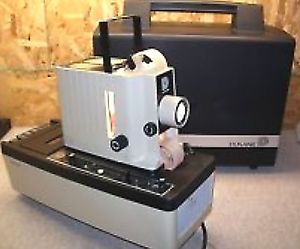
Mr. Dukane
“Anybody remember Mr. Dukane?”

Specific examples of classroom A.I. are hard to come by, beyond top ten lists and other generalized descriptions. I remember those library film-strip projectors we used in Grade 1, with the tape decks attached. Pressing “Play,” “Stop,” and “Eject” was easy enough for my six year-old fingers, thanks to engineers who designed the machines and producers who made the film strips, even if the odd time the librarian had to load them for us.

(At home, in a similar vein, how many parents ruefully if necessarily consider the T.V. a “babysitter” although, granted, these days it’s probably an iPad. But personification does not make for intelligence… does it? Didn’t we all understand that Max Headroom was just a cartoon?)

There’s a trivia game app with the hand-held clickers, and there’s an on-line plagiarism detector – both, apparently, are A.I. For years, I had a Smart Board although I think that kind of branding is just so much capitalism and harshly cynical. Next to the Smart Board was a whiteboard, and I used to wonder if, someday, they’d develop some windshield wiper thing to clean it. I even wondered if someday I wouldn’t use it anymore. For the record, I like whiteboards. I use them, happily, all the time.

Look, I can appreciate this “ground-up” concept as it applies to e-machines. (I taught English for sixteen years, so metaphor’s my thing.) But intelligence? Anyway, there seems no clear definition of classroom A.I., and far from seeming intelligent to me, none of what’s out there even seems particularly dim-witted so much as pre-programmed. As far as I can tell, so-called classroom A.I. is stuff that’s been with us all along, no different these days than any tool we already know and use. So how is “classroom A.I.” A.I. of any kind, symbolic or otherwise?

"... so whose the Sub?"
“Hey, so who’s the Sub today?”

Symbolic A.I., at least the basis of it, seems not too dissimilar to what I remember about computers and even some video arcade favourites from back in the day. Granted, integrated circuits and micro-processers are a tad smaller and faster these days compared to, say, 1982 (… technology benefitting from its own surplus?) Perhaps more germane to this issue is the learning curve, the literacy, demanded of something “intelligent.” Apparently, a robot vacuum learns the room that it cleans, which as I gather is the “ground-up” kind of A.I. Now, for all the respect and awe I can muster for a vacuum cleaner – and setting all “ground-up” puns aside – I still expect slightly less from this robot than passing the written analysis section of the final exam. (I taught English for sixteen years, so written analysis is my thing.) It seems to me that a given tool can be no more effective than its engineering and usage, and for that, isn’t A.I.’s “intelligence” more indicative of its creator’s ingenuity or its user’s aptitude than of itself or its pre-programmed attributes?

Press Any Key to Begin

By the same token, could proponents of classroom A.I. maybe just ease off a bit from their retcon appropriation of language? I appreciate getting caught up in the excitement, the hype – I mean, it’s 21st century mania out there, candy floss and roller coasters – but that doesn’t mean you can just go about proclaiming things as “A.I.” or, worse, proclaiming A.I. to be some burgeoning technological wonder of classrooms nationwide when… it’s really not. Current classroom A.I. is simply every device that has always already existed in classrooms for decades – that could include living breathing teachers, if the list of functions above is any guide. Okay then, hey! just for fun: if classroom tools can include teachers who live and breathe, by the same turn let’s be more inclusive and call A.I. a “substitute teacher.”

Another similarly common tendency I’ve noted in descriptions of classroom A.I. is to use words like “data,” “algorithm,” and “training” as anthropomorphic proxy for experience, decision-making, and judgment, i.e. for learning. Such connotations are applied as simply as we might borrow a shirt from our sibling’s closet, as liberally as we might shake salt on fries, and they appeal to the like-minded, who share the same excitement. To my mind, judicious intelligence is never so cavalier, and it doesn’t take much horse-sense to know that too much salt is bad for you, or that your sibling might be pissed off after they find their shirt missing. As for actually manufacturing some kind of machine-based intelligence, well… it sure is easy to name something “Artificial Intelligence,” much less bestow “intelligence” by simply declaring it! The kind of help I had back in the day, as I see it, was something I just now decided to call “S.I.”: sentient intelligence.

Facetiousness aside, I grant probably every teacher has spent some time flying on auto-pilot. I’ve definitely had days that left me feeling like an android. And fair enough: something new shakes things up and may require some basic literacy. There’s no proper use of any tool, device, or interface without some learned practical foundation: pencil and paper, protractor, chalk slates, the abacus. How about books, or by ultimate extension, written language, itself? These are all teaching tools, and each has a learning curve. So is A.I. a tool, a device, an interface? All of the above? I draw the line where it comes to classroom tools that don’t coach the basketball team or have kids of their own to pick up by 5pm: the moniker “A.I.” seems more than a bit generous.

And hey, one more thing, on that note: wouldn’t a truer account of A.I., the tool, honour its overt yet seemingly ignored tag, “artificial”? R2D2 and C-3PO may be the droids we’re looking for, but they’re still just science fiction.

Fantastic tales aside, technological advancements in what is called the field of A.I. have and will continue to yield useful, efficient innovation. And now I mean real Silicon Valley A.I., not retcon classroom A.I. But even so, to what ends? What specifically is this-or-that A.I. for? In a word: why? We’re headed down an ontological road, and even though people can’t agree on whether we can truly consider our self, we’re proceeding with A.I. in the eventual belief that it can. “It will,” some say. Not likely, I suspect. Not ever. But even if I’m wrong, why would anyone hope that A.I. could think for itself? Why?

Artificial Intelligence
10. Be “A.I.”    20. Go to 10     Run

Hasn’t Heidegger presented us with enough of a challenge, as it is? Speaking of time and energy, let’s talk opportunity costs. Far greater minds than mine have lamented our ominous embrace with technology. Isn’t the time and energy spent on A.I. – every second, every joule of it – a slap-in-the-face of our young people and the investment that could have been made in them? It’s ironic that we teach them to develop the very technology that will eventually wash them away.

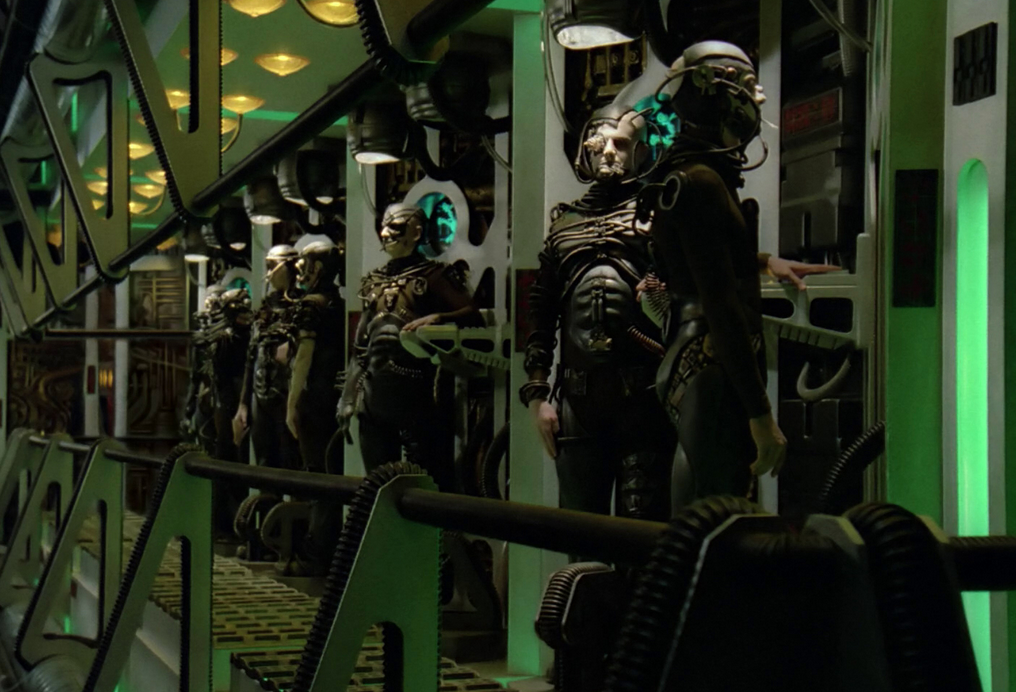
Except that it won’t. I may be out on a limb to say so, but I suspect we will sooner fall prey to the Twitterverse and screen-worship than A.I. will fulfil some sentient Rise of the Machines. The Borg make good villains, and even as I watch a lobby full of Senior Band students in Italy, staring at their iPhones, and fear assimilation and, yes, worry for humanity… even then I reconsider because the Borg are still just a metaphor (… sixteen years, remember?) As a teacher I am more driven to reach my students with my own message than I am to snatch that blasted iPhone from their hands, much as I might like to.

On the other hand, faced with a dystopian onslaught of Replicants, Westworld Gunslingers, and Decepticons, would we not find ourselves merely quivering under the bed, frantically reading up on Isaac Asimov while awaiting the arrival of Iron Man? Even Luke Skywalker proved susceptible to the Dark Side’s tempting allure of Mechanized Humanity; what possible response could we expect from a mere IB cohort of inquiry-based Grade 12 critical thinkers and problem-solvers?

The Borg
“Resistance is futile.”

At the very least, any interruption of learners by teachers with some classroom tool ought to be…

  1. preceded by a primer on its literacy,
    • i.e. explaining how to use that particular tool in…
  2. a meaningful context or future setting,
    • i.e. explaining why to use that particular tool, before anybody…
  3. begins rehearsing and/or mastering that particular tool,
    • i.e. successfully executing whatever it does

If technology helps create surplus time and energy, then how and why and what had better be considered because we only have so much time and energy at our disposal. The what, the how, and the why are hardly new concepts, but they aren’t always fully considered or appreciated either. They are, however, a means of helpful focusing that few lessons should be without.

As a teacher, sure, I tend to think about the future. But that means spending time and paying attention to what we’re up to, here and now, in the present. To that end, I have an interest in protecting words like “learning” and “intelligence” from ambiguity and overuse. For all the 21st century hearts thumping over the Cinderella-transformation of ENIAC programmable computation to A.I., and the I.o.T., and whatever lies beyond… for all that, our meagre acknowledgement of the ugly step-sister, artificiality, is foreboding. Mimicry is inauthentic, but neither is it without consequence. Let’s take care that the tools we create as means don’t replace the ends we originally had in mind because if any one human trait can match the trumpeting of technology’s sky-high potential – for me at least, not sure for you – I’d say its hubris.

Another fantastic tale comes to mind: Frankenstein’s monster. Technological advancement can be as wonderful as it is horrifying – probably usually somewhere in between. However it’s characterised or defined, though, by those who create it, it will be realised in the end by those who use it, if not those who face it. For most people, the concept of cell phones in 1982 was hardly imagined. Four decades later, faces down and thumbs rapid-fire, the ubiquity of cell phones is hardly noticed.