On Bias: IV. Right Bias?

Featured Photo Credit: Adam Derewecki on Pixabay

Click here to read On Bias: III. Fun With Dialectics

On Bias: IV. Right Bias?

Here’s an idea: let’s eliminate bias!

We’ll all finish breakfast together and head out, everyone trying their very hardest, pitching in with, like, mindfulness and all – and boom, we eliminate bias. Well, except for all its inevitable ripple-effects, what with that ‘cost to everything’ thing and everything that goes with that, but… here’s the thing: we eliminate our bias!

I hear this idea fairly often in Teacher Education: “Eliminate your bias.” Actually, it’s more of a recommendation than an idea, come by honestly, as I see it, from a place to (a) preclude unconscious assumptions, which I gather to be individual, and (b) guard against inherent power structures, which seem bigger than individual, at least as far as their fount if not their flow – which is sort of like saying the heart itself is not quite the circulation that depends on it, or that life is not itself the exactness of living. Basically, the difference between (a) and (b) might be cause-and-effect although, when anyone says “basically,” it’s bound to be an oversimplification, so maybe just forget I said it.

And as I’m about to mention ‘space between’, of course I’ll be speaking metaphorically: for example, the space between teachers and students.

Where the one ends and the next begins …some more than others
Photo Credit: Matheus Bertelli on Pexels

Speaking of metaphorical space between… from my own experience, I’ve found where one person ends, as it were, another finds space to begin. In between them is space… sometimes a void or distant divide, or sometimes an inseparable overlapping affinity though, more likely, something less fringe-worthy in between. It is space filled by dialectical influence, by relational back-and-forth, something I’ve elsewhere called a kind of curriculum. And where all this is true for all, even so I suspect it will resonate more with someone who was told at school that they were, say, a troublemaker, or a top student – at different times, I was told both, so I oughtta know.

But as metaphorical space relates to ‘eliminating bias’, well… when teachers are told to eliminate bias, or minimize it in their planning and practice, for being superficial the suggestion for me is essentially misleading.

Dusek distinguishes between a generalised teacher bias, “expectations regarding the performance of children who are equivalent on some objective measure,” and what seems to be more individuated teacher expectancy, the “significant effects due to the teacher’s own, self-generated expectations regarding students’ performance” (p. 679). Expectancy, he notes, can beget bias such that a teacher “subjectively [feels that some] students are [less capable than others] of grasping certain material.” Apparently, the difference between teacher bias and teacher expectancy, as in “some objective measure” and “self-generated expectations,” is something like objective-subjective.

When teachers are told to eliminate bias from their planning and practice, the suggestion is superficial and thereby misleading.

Now, one could expound for pages, distinguishing external from internal, collective from solo, or communal from individual, or arguing apparent vs inherent, without vs within, or knowing vs doing, or even exploring remembrance-reaction or learned-instinctual. They all seem nurture-nature in some way or other (which yes, I’ve had to reverse from the more common usage, nature-nurture). I didn’t even bother with hyperlinks because there are just too many options – search for yourself and see, any similar form for any of these pairings. Fun with dialectics, indeed.

Instead, I simply note here how I described it on the homepage in its more common order, nature-nurture: there’s me and there’s not me. It’s a philosophical difference, definitely epistemological if not also ontological, so take it or leave it, but at least please understand it for your own philosophy as well as mine.

As all this pertains to teaching – because I write here most often as a teacher – the difference seems one of perspective, which is probably pretty telling, so educators take note. Where the difference seems one of perspective, with each person left to construe what other people also construe, maybe the most we could expect from a bunch of persons is consensus – seems a shame, then, to demand something instead like conformity.

To those unconscious assumptions that Teacher Ed aims to preclude I relate Dusek’s teacher expectancy – both seem more individuated. But as one sets upon “eliminating bias,” whether that one is a teacher or anyone else, how exactly do we measure expectations? How do we even identify assumptions that are unconscious? Is there “some objective measure,” maybe some kind of systemic outcome, to help us determine where bias ends and expectancy begins? Because, if there were, bias might almost even seem reliable, maybe have some practical utility – seems a shame, then, to eliminate it, I mean if that were true.

Less formally, I can imagine teachers intentionally mitigating expectancies in order to respect student autonomy – I’m pretty sure I have. Thanks to Dusek, let’s consider an attempt at identifying and mitigating expectancies to be, by extension, an attempt at managing bias. And this much I’ll grant you, Teacher Ed: indeed, we can manage bias. And surely this would affect ensuing outcomes – those times I managed, I’m pretty sure that was my thinking.

“… every ripple, rippling and re-rippling, placid at times though many times not”
Photo Credit: Linus Nylund on Unsplash

Maybe a systemic distinction between bias and expectation could indicate some kind of synthesis… of people, of history, of institutional aims and cultures, and all their back-and-forth influences – every ripple from every pebble tossed, rippling and re-rippling across the gulf, placid at times though many times not. All this is its own continual cause-and-effect-yet-more, in which bias seems as much an unending if curiously dissociated mutual negotiation of each with every other.

Mackenzie – remember Mackenzie? – may have been on to this, too: he finally quells our “deplorable” state of bias as “… not something which should be feared in education… [but rather] the beginning of a process of debate… [ending] either in a discussion of appropriate emphasis, in the accuser coming to see that an allegedly neglected viewpoint has indeed been covered, or in the accused learning something new” (p. 499). Okay, maybe Mackenzie’s still a little polarised, but he’s unquestionably a little more flexible, too: therein the patient, and all. And maybe there really is something to all that ‘mindfulness’ crap, aside from being so popular.

Biased people, biased history, biased institutional aims and cultures… with literally everything to consider, yet being only human, we’re inevitably certain to leave something out on account of that limit, our incapability for anything beyond: eliminating bias starts chipping away at all we know because bias is essentially what we are. Eliminate bias, eliminate self, which could mean ‘change’ or could mean ‘self-destruct’. So, how to proceed?

For starters, let’s not just openly acknowledge bias, let’s embrace it: the rigor of education, of discourse and sharing and research… if two heads are better than one, imagine the dialectic arising from a dozen, or a hundred. We already know the potential of entire communities. Let’s value the humility of learning precisely because no one can say it all, know it all, or do it all. No less was suggested by Sir Francis himself: we all can do better together, and not just kumbaya – gotta love some bacon. Let’s learn and teach how to reason and how to communicate, and how to be biased.

Let’s learn and teach how to reason and communicate: how to be biased.

And let’s let bias be. If it limits alternatives, bias also clarifies too many. Ambiguity can amplify what we already know and also what we don’t; from there, we proceed. Elsewhere I’ve mentioned my ignorance in a museum: where I knew nothing about the exhibits, plenty others did know, and certainly over time, we all come to know however much. In the meantime, though, I’m partial for my ignorance, and a decision befalls me to take action, to study and learn, or to do something else.

Study is only a potential outcome of education, making education only a potential process of constant renovation, of who we are and what we know. Study is a decision that not everybody makes, I think because it’s humbling. It brings us to realise how much we’ll never know. Some rare few master plenty, but even they have limitations. We do what we can, or anyway, we ought to. But whether or not each of us accepts our own responsibility for our own decisions, come what may, we will still face the outcomes.

For all this, on balance, I’d say bias is a good thing. It changes as we grow, even if ‘change’ just means leaning further the same direction. Given our context – myriad influences, ceaseless decision-making, the whole roiling rippling mess – we’re probably wise to consider bias dynamic: fluctuating, buffering, whispering continually in our ears, always remaining, never quite resembling…

Bias is potent energy, our source of passion, opinion, vision: our perspective. Where a world without bias would be flat and dull and monotonous, lucky for us “eliminating bias” is also mere aspiration. For the world in which we live, bias marshalled by a culture of responsible morality can actually enrich our collective experience.

“…a world without bias would be flat and dull and monotonous,” so if you think this pic is oversaturated, maybe the world has too much bias… or could it be you simply see a world with too much bias?
Photo Credit: analogicus on Pixabay

That’s why, when teachers are told to minimize or eliminate bias from their planning and practice, I take the suggestion as essentially misleading for being superficial. Bias is an always-thing, not something we minimize or eliminate but something we identify and address, and if we’re wise enough, something we incorporate. Bias is not pejorative, it’s descriptive, and even people you admire have it. Everybody has it, which is perhaps most obvious when they say they don’t – that’s a fool’s game to be avoided by responsible teachers.

Worse, teachers who do plan and practise under this spell of rectitude risk falling blind to the costs of their still-biased decisions: believing they have somehow minimized or eliminated their bias, they merely shift its cost from whomever they sought to protect onto somebody different. As I’ve concluded about decisions more generally, a teacher’s so-called ‘best’ decisions would seem to be their most informed decisions. If so, then I think a teacher’s professionalism can oblige no less yet can also demand no more.

For me, there’s no such thing as unbiased – if a single word can be an oxymoron, ‘unbiased’ is it. There is, however, such a thing as multi-biased; in the current lingo, that would be interdisciplinary or holistic, or what I might otherwise simply call responsible, considerate, or even mature, or how about maybe just educated.

Click here to read Common Ground

On Bias: III. Fun with Dialectics

Click here to read On Bias: II. Wrong Bias?

On Bias: III. Fun with Dialectics

Above-below, up-down, in-out… let’s understand these as some basic opposite pairings in English vocabulary.

Some pairings seem as rooted in tradition as opposition – love-hate, war-peace, success-failure – while some pairings automatically imply something else – just as ‘landlord’ pays its dues to ‘tenant’, so ‘parent’ only makes sense alongside ‘child’. Along the same line, as surely as ‘zenith’ is joined to ‘nadir’, something ‘ahead’ is followed by something ‘behind’. Conversely, it goes literally without saying that a ‘turn’ to face Thing 2 is the same pivot away from facing Thing 1. Being a duality, two moves at once, maybe this is why one good turn deserves another – after that, on we go.

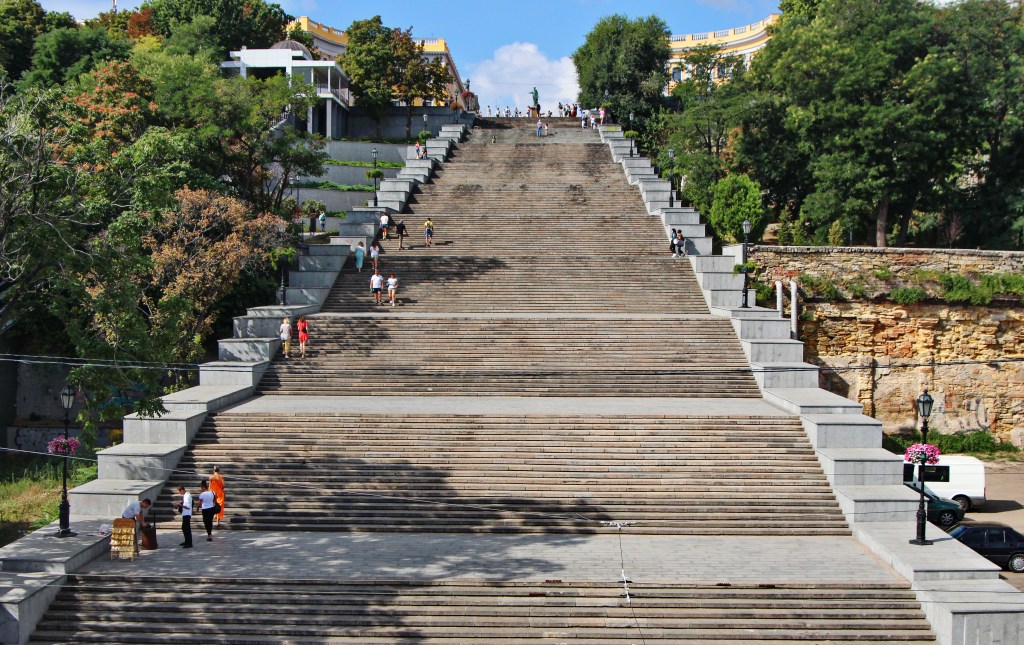
Looking up the Odesa Steps… not the Eisenstein montage today
Looking down the Odesa Steps… only the landings are visible

Photo Credits by Oleksandr Malyon – Own work, CC BY-SA 4.0, https://commons.wikimedia.org/w/index.php?curid=94182671 https://commons.wikimedia.org/w/index.php?curid=94182670

But our vocabulary is not always so obvious or easily taken for granted… something ‘ancient’ by contrast might only suggest something… well, less ancient: ‘modern’, ‘current’, ‘contemporary’, how about ‘fashionable’ – now we’re talking connotation as much as denotation. And with plenty of other word-pairings – ground-air, hard-soft, strong-weak, first-last – if any of these are less automatic than good-evil, to-from, wet-dry… well, they still seem just as opposite. Funny, though, a word like ‘moon’ implies ‘planet’, yet no planet requires a moon.

Actually, this post isn’t some attempt at anything formal although, if you’re up for it, knock yourself out.

Theory-practice, reflection-action, curriculum-pedagogy, classroom-real life, content-skill, teacher-student… education is all about such pairings. For the sake here, let’s consider these as ‘dialectical pairings’, where each concept is not merely reciprocal to the other but inextricably indispensible, such that the two concepts together comprise not a united opposition but a concerted reciprocity. And from the two arises something further, something more.

Matter tells space-and-time to curve; space-and-time tells matter to move: their fearful passage is the two-way traffic of our stage.

Maybe that’s a bit much. Let’s just stick with ‘dialectical pairings’, in a loosely Hegelian way that says, “You complete me.”

Here’s one we all know from education… ‘fairness’ balanced in concert with ‘unfairness’… in accordance to circumstance, fairness being the treatment of people without discrimination, marked by impartially, as conversely distinct from unfairness, discrimination marked by partiality. But without circumstances specified, this distinction remains ambiguous, such that one could argue fairness – treating every person impartially – as being equality, treating everyone the same, rendering unfairness as inequality. More recently has a distinction also been emphasised between (in)equality and (un)fairness such that the resultant outcome of specific treatment is considered (un)equal while the ongoing act of treating is described as a measure of (in)equity, the specific measure evidently being human rights, typically as these rights have been defined by some authority.

Anyway, let’s consider fairness-unfairness as having arisen from something else we’ll call ‘bias’ although that may actually be more of a Hegelian reversal, if you see what I did there. OK, so we consider this, but on what basis? What I’m suggesting is twofold…

(i) Bias is an always-thing, and utterly inescapable
(ii) No matter how exactly we do something, bias instils every decision with unintended consequences

As a result of everybody’s overlapping biases, i.e. that system of forces made real by everybody’s ongoing decisions, somebody somewhere along the way incurs some cost in payment of an outcome

Sidebar #1: We’ve been facing a lot of absolutes, thus far… inextricable, indispensible, utterly inescapable – let’s consider these inexorable. As for absolutes, let’s consider them unlimited by anything besides themselves.

Somebody pays a cost… I call it a cost, and depending on the circumstances, maybe we call it fallout, or unintended consequences, or collateral damage. Depending on the circumstances, maybe we call it a trade-off. But what it’s called doesn’t negate the truism that there is a cost to everything, which is sometimes described in education as the hidden curriculum.

Sidebar #2: Ivan Illich is often credited with coining the term, ‘hidden curriculum’, and his meaning actually took to far wider critique than just education. Illich argued for the disestablishment of schools, comparable to the separation of church and state, on the basis that our most insidiously aberrant institution is compulsory schooling, which proliferates “the alienating institutionalization of life by teaching the need to be taught” (p. 34). Illich critiqued compulsory schooling’s duplicity, in which learning is ritualised myth-making, “something for which you need a process within which you acquire it” (p. 67), a problem defined by a self-justifyingly selfless solution:

“… other people told me [schooling] was… the most practical arrangement for imparting education, or for creating equality, [yet] I saw that most people were stupefied by this procedure, were actually told that they couldn’t learn on their own and became disabled and crippled… a new kind of self-inflicted injustice… a liturgy [for generating] the belief that this is a social enterprise that has some kind of autonomy from the law.… If the rain dance doesn’t work, you can blame yourself for having danced it wrongly.” (p. 66)

For Illich, words like ‘planning’ and ‘development’, ‘class and ‘equality’, ‘system’ and ‘assessment’, all central to North American schooling, are anathema to ‘knowledge as an intrinsic good’ and ‘coming to know things as inalienable living’ – those absolutes again.

And what it’s called doesn’t negate the responsibility to consider more than one perspective, on behalf of others, while weighing or enacting our decisions. If anything, bias demands responsibility unless, of course, your concerns lie elsewhere than somebody somewhere paying some cost. This, if you ask me, definitely falls to a matter of character, as does a sense of whether this post seems to have abandoned the whole ‘dialectical pairing’ thing.

Click here to read On Bias: IV. Right Bias?

On Bias: II. Wrong Bias?

Featured Photo Credit (edited): Jonathan Pendleton on Unsplash

Click here to read On Bias: I. Disparate Bias

On Bias: II. Wrong Bias?

The school must conduct its affairs in some way or other; the curriculum must include some areas of human experience and omit others. In doing so the school thereby commits itself on these issues, often without proper, or any, consideration of alternative possibilities.

Mackenzie, 1997 (p. 499)

The first half of Mackenzie’s remark, a priori, I accept: school must conduct its affairs in some way or other, and the curriculum must include some areas of human experience and omit others.

As to the second half… hey, we all have opinions, and as we take each other to be informed to greater and lesser degrees, we agree and disagree. So, where I can imagine the dearth of “any” consideration of alternative possibilities, I’m still uncertain what Mackenzie means by “proper.”

So long as an attempt is made, wouldn’t literally any consideration leave us free to judge school’s conduct of its affairs… unless, of course, somebody’s gone and figured it all out on behalf of the rest of us. Did some school back in ’97 really manage to offer it all in one go? Who were the teachers and administrators demonstrating that kind of wisdom? Who sat for that District Board, staffed that government ministry? By all of which I’m really asking, who gets to say what’s proper and, thereby, what’s improper? You? Me? Mackenzie? Further still, who even gets to say who gets to say? Don’t say “Mackenzie’s parents.”

To be fair, “proper” in this case could be interpreted more procedurally than substantively, as some generic curriculum development protocol – a proper approach to considering alternatives versus proper alternatives per se. Yet similar questions remain about who sits as part of that process, and who chooses who sits, and who chooses who chooses, and on it goes, the politics of education.

If you ask me, i.e. thanks for reading, a conscientious teacher faces questions analogous to these every single day while enacting curriculum many times a day, balancing their own perspective with how they interpret each student’s needs and interests. And I say “each” student, but of course we all know things are sometimes less individuated than the world of idealism. Teaching anybody, much less young people, much less 2–3 dozen at once, is no singular thing, which the gerund “teaching” hardly conveys.

By the same turn, though, teaching is no crap-shoot, or maybe better to say it can’t afford to be. Isn’t the real trick of teaching learning to live with uncertainty? And isn’t that last sentence funny for juxtaposing teaching so cavalierly with learning? Teachers learning? as in, don’t they have it all already figured out – aren’t teachers already supposed to know things?

Don’t be misled as to what you imagine teaching to be, despite any time you may already have spent in a classroom.

Teachers owe a duty of care to meet people (if not each person) where they’re at, then help them along. So… how does a teacher balance their own knowledge and awareness with what matters to their own self? That’s a real distinction, by the way. And if they can balance this, how next do they balance this with their duty to help students learn what students feel matters to students? Trust me, that last sentence is even harder to do than it is to read because, sometimes, students just don’t know yet what matters to themselves – the same can be said of some teachers I’ve met, too, since we’re on the subject.

Convolutedly, the reverse is also true – for some other teachers, their politics is inherently part of their classroom curriculum, something I’ve heard insisted to be not only good teaching but moral teaching. This opens an always nuanced and often contentious discussion – he said from experience – such as precluding an opportunity for students to reach moral ground on their own terms in their own time. Rather than discuss it further here, though, I’ll suggest another way to ask my question about teachers balancing self with students: how might education be made “simultaneously both responsible and free” – it’s something Dr. Shulman wondered as far back as 1983. I gather he was leaning more towards teachers acting on behalf of students whereas I’m definitely asking on behalf of everybody in the classroom. For me, this ultimately seems a question of autonomy, the heart of which is bias.

Oh boy, I know this is a series on bias, but really? Always ‘bias’? It may be safe to say, or else totally ironic, that the principal curricular consideration we face is What is most worth teaching? That’s a collective ‘we’, by the way, not the royal one, and fair play if you disagree. In any case, this infamous question inevitably leads to an even bigger one, What is school for? What’s the purpose of this thing we call K12 education? Lately, though, as we’ve particularly hitched our wagons to constructivism, I wonder if these are the wrong questions.

Lately, I’ve been trying out something different, and just to be clear, I’m not referring to subject-specific curricular anything. To be clearer still, I’m considering what teachers bring with them through the classroom door each day because they’ll be bringing it, whatever question we ask. And what are we asking?

Up til now, where someone may have been asking, What is school for? I’m asking Who participates? and further, What are some suitable attitudes or expectations for participants? How best to proceed in K-12 with this thing called ‘constructivism’… I mean, if we’re genuinely committed to living it out, because I don’t yet see that we are – not even when we think we are. Yeah, long question.

And yes, still collective, not royal, only now I wonder if anyone’s upset with me lumping them into the collective. In responding to these questions about school and curriculum, I’ve obviously been considering neither content nor skill but people. So, as we’ve hitched our wagons to constructivism, I wonder whether people might be the purpose of school, making the principle curricular consideration not ‘what’ we teach but ‘who’ we teach, alongside which both ‘how’ and ‘why’ we teach find appropriate kinship.

If you disagree thus far, please don’t let your bias run away with you while, if you agree, please don’t go clicking ‘Like’ and ‘Share’ just yet – he said with smug presumption – because this is still far more nuanced than I’ve offered just yet.

I think it’s fair to say this idea is something I’ve wondered more broadly across The Rhetorical WHY, primarily as a facet of curriculum since teaching and coaching and mentoring are some things I’ve come to know fairly well – and, hey, write what you know.

There’s a common distinction between curriculum, mandated documentation about what to teach and learn in K-12 schooling, and pedagogy, the manner in which curriculum’s taught to this or that class of students. Both lack nuance for being oversimplified. From all my pondering, I’m lately gathering that an ill-advised separation of this dialectical pairing may be an ongoing source of trouble faced by teachers, students, and education in general. I think curriculum and pedagogy may be better considered one concept, and I think so because of bias, and I wish I had something more substantive to offer – as I say, it’s threaded throughout this blog, but that’s a lot to synthesise.

I’m no longer certain that school’s the place for any superseding authority, either the kind we commonly associate with curriculum or the kind we commonly associate with pedagogy.

I think how or why we’ve made this separation is an issue of a higher order; for now, suffice to say I suspect Illich was on to something. The bottom line is that I’m no longer certain that school’s the place for any superseding authority, either the kind we commonly associate with curriculum or the kind we commonly associate with pedagogy… what I mean by school is the sort of experience I had, where the superseding authority was largely into ‘telling’ and ‘explaining’ things – maybe that resonates for you, too. On the other hand, what I mean by “no longer certain” may not be what you think, so bear with me.

“… are we doing this right?”

We all come away from ‘school’ with an idea about what it is and how it works because we all went through those years, ourselves. Honestly, though, in this era of constructivist halos, I still see plenty of telling ‘how it is’ and explaining ‘how it’s done’, and ‘this is what’ and ‘here’s how’ and just all sorts of expectation and behaviour from teachers and instructors and professors that suggest, to me, how little has actually changed.

We find all sorts of ‘student-centred’ this and ‘self-regulated’ that in today’s educational circles, and we call it constructivism, but I’ve felt far less certain about the constructivist perspective since it came to, er… rule the day dominate the landscape become so popular since we adopted it. Apparently, we tend to repeat what ‘school’ is and how it works, even when we say we’re changing… is this because we all went through those years, ourselves?

But hey, changes take time and patience, and people who spend their time waiting to arrive miss that time spent. And I can only judge from my own perspective, but in the classrooms I know, what I take Mackenzie to mean by “proper” for schools may finally be gradually changing.

I say so with some unfinal gradual assurance because what I’ve been seeing is only four or five years old while institutional changes seem to be generational – did you notice, above, I chose a quote that’s twenty-five years old? Someone else might have embellished those twenty-five years for effect – “more than two decades” or “a quarter-century ago” – but I didn’t want any rhetorical ‘why’ to diminish all the teachers and students whose efforts at change over twenty-five years have arisen and are having effects all their own.

So fair play to all the teachers and students in schools I know. Also noteworthy… the roots of their change seem to reach well beyond any teen angst, or that world-conquering spirit of twenty-somethings. Their changes also seem to be found in more than one institution, even one as ubiquitous as school. It’s the cultural shift we’ve all been experiencing for a few years now, a stand-out willingness to confront assumption and habit and bias, and behaviour, and prejudice and bigotry and hatred. And it’s the determination against all these to assert an alternative superseding authority – although whether as a challenge or as an equal seems dependent on circumstance. I won’t label this change since most people probably call it something for themselves, but the overwhelming sentiment has seemed to be that this time is different.

As for me – and of this I’ve had far longer to be convinced… the greatest obstacle to change is the force of habit, which can manifest any number of ways and which is maybe just another way of saying bias. If I have one analysis to offer, it’s to be conscious of bias as its perceived by an audience, something along these lines: “… to the creatures outside looking in from pig to man, and from man to pig, and from pig to man again, it was already impossible to say which was which.” So for me, anyway, not sure for you, I’d say we have a ways to go before we’re okay characterising any “changes” as thorough or convincingly different just yet.

Still, things sure seem different this time around.

Click here to read On Bias: III. Fun With Dialectics