
Featured Photo Credit (Edited): Steve Buissinne on Pixabay
Emotions are an authentic human response – at least that’s what people say when they agree with those emotions. If it really is true, that would mean emotions are just as authentic a response when people disagree.
Probably just a handful of posts on this blog fall into the ‘rant’ category although Hey! that includes the one that started it all.
So at least the following emotions don’t lack precedent.
This Just In…
A lead on the morning news one past winter about heavy snow: “Great for skiers, bad for drivers.”
The past year, the past decade, and longer, you’ll have noticed an unquestionably gradual and ceaseless severity of weather effects, here and around the world. Heat domes, atmospheric rivers, bombs and cyclones, vortices and hurricanes and typhoons. You may also have seen news reporting that characterises the planetary climate as the enemy of motorists at the same time as it’s the victim of greenhouse gases, not to mention the harbinger of far worse to come.
From one TV news story: dozens of vehicles, some halted, some helplessly sliding, all paralysed by snow… enough to bring any motorist to tears. I’m almost paraphrasing the anchor’s light-hearted sympathy.
Each flake imperils the “unprepared” driver, who seems to risk the same foolhardy decision year upon year – though, let’s grant, it’s hard to know every circumstance. Let’s also grant that no enemy threatens winter driving quite like the reckless shitheads who lord their superior winter confidence over every other fool and sage behind the wheel: “Go home!” shouts the DB passenger of a white Eff-150 as they showboat past every stranded car they can scorn. “Go home,” as if they could. If you’re keeping score, weather thus far is not the enemy.
Someone far wiser than me will surely be explaining by now that Enemy Bad Weather is simply an affectation of our Harried Rat Race by the Charm of Morning News.
Could be… or could be the augury of addled brains, muddled thinking, and the subtle catalyst of still more unpredictable beliefs and behaviours yet to come, the kind that take decades to manifest before they’re detectable. Did you also know, you can pretty much say “shit” on TV now, and “eff” puns too. Still, as helpful as it would be, it’s hard to know for sure how long it might take culture to change as detectably as it took the climate. I guess we’ll see what happens.
Anyway… what’s to come of having reached millions upon millions of people, for whom a daily wish for good suitable weather competes with a daily war against undesirable bad weather… and all this, maybe – but, then again, maybe not – aside from an existential fight to “save the planet” while also chasing ambitions of travel and leisure and global what-not… sorry, by the way, all that was a question: ‘What’s to come of it all’?
Well, back to the news… literally the next story: “Massive overnight snowfall is the perfect storm for local ski resort!” which of course is code for ‘financial windfall’, which of course is not one but two weather metaphors to keep things light in an offhand way that says, “Have you got your shit together?”
And this from a few weeks earlier: “… forecasts predicting a risk of frost.” I can remember in the past hearing a “chance” of frost. These days, though, it’s a “risk.” A “risk” of frost. Frost.
One bleak headline even pits nature against nature although, sure enough, the frost in that story is mere backdrop for the Science that saves vulnerable naked vineyards, which of course is code for ‘commercial investment’. Granted, a belligerent “cold snap” isn’t exactly Daniel Plainview, or even Cobra Commander, but this story, with its closing remarks about “the silver bullet” – especially up against severe 60° temperature swings – betrays little beyond concern for our wine.
And exactly how do our priorities measure up with our frivolities – or, sorry, is that no longer a distinction? Anyway, I’m told we don’t use upmarket words like “frivolities” because too much Inside Baseball gets us too deep in the weeds… a risk of losing the audience, you know – must be that eff-word thing again.
Same week, same newscast… multiple winter tornadoes: “destructive” and “devastating.” A few weeks prior… once-a-century local flooding that restores a lake upon the flood plain, at the cost of homes, livestock, and livelihoods. Two weeks later… winter wildfires: “frightening” and “deadly.” In truth, all of these were terrible and damaging events – and all preceded the catastrophes of Lahaina and Los Angeles by two and three years’ time.
Against these events, and their human cost, rate this post as little more than a callous, self-absorbed tantrum.
Then rate the incoherence of news outlets, as they forewarn “Icy danger!” while smirking at “Snowy fun!” – nothing seems amiss? News outlets that prosecute seasonal war against the bitter “risk” of frost, and a cold-hearted enemy known only as “snow”… then broadcast the roar of trucks and ploughs and blowers, and hail those diesel heroes who salt and clear our roadways for the very traffic that helps to pollute and push our climate – and us – toward severe and unquestionable doom…
Against all this we might ask whether the recasting of “Global Warming” as “Climate Change” instead might have been, “Global Just Pleasantly Wintry-slash-Summery Enough Everywhere All the Time in the Place I Live – but, I mean, not too hot, and not too cold, and not too rainy, but not so dry… especially for, like, Vacation – but, other than that, yeah no, totally! yes! Save the Planet and all because, like – are you kidding me? – look what we’ve done, I mean, it’s just awful.”
Which brings us to one last cringe-worthy critique – this one not a headline but a slogan: “We’re killing the planet.”
Is there really no better statement to replace this ridiculous assertion of self-importance self-impotence? … no statement that captures the human species’ relatively momentary historical insignificance in contrast to the vast entirety of the planet??? … its perpetual environment, its magnetic and gravitational forces, its eons of solar formation and space-time existence at 4.5 billion-with-a-‘b’ billion years, it’s out-and-out gargantuan volume, mass, and physical composition – really? We think we are killing that?
Imagine that dolly shot from [ latest streaming dystopian holocaust ] with all the shrubs and weeds reasserting themselves through twisted concrete rubble, as the sun shines down once more. And, let’s rant – er, let’s grant – that we have reached a point where I could hardly blame the Planet for preferring to sustain life without us – except, of course, the planet has no preference because the planet is no enemy. It’s a planet.
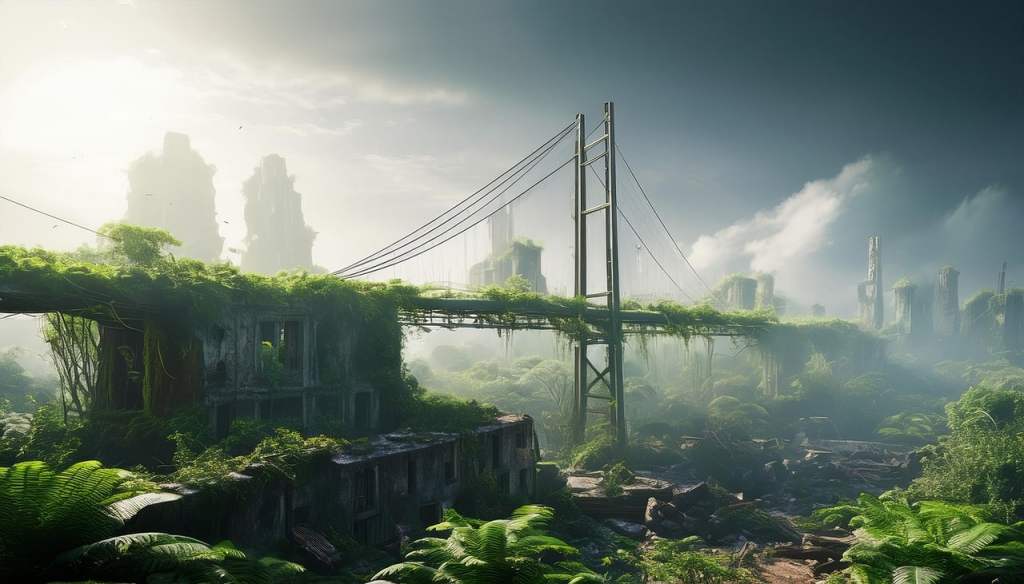
A.I. Image Credit: Jack Drafahl on Pixabay
So… sorry, not sorry: we are not killing the planet.
And looking back on our 0.007% share of its history, there isn’t a soul alive or dead who could boast otherwise. Flipside, for those who have been keeping score: consider in return the number of people over our centuries upon centuries upon centuries of 0.007% history who have been affected – killed or otherwise – by the Planet’s natural geological activity… at worst, we’re a nuisance upon its face.
“We’re killing the planet.” Does nothing in this statement betray the same hubris that caused all our problems in the first place? Rest assured, the Planet will see to us and be just fine long after we’re gone.
If we’re killing anything, it’s hope of our own tolerable survival as planetary inhabitants so, yeah no, we do face real urgency to get behind a perspective that fears an existential threat because it fears the planet – which, by the way, is one last subtle play on eff-words.
As for the influence we continue to inflict upon the face of the Planet, we’re all of us indisputably reckless shitheads for our collective failed stewardship. And any triage of priorities and frivolities – of enjoyment and antagonism, danger and fun – will confirm that these are not the planet’s response to all our spewed contaminants – these are our response(s). If you have been keeping score, by now you’ll surely see: the enemy is us.
We imperil only ourselves.
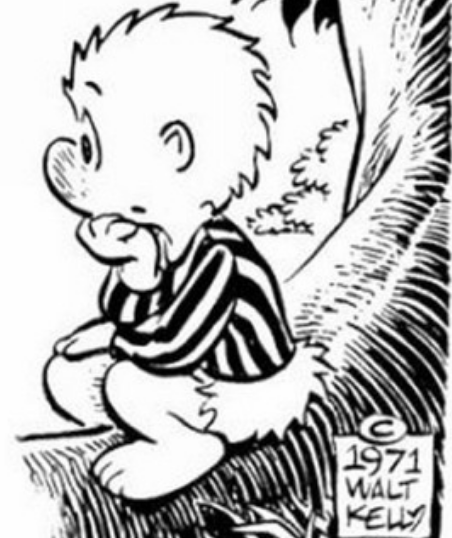
“Pogo” by Walt Kelly
 The Rhetorical WHY