The Latest Visual WHY

Click here to read the latest Visual Why

Liubov Popova, “Space-Force Construction” (1921). Oil on plywood, 64 x 60 cm. State Tretyakov Gallery Moscow, gift of George Costakis.

The story behind Eddie Van Halen’s signature guitar art is pretty well known and well documented, as far as when and how and perhaps why he did it. So when I saw this 100 year-old painting, “Space-Force Construction,” by Russian constructivist Liubov Popova, it stopped me short. And I just wondered. Maybe you’re a little taken aback, too.

Seeing this painting lead me to Tate and this article, “Aleksandr Rodchenko’s Lines of Force,” by Brandon Taylor, and I wondered a little more, then added all that wondering to the Visual WHY – you’ll need to scroll down to the Van Halen piece because I still haven’t figured out WP anchor links.


The word “text” derives from Latin, texere, meaning to weave or fit together. For me, text connotes far more than just the printed word – photography, movies, music, sculpture, architecture, the list goes on. The Visual WHY offers a specific look at paintings, texts with no less substance and arguably far more aesthetic. But underpinning the textuality of art altogether is its human endeavour. And beyond weaving something together for the sake of weaving, a weaver – an artist, a person – has a further end: communication.

Artists across all media are people with influences and motives for expressing themselves. Conjointly, texts of all kinds are also plenty human: provocative and reflective. Whether rich and symbolic for a global audience, or doodled sketches for your own amusement, art is text, and text has purpose. As we try to understand it more thoroughly, we can’t help but raise the level of discourse. Who knows, someday maybe art will save the world…

For those who’ve been wondering about the painting featured on this site’s front page, the latest Visual WHY may help explain that, too.
… of Robbie Burns Day

The best-laid schemes o’ Mice an’ Men
Gang aft agley…”

In observance of Robbie Burns Day and, thereby, of John Steinbeck’s novella, Of Mice And Men, I highlight this thoughtful character study of Curley’s wife, by Leighton Meester for The Huffington Post, based upon her own stage portrayal of that character.

Perhaps above all I appreciate Meester’s nuanced intuition about the audiences who judge Curley’s wife which, beyond their relationships to the characters in the story, might suggest something about their own – our own – blind spots and hypocrisies. How often we live with daily nonchalance, oblivious to the interiority of those we encounter, and of those beyond. How much we rely on our affirmed belief of our selves.

If confronting ourselves is art’s great authenticity, then Meester’s perception is spot-on: in Curley’s wife, Steinbeck subverts our conceit – whether he intended to or not. Indeed, the best-laid schemes…

The Latest Visual WHY

Click here to read the latest Visual WHY.

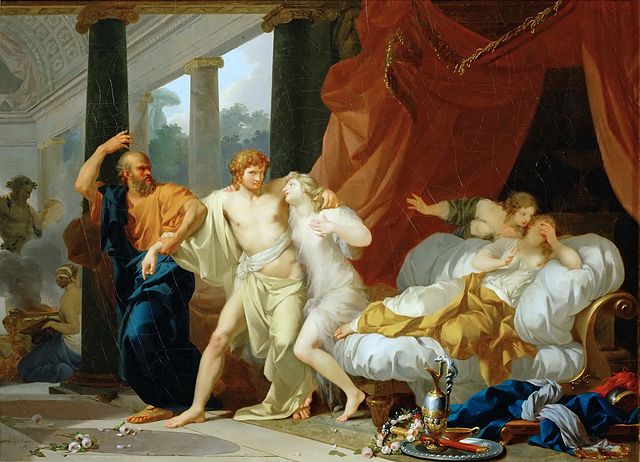
Jean-Baptiste Regnault - Socrates Tears Alcibiades from the Embrace of Sensual Pleasure (1791)
…could we ever know what art makes oneself better, if we were ignorant of what we are ourselves?”

“…a picture’s usually worth even more than the thousand words we commonly ascribe.”

The word “text” derives from Latin, texere, meaning to weave or fit together. For me, text connotes far more than just the printed word – photography, movies, music, sculpture, architecture, the list goes on. The Visual WHY offers a specific look at paintings, texts with no less substance and arguably far more aesthetic. But underpinning the textuality of art altogether is its human endeavour. And beyond weaving something together for the sake of weaving, a weaver – an artists, a person – has a further end: communication.

Artists across all media are people with influences and motives for expressing themselves. Conjointly, texts of all kinds are also plenty human: provocative and reflective. Whether rich and symbolic for a global audience, or doodled sketches for your own amusement, art is text, and text has purpose. As we try to understand it more thoroughly, we can’t help but raise the level of discourse. Who knows, someday maybe art will save the world…

For those who’ve been wondering about the painting featured both here and on this site’s front page, this latest update may help explain that, too.

Click here to read the latest Visual WHY.