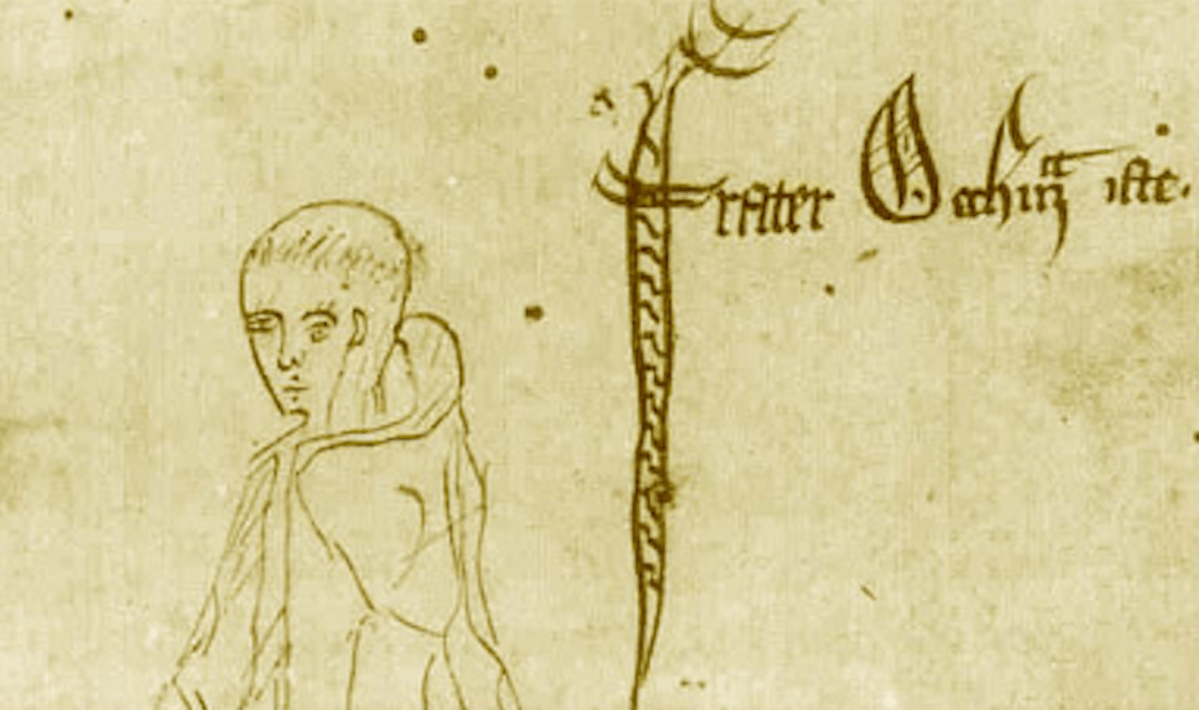
Featured Image Credit (edited) by William of Ockham – from a manuscipt of Ockham’s Summa Logicae, MS Gonville and Caius College, Cambridge, 464/571, fol. 69r}, Public Domain via Wikimedia Commons
On Teleology: I. Efficiency
Teleology is the study of final causes or, put another way, the fulfillment of inherent purpose or, even more simply, completion. As a quality or trait, we can call this τέλος, or telos.
An analogy I use in Teacher Ed to illustrate telos is shipbuilding… what kind of ‘ship’ – or maybe better in plural, what kinds of ‘ships’ – have school teachers been aiming to build? One warrant for this shipbuilding comparison, my thinking goes, is our culture’s hankering obsession with efficiency, i.e. what ocean-going vessel ever gets built except to fill some function or purpose?
By analogy, what function or purpose do teachers envisage or intend for K-12 graduates – what kind(s) of people do we want K-12 graduates to become? How closely does this resemble the kind(s) of people the Curriculum has in mind? And then, maybe more importantly, what kind(s) of people do teachers actually end up ‘building’? Alternatively, from the student perspective, what kinds of influence have teachers brought to bear upon their telos? What kinds of people finally cross that stage for their diploma?
No analogy being perfect – sort of the point with analogies – we can then make broader comparisons and contrasts between students and ships and gain a bit of insight about the intentions around which we approach the ‘building’ of each one.

But if ships don’t float your boat, try framing telos in the natural world… by analogy, imagine bacteria, forever on the hunt to feed and survive, yet to what end? Do bacteria literally just feed because they already live and will procreate, or do they need to survive in order to fulfill some further function or purpose?
geralt on Pixabay
Likewise, consider the cells in our bodies. Controlled as they are by genes, proteins, and nuclei, each has a specific function that elicits some somatic or physiological consequence. By analogy, we might even stretch the description as far as saying cells seem to operate with some kind of ‘intention’ although that’s not to invoke ‘awareness’ or ‘sentience’… none as far as we know, anyway, not like the awareness a shipbuilder has while building ships or the intent a teacher has while teaching students.
Hmm… could telos be more inherent or instinctive than intentional, some mere effect of causes, which fall like dominos? Possibly, but for now let’s defer that question on the basis, as noted above, that our culture prefers to ply the Road of Efficiency, towards which ‘a purpose for everything’ definitely fills the bill. Of course, it’s no secret who else plies Efficiency Road – plies it like a wide-load truck – and it’s no outlander who believes that Science embraces teleology.
Along that Road, ‘a purpose for everything’ might also convey ‘nothing wasted’… think Occam’s Razor and a cut-to-the-chase sentiment that we might dare to call “relentless” although maybe let’s amend this to something kinder and gentler, like “persistent” – still sharp, just not so cutting.

Hang on, though… let’s also clarify exactly which Occam’s Razor we’re using here because, you know, there’s Occam’s Razor and there’s Ockham’s Razor…
(i) Occam’s Razor
‘All things being equal,
the simplest explanation tends to be the correct explanation.’
and/or
“…permission to wrap up all epistemological loose ends
as ‘finished science’ in one fell swoop of fatal logic”
– posted on by The Ethical Skeptic
Occam’s Razor would keep matters simplistic by having us ignore or dismiss whichever details and data don’t suit some preferred belief or objective. In other words…
‘That which is easier to understand’
equals
‘That which is therefore more likely to be true’
equals
‘I’ll not be wasting my precious time with all that
thinking, testing, wondering crap’
equals
‘I don’t agree with you’
‘I don’t want to agree with you,
and, for that reason, you are wrong,
plus Occam’s Razor is Sciencey;
ipso facto, I am invincible’
(ii) Ockham’s Razor
“Pluralitas non est ponenda sine necessitate”
equals
“Plurality should not be posited without necessity”
William of Ockham would have us avoid leaping to conclusions or posing explanations beyond what can be justified by careful reasoning, yet with exceptions for what is self-evident, what is known to experience, and what might be “… proved by the authority of Sacred Scripture.” [William of Ockham, you understand, was a devout pre-Protestant friar and scholar who, thereby, viewed God as the sole ontological necessity.] In other words…
Proffer something because reason can warrant or justify its addition
equals
Don’t let your ego write cheques that Science can’t cash
And how come? Because something straightforward is and ought to remain distinct from something simple just as something complex is and ought to remain distinct from something complicated.
The razor imagery, meanwhile, is metaphor for scraping away the ink you spilled from writing (or thinking) unnecessarily.
OK, let’s recap: Telos thus far = Ships, Cells, Bacteria, Science, and two kinds of Razors… up next – you guessed it: Acorns!
Click here to read Part II. Illustration

 The Rhetorical WHY
7 thoughts on “On Teleology: I. Efficiency”