Tech Trade-Off: II. Learning to Think Differently

Featured Photo Credit: Steven Weeks on Unsplash

Click here to read Tech Trade-Off: I. Time to Think Differently

II. Learning to Think Differently

A gerund is a verb that ends with “ -ing.”

Gerunds are a verb form that often function as nouns, indicating some specific ongoing action or process underway, e.g. washing, drying, folding.

Generic gerunds are specified by accompanying words, to help fill in the picture:

“Doing… what exactly? Ohh, doing the laundry.”

At a minimum, we might describe ‘doing the laundry’ as a two-step process, the second being when we turn on the dryer. Some people even add a third step: ‘Folding the laundry’.

But whether specific or generic, gerunds do little to convey any sense of the stages or steps to that ongoing process. If anything, a 2–3 word gerund phrase reduces a series of steps – ‘the ongoing process’ – to ‘a singular thing’ or ‘a discrete event’, e.g. “Doing the laundry is such a chore!”

In Part I, I called this manner of thinking “shorthanding,” as we conceive and describe and reduce multi-step complexities into solely singular events, and I wondered whether innovation, progress, and technology might be having a longer-term influence that reiterates this reductive effect upon our outlook and our thinking…

(a) We develop technology for doing Task ‘A’ so that we don’t have to,
which yields surplus time

(b) We develop an accompanying frame-of-mind, which reinforces itself
more and more with each innovation that comes along

For all its efficiency and time saved, Technology teaches us a commitment to surplus. Think Wall-E and all those people buzzing around the Axiom spaceship in loungewear and e-chairs.

We can depend on A.I.!

Down here, closer to Earth, think ‘Gen AI’ or ‘self-driving cars’.

As we grow more accustomed to the surplus, our accompanying frame-of-mind more readily reconsiders matters of ‘process’ from being a series of steps to being a singular moment or event – this is shorthanding. This feedback loop is training us to think in ways that are more and more accustomed to shorthanding, and on it goes.

All this I’m deliberately claiming informally – it was me who picked the word, “shorthanding,” with zero empirical science to back it up, so…

Sorry, STEM – blame it on STE(A)M, if you like.

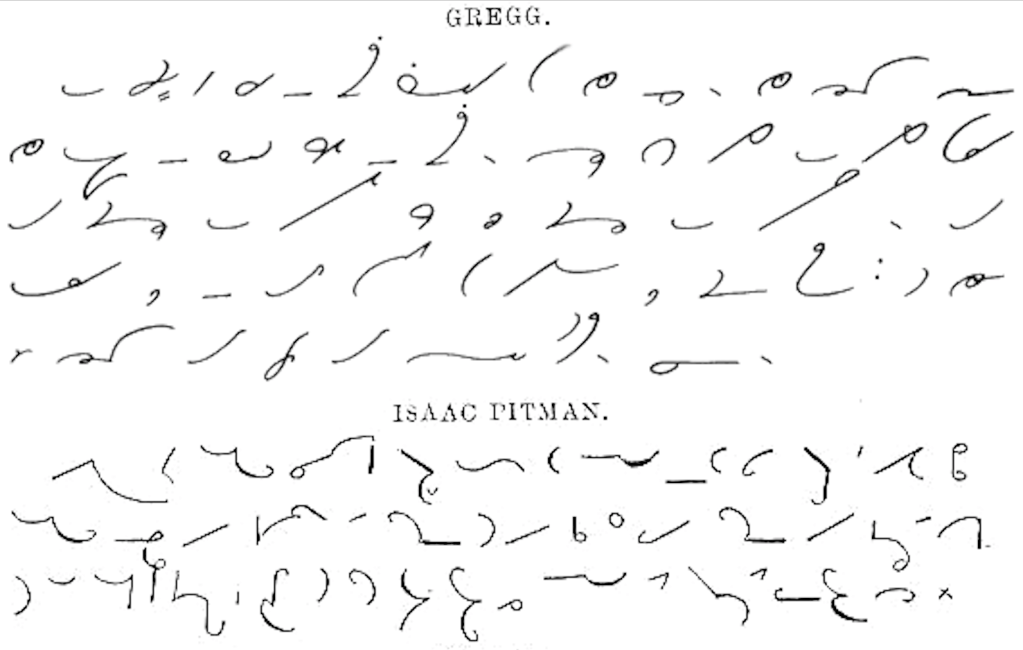
And, sure, shorthanding’s a bit abstract and hard to define. For starters, it might be more akin to Pitlick & Gregg than Pitman & Gregg.

Two minutes for… cross-checking?
Image Credit: Public Domain

And language shorthands like this all over the place – look no further than the gerunds and nouns, already mentioned: ‘vacations’, travelling’, living’, life’.

But we’re not simply trading up on Technology for time and convenience, nor on chores and labour for preferred activities. We’re trading in one kind of living for another, by way of a specific manner of who we are and how we live, which is to say by way of how we think. And we appear to have been doing all this without much concern for the price of the trade-off. Whatever that price might be, I suspect we’ve been the ones left short-changed.

For all its marvellous ease, Technology has been feeling more and more to me like a bad habit none of us can resist, and that gets me wondering where else we’re shorthanding. How else have we been altering some ongoing process into a misleading singular notion or concept, like ‘doing the laundry’? And what might be the nuance of such abbreviated shorthand thinking?

One altered concept, I’m afraid, is the process of ‘learning’.

Image Credit: Gerd Altmann on Pixabay


Click here to read Tech Trade-Off: III. Thinking Differently about Learning

Tech Trade-Off: I. Time to Think Differently

Featured Photo Credit (edited): constantiawork on Pixabay

“Tech [Anything]” grabs attention these days, so don’t be too miffed once you start reading because this is me literally giving it away inside thirty words.


I. Time to Think Differently

Fill the washing machine, add some detergent, set the dial, and push ‘Start’.

It’s a 25min cycle… now, why not grab a coffee, or something to read…

Technology is a marvel… and if there’s one benefit we enjoy, thanks to Technology, you’d have to think it’s surplus time. Take that laundry off your hands, and all that time’s now on your hands.

So close that door behind you, and grab that coffee, and something to read – after all… you are, technically, still ‘doing the laundry’ – we all respect that… why else even invent a washing machine? Listen closely, behind that closed door: can you hear it? That little machine chugging merrily along, doing the laundry while you slip away, guilt-free!

Like I said: Technology is a marvel.

Photo Credit: Emmanuel Ikwuegbu on Unsplash

And only a fool would disagree – next time you find yourself faced with doing the laundry, just weigh your surplus time against all that hand-wringing labour … unless, of course, you prefer leaning over a washtub down by the creek, or beating your clothes with a rock.

From delicate hands Technology lifts all the toil we prefer to avoid, and in the process, what we learn while ‘doing the laundry’ is how surplus time is the expectation we once never knew we couldn’t live without. Listen more closely, behind that door, and what you’ll hear is not the intrepid little washing machine but the sterile drone of some finger-raw laundry fool processing their foolish foolishness. But you’re nobody’s fool – you set that dial and went to grab a coffee, and owned that fool in the process.

We seem to shorthand a lot of things this way – or, rather – we seem to invent a lot of Technology that shorthands things for us by compressing something lengthier into a more singular ‘process’… whatever took time over several steps to complete, now just a mere leap ‘from there to there’.

We also seem to talk this way – or, rather – we seem to think this way. For instance, you’ll hear people shorthand their vacation: “We did the Louvre, did the Eiffel Tower, did the whole Paris thing…”

And hey, when you only visit a few days, that means squeezing in as much Paris as you can while you can because, like any process, that ‘vacation’ you start will eventually be coming to an end. Added bonus: back home, when someone asks, “How was your vacation?” you can shorthand the whole trip with that cool touch of insouciance about all the places you “did.”

Photo Credit (edited): Margarida Louro on Unsplash

And sure, maybe this shorthanding is a checklist mentality bereft of politesse, but for anyone who really knows, an embrace of surplus is a sophisticated taste grown accustomed to efficiency. Besides, it wasn’t just anybody who “did Paris,” was it? As they would say in the City of Light: “Comme tu penses, donc tu es.” They’d say it fluently, of course.

As for this post, I’ll grant that a two-sentence leap from laundry to the Louvre is a little abrupt. But if you’re struggling to spot the Technology thread in this Paris bit, that is sort of the point.

Beyond e-devices and microprocessors and the digital stuff typically considered these days to be Technology, think about process and all the simultaneous design and infrastructure we simply take for granted… I mean beyond obvious stuff, like WiFi and satellite communications, or fibre optic networks and transmission towers, or even jet engines and global travel. Think way back. Think like that fish who suddenly notices all the water… but this time, instead of noticing the water, notice how long you’ve been immersed in it.

Take Paris trips and leisure time. Take the whole concept of ‘vacation’, for being a great example of technological surplus. For one thing, ‘vacation’ now means it’s not ironic that hotels, restaurants, and tourism have become an industry unto themselves.

Think past museums and exhibits and architecture… magnificent towers, world cities, global infrastructure… stable governments, world commerce, industrial agriculture, economies of scale… think past all that and, instead, think how all that stuff has developed really gradually over a long, long, long, long time. A long time. Centuries, I mean – not days.

Think how all that stuff had to be rethunk and revised and rebuilt again and again and again through multiple versions and earlier forms in how-many-other-places across Planet Earth – so, think ‘actual history’, the process of life underway. If you can, even think back further than the 21st century – ikr!

Think of the manner by which all our Technology has been developed and refined in dozens of countries by gazillions of people over centuries of accidents and mistakes and trial and error and serendipity. Think about all the discovery and extraction and refinement of raw materials for manufacturing, and all the supply chains that had to be invented from scratch to keep it all circulating, and all the sales and retail and finance that were established, not just to keep all those things viable but supplied and chained in order to be sustained. And think about all the years and decades and centuries of time during which all this came to be. Think about another way to conceive of “technology” – think not “tech” but “-ology” – and think at least once-removed from 21st century glee. As opposed to surplus time, think committed time. Think historical time and geographical time (which would be time- and place-time). If possible, think about all this stuff from any perspective that is beyond your own.

Oh, and think with no defined horizon, no particular pinpoint. As each ‘present moment’ arrives, and moves on, then arrives again, and then again moves on… think process in its most literal ongoing expression: think always now, with due respect for both memory and foresight. Stop thinking about what process means, and start thinking what process is.

All this is probably a lot to think about, but we are nearly done thinking: think how submerged we are in technology, innovation, progress, and euphoria, and commerce and growth and leisure, and the way things are, and the way we want them to be, and the way we’re accustomed to all of them being, all at once even if not all in concert.

… or, failing all that, at least think of our taste for efficiency and our commitment to surplus.

Recap:

(a) Time spent on process? Not on my watch!

… yet for misconstruing ‘steps in a process’ as ‘short-lived times spent on innumerable single events’, each shorthanded process gradually changes our outlook from ‘means as means’ to ‘means becoming ends in themselves’

(b) Eureka! Time saved by technology!

… yet for gradual changes to our outlook, ‘surplus time’ has a real effect upon our thinking and, thereby, upon our decisions and behaviour

What I hear called Technology someone else might call “innovation” or “advancement,” or someone else might critique as “progress.” “Pioneering,” “state of the art,” “cutting edge” – all these, also, to the point: as we stake claims of ownership for words and concepts, that seems pretty telling as to how immersed we are, living inside all this. Or maybe better to say how all this lives inside us. And the more immersed it is, the more feverish our yammering becomes: “next level,” “über-sophisticated,” “transcendent.”

We’re soaking in ourselves, it seems, and maybe it’s time for a rinse. And thus do we find our way, in the space of two sentences, back to doing the laundry.


Click here to read Tech Trade-Off: II. Learning to Think Differently

The Nuisance of Nuance: IV. Will

Feature Photo Credit by Sigmund on Unsplash

Click here to read Part III. Comprehension

With all that wind and the trees falling over and stuff, we may be safer just to leave the park behind and head someplace else – disdainful crowds were never really my thing anyway.

… after the hurricane’s blown through!

Generally, where we might accept a ‘fact’ as one piece in the truth puzzle, we can only claim ‘belief’ for how those facts ought to piece together and contribute to some bigger thing, factual or non-factual: as far as I know, nobody has, or ever will have, a complete front-of-the-box picture of Truth. Besides, fact and truth, knowledge and belief… if these all meant the same thing, we’d be using the same word and not four different ones. How, then, do they differ? Well, for one thing, where belief requires facts, facts can speak for themselves.

The Original 3D Puzzle
Photo Credit by Xavi Cabrera on Unsplash

So, if I’m hiking up a hillside, I might believe another hill slopes down in opposite fashion, just out of sight over the peak – but then again, maybe not… maybe there’s an even taller hill to climb, which I’ll only spot once I’ve crested this hill. I hope not because I’m getting pretty tired, but whatever. Meanwhile, what I know for indisputable fact is that behind me right now is a hill that descends back the way I came. So there’s at least one key difference between fact and belief, and if my measure for this is temporal, that works just fine for me.

In addition to ‘what I come to know’ – a pathway up the hillside as I traverse it – there is also ‘what I come to believe’ – a different path down once I crest the peak… that is, unless I’m mistaken, and the only path down is the one I walked up. Where or how has some belief arisen that more paths down exist…?

“I heard…”
“I remember…”
“I wish…”
“I think…”
“I hope…”

…or maybe the most reliable of all…

“I learned…”

Are you spotting that temporality yet?

Even so, ‘knowledge’ per se is somehow not simply ‘knowing’ the things that I’ve learned: as I hike up that hillside, toward the crest and what lies beyond, I’m able to distinguish ‘what I know’ (which is behind me) as fact compared to ‘what I believe’ (which lies beyond) as… knowledge? opinion? wishful thinking? It’s a distinction that makes me wonder whether this thing we so glibly call “knowledge” is both fact from the past as well as belief of what’s to come, all at once. If so, that seems kind of Hegelian, where ‘kind of’ is sort of like if Hegel had taken to wearing his shirts inside-out.

Things that make you go GAH – all this pedantry! Recall, that’s where all this began, with knowledge being situated on two separate stairs or one step to the left, thereby not being exactly the ‘same’ knowledge. But in the great puzzle of truth, even pedantry has its own place in among the rest of the pieces. In fact, I believe one reason we argue so much is that we no longer allow enough for pedantry and detail. Once upon a time, I suspect we did, or else we’d have demolished ourselves long before this. This nuisance of nuance takes patience and time although neither of those seems too popular in the Twitter-world of reverent Instagram… stick that in your pipe and smoke it.

In that world, no amount of philosophizing over reality and the truth matters a jot a pixel. In that world, what seems to matter more is consensus the ‘Share’ button. After all, as we’re I’m discovering of late, disagreement on ‘facts’ is so fundamental as to be irreconcilable. Or, put another way, words only matter when it’s me who’s tweeting them.

Be that as it may… as a matter of fact, words really do matter, for precision – P – E – D – A – N – T – R – Y – and clarity – N – U – A – N – C – E. Words matter for the feelings they invoke and the memories they provoke. Every word we utter, hear, write, or read must have some basis at least in consensus print media television on-line sharing, if not in actual fact; otherwise, what’s the point of language? Hey, if no one communicated, period, then sure, problem solved. But more fundamentally… if every belief we have, prior to our words, has only some basis in consensus on-line sharing, and not in fact, then the sum total of all language is just so much scattered chaos the Internet. The reason why words matter is that people are where words erupt and evolve, which means that words are what people – and not just any sole person, but all of us, people – words are what we’re all about. Luckily, some of us know a few extra words, or even several extra languages.

But without any basis to know anything beyond our selves, all we can do – maybe what each one of us must do – is trust that we share a similar comprehension of facts.

Photo Credit by Guillaume QL on Unsplash

And if knowledge really is situated – whether up that flight of stairs or a split second later or a step to the left from where you now stand – if that is really accurate, is it any wonder we’re all at a loss, or destined to endless dispute? We may all apprehend the same event, but pedantically speaking, we can’t all comprehend literally the exact same facts. We may share the same event, but we cannot share the same experience: each of us has an experience all their own, and when we share that experience – if knowledge really is situated – then we can only believe and trust how closely your experience corresponds to mine, or anyone else’s.

If knowledge really is situated, what we need within ourselves is an ability to reach beyond our selves: beyond anything shared, what we need is the will to believe and trust each other.

[p.s. if you’ve missed the imagery, it’s a reversal: beyond our selves extends outward, like what we believe might be over the cresting hill, whereas beyond anything shared is back the way we came, inward unto ourselves, reliably back the way we came.]

And if that’s feeling a little anti-climactic, here as a closing, you can’t say I didn’t warn you about that next hill to climb.

Photo Credit by Murat Gün on Unsplash