On Free Speech: IV. Grounding Movement Control

Click here to read Pt. III Craft Displacement

IV. Grounding Movement Control

“I think what we’re learning is that, particularly when they get a choice, a lot of people decide to believe what’s more comfortable for them, even if it’s not the truth.”

– Ellis Cose

We’ve always lived with both truth and lies. Concern today, arising directly from how ubiquitous they are, truth and lies, is how competitive they are. And how rapidly they spread.

I’ve sometimes thought “social media” should be renamed social immediatesocial’s a bit generous, I think, altruistic, but of course it’s media and immediate, sharing common etymology, that are more than just clever word-play.

On-line life began like any new relationship… a little mysterious, a little enchanted. Since those early days, we live so much of our lives on screens… how are we coping with the reach and pace of this on-line world, its arbitrary spread of content that people decide to believe, that “gives the illusion of consensual validation”? How are we affording ourselves “sufficient time to avert the evil consequences of noxious doctrine by argument and education”? How are we reckoning with the access and clout marshalled to special advantage by a privileged few? By how, I mean intentionally how?

These are hardly questions to be glossed over, especially when we use the very same lightspeed reach and pace for argument and education. We seem to be building the plane while learning to be the pilot while also issuing boarding passes and studying for our tower badge while flying. On top of all this, what the tower calls a landing strip some pilots believe is a mirage, if not flat-out deception.

It’s very difficult to say on what grounds something is hate speech and who should make that decision because some people find Zionism hate speech. Some people find Black Lives Matter hate speech. It’s easy to use the phrase ‘hate speech,’ but it means different things to different people, even people who think they know what it is when they see it.

Ellis Cose

By the way, if you’re thinking just now, “Yes, it’s awful how quickly lies spread,” well, it’s possible the liars are thinking the same thing. Maybe you’re now spotting the same problem as me… two wrongs don’t make a right, and yes, it’s a different way to think of the two wrongs, owned one each per ‘side’ – just to clarify, this would be both sets of ‘liars’ sharing responsibility to connect, or else clash. So yes, it’s a bit different, and it’s definitely no cause for censorious scorn or sanctimonious virtue-signalling – I mean, unless everyone wants the fighting to continue. And if that redoubles your indignation, well, very likely it’s doubled theirs, too, and here we all are, equal by at least one measure.

We all lay claim to weighty title-deeds; but as any physicist will tell you, weight is commonly misapprehended, and the question, really, is over whose voices bear sufficient persuasive mass to tamp the rest of us down within their gravity well, and whose would have us believe we’re defying gravity.

And here is the heart of Cose’s counsel: truth is not driving out lies.

“Pass me that screwdriver, will ya… huh? Alright, how about a hammer?”

As I say, it’s competing with them. Cose takes himself to be justified on the ‘side’ of truth – fair enough, we all have our convictions; for the record, I agree with him. In this post, however, I’m trying more clinically just to observe the conflict, which seems as protracted for a liar as for anyone since driving out lies with truth precludes no truth that any ‘side’ might wield. If that’s not a debate toward persuasion, it can still be a battle to the death.

Yes, “speech may be fought with speech,” but how effective is it when people’s beliefs on the same planet have become separate world ideologies? And when government, for the public, has no claim to control what somebody, in private, decides they want silenced, just who gets to say who gets to say? From having earlier considered the speaker, and the speech they profess, we’re now unquestionably trolling the realm of the audience.

And that audience has a setting, whether a venue or some medium, which itself is part of a larger culture, etc etc, blah blah blah… and if appreciating all this ‘in context’ seems obvious, then ask yourself why we still dispute free speech? To borrow an earlier phrase, it’s hard to blame the craft when it’s the artisan.

Free speech per se is a concept, and it’s one thing to aspire to values. But it’s quite another to assume them, and we don’t live in a Land of Should, where the statues talk and live among us, and concepts send us greeting cards embossed with dogma. As we’re now considering audience, we’re no longer considering only the person who speaks, or only their speech, or only the venue in which they speak. We’re also beyond one audience’s concerns, or one cultural setting, or even cultures colliding: free speech enacted is all of the above. Like loose strands in a weave, pulling one means the rest come with it. To do it any justice obliges us to consider free speech not in the immediacy of one person’s freedom but as an ongoing social gathering, or convergence. Free speech per se is one thing; free speech enacted is quite another.

Spot the regulatory influence: as we fly by Instrument Flight Rules or Visual Flight Rules, so we speak in the public sphere and the private sphere.

At issue is not free speech per se but our e-tech immediacy, so vastly more efficient than ever before, with a widespread audience to match.

At issue are the people in that audience, and their coping strategies: discernment, tolerance, critical thinking, an ability to hold in mind two contradictory ideas, or at least more than one comfortable idea.

At issue are ideology and the “immediate interests [that] exercise a kind of hydraulic pressure which makes what previously was clear seem doubtful”… all the ‘should’ that wants to last and grow and protect and endure by carving a comfortable niche.

At issue is our patience, and our willingness to distinguish nuance, and our susceptibility to emotion, as part or separate from reason – that’s on you and me both, and sorry for getting in your face about it, but while we’re on you, what exactly do you make of the speaker’s character? Because that’s no longer just you; that’s both you and the speaker. Cyclical, mutual, together. This is a joint effort.

I consider the nuances of free speech with the three rhetorical appeals and wonder at some error in the sonorous formula by which one person, like one appeal, is raised to matter above all else. In the so-called digital age, what lies between the echo chambers is less a public forum than the contested battleground of a fight that is less about some freely spoken topic than who shall freely speak. When I hear people invoke “free speech” as targeting anticipated outcomes or effects of speech rather than addressing the catalyst or cause of speech, I wonder if their judgment has already been passed. I wonder if the speaker’s credibility is simply ad hominem in waiting – it’s not always so, but I wonder at the possibility, at the sure traction we seek on the slippery slopes we grade.

I wonder if an entire audience has had its capacity assumed, in lieu of their involvement, by a few of its more vigilant assertive presumptive strident zealous clamorous… – by ideologues… – by a few of its members. In fairness, what one may call advocacy another might call oppression; just as what one may call disinterest, another might call complicity; or as differently educated, ignorant or uninformed. Yet no impasse need be permanent unless we’re willing – is it obstinacy that makes you so parochial, or integrity? When is refusal a sign of conviction, and when is it just being lazy?

We possess no freedom – neither active freedom to nor passive freedom from – that is not without corresponding cost; we live alongside others whose freedoms, like our own, ought not to be denied.

And we bear no right that does not oblige concomitant responsibility to others; apart from others, what stipulation of freedoms or rights is even necessary?

All well and good, but when are principled statements ever more than mere words? And if you say, “Rule of law…” I’ll reply, “… yes, and lawbreakers.” High statements about rights and freedoms are symbolic, nothing more. Respect for the rule of law is realised behaviour, enacted decisions, and real consequences; words, like statues and sculptures, only depict and describe. True, there’s yet to say “self-discipline,” “community,” and “education,” or how about “enforcement,” but free speech per se remains a concept, nothing more.

Free speech enacted is more complex. It’s not about the one who’s angered and vocal, it’s not about the one who’s squeamish and militant, it’s not about any one at all whom we might try to describe as a speaker or a listener – free speech is not about any one, but always at least two, and far more likely even more. Free speech, like every freedom and right we boast, demands as much give as take. If that balance is contextual, it’s also never only one person toeing its edge.

At last we’ve landed in a place to offer the trite-and-true “words matter”: indeed, words do matter, in a demonstrable, consequential, fundamental way. They matter, just like the people who use them – or rather because it is people who use them.

Grounded, or just playing it safe? Anyway, when the sky’s the limit, you know your limits.

Words matter because people matter, yet we protect and prize our free speech distinctly inside the public sphere versus outside. Prohibiting government from restricting our free speech, based on its content, is its own defining characteristic: it is based on past experience and, you might say, ought to speak for itself. In other words, protecting our speech, with some granted qualifications, from government interference was an intentional decision.

Curious that we might find similar…? intent in the private sphere, except here the intent seems…? to restrict free speech, and it arises among people who evidently privilege themselves…? as a kind of alternative government without prohibition. Quite apart from choosing to not listen to free speakers, such people proclaim a mandate on behalf of the rest of us to silence them. Who among us may justifiably enact this distinction? Whomever already does.

Click here to read the final post in this series on free speech: Part V. Bending Two Extremes.

On Free Speech: II. The Speech of Free Speakers – “A Delusion of Certitude”?

Featured Image by Lynn Melchiori from Pixabay

Click here to read Pt I. The Free Speakers of Speech – “Strands in the Web of Freedom”

II. The Speech of Free Speakers

“A Delusion of Certitude”?

“I think what we’re learning is that, particularly when they get a choice, a lot of people decide to believe what’s more comfortable for them, even if it’s not the truth.”

– Ellis Cose

Is any look at speech, free or otherwise, fairly completed before considering the listening and the thinking that the speech provokes?

From the context of his interview, Ellis Cose’s statement above seems less about how freely people do or don’t speak than about how the rest listen, and cope, and think. It’s about how readily people arrive at some assurance and, from that position, rest in acceptance of only certain other perspectives.

As I mentioned in Part I, his statement (for me) is about bias, as in what was learned from the speaker’s education that now prompts the message they speak aloud. And hey, from any given perspective, as we can never be two places at once, so we can only utter (or write) one thing at a time. “Perspective” has to mean something. So maybe what Cose calls “more comfortable” we might term less generously as “lazy” or “narrow-minded,” as in Hey, if you plan to see from any other perspective, you need to get up and move.

And now I can imagine the anti-them us-approving fist-pumps spurred by the previous sentence. Is it some “immediate overwhelming interest which appeals to the feelings and distorts the judgment”? Rather than wholeheartedly agreeing, from your current perspective, that the prescription to get up and move is antidote for others, consider how well it applies to any perspective at all. Consider that it may well be directed at you as directed by you… which is not to challenge anyone’s morality so much as note that morality can be challenged.

Surely, though, getting up and moving yourself is more humble and accommodating than expecting or demanding it of others – isn’t it? It’s the difference between being humble and being humbled, and I think we’d all prefer the former, if that choice were all we had.

I suppose what I’m advocating is a thorough investigation of alternatives, even the ones we might have thought objectionable, before we opt for anything more drastic. And look, nobody needs to invite their opponents over for nachos and board games just yet. Even so, ask yourself, “What small space can I clear for people that, up til now, I just haven’t allowed?” Is such space even conceivable?

On the other hand, if we’re flat-out convinced, and some other perspective feels equally immovably justified, and there’s no recourse but to fight it out, well… it has been known to happen.

Judgment [of free speech] is… solicited on a conflict of interests of the utmost concern to the wellbeing of the country. This conflict of interests cannot be resolved by a dogmatic preference for one or the other, nor by a sonorous formula which is, in fact, only a euphemistic disguise for an unresolved conflict. If adjudication is to be a rational process, we cannot escape a candid examination of the conflicting claims with full recognition that both are supported by weighty title-deeds.… Full responsibility for the choice [belongs] not to the courts [but] to Congress.

Dennis vs United States, 341 U.S. 494 (1951)

For me, though, what Cose elucidates above all else is nuance. Its laced throughout his interview. He himself has an informed take on the history and the context of an issue that, on its face, we call “free speech.” It bears mentioning that “free” is not meant in the sense of getting a free burger at McDonald’s but, rather, getting a public opportunity to say or write what you believe, unhindered by government on the basis of content. What is prohibited is the act of government censorship, with some qualification reserved for government to negotiate with the speaker (via judicial systems) on such bases as common obscenity, so-called “fighting words” of hatred, malicious defamation of public officials, and more generally the balance in likelihood between the “gravity of the ‘evil’” and whatever “invasion of free speech” might be deemed necessary, say if someone were inciting others toward government overthrow.

Of course, neither government nor citizen has full and unbridled ability to act. The balance is contextual, and it’s usually lawyers who argue before judges and juries who decide. Here is a good discussion on that note.


Image by Venita Oberholster from Pixabay

And of course, in the Cose interview anyway, the entire topic is steeped in the conflated history of America’s socio-economic politics, including other Constitutional concerns such as citizenship, due process, and equal protection under the law, which fall under the Fourteenth Amendment. As Cose explains, “free speech” today and historic First Amendment protected speech aren’t necessarily the same thing.

As for me, I’m no expert lawyer, I just watch them on television. So I fear my attempted definition here is hardly precise enough. But how else can we discuss such topics unless we try to be more than just forthcoming? We must also try to be more thorough. In fact, that’s one reason, maybe the main reason, why I started this blog. But my mono-blog is only one voice in our dialogue, so please offer to this discussion whatever informed-slash-substantive insight you have.

As every one has a right to be heard, let us hear from every one, that we might hear from everyone.

Click here to read Pt. III Craft Displacement

On Free Speech: I. The Free Speakers of Speech – “Strands in the Web of Freedom”

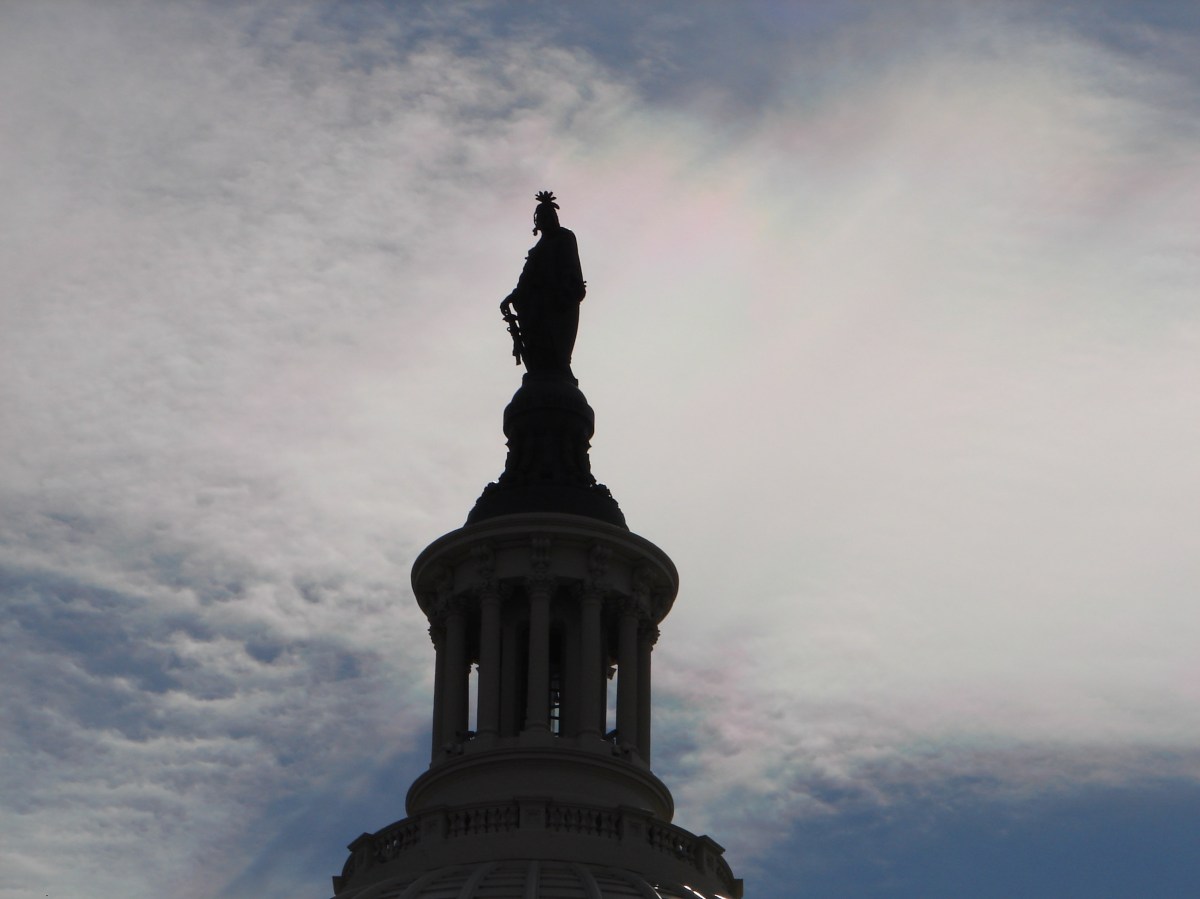
About the Featured Image: At 19’5” tall and 15,000 lbs, the bronze statue named Freedom, set atop the Capitol Dome in Washington DC, was created by architect Thomas Walter, sculptor Thomas Crawford, sculptor Clark Mills, and master craftsman Philip Reid, four men who well represent both a complex history and complicated symbolism.

I. The Free Speakers of Speech

“Strands in the Web of Freedom”

“I think what we’re learning is that, particularly when they get a choice, a lot of people decide to believe what’s more comfortable for them, even if it’s not the truth.”

– Ellis Cose

Before anyone starts rating Ellis Cose’s statement, “whereby phrases are made to do service for critical analysis by being turned into dogma” wielded against whomever they oppose… just stop and consider instead, against “the impregnating atmosphere of the times,” how neutrally this statement applies to anyone at all who might hold any position. Consider how anyone we oppose may wield this statement against us just as righteously as we may characterise it by using them.

There’s wisdom in this statement by journalist Ellis Cose, and an informed perspective that directs my attention toward a truer opponent facing all of us, which is to say all of us. It’s not so much a person, this opponent, but a tendency – a rather drastic tendency we have to skew our perspectives toward one outlook, one interpretation, one ‘side’ of… well, whatever we face.

[NB: what I call a ‘side’ can be populous or solitary. I’ve presented ‘side’ in single quotes because I know it’s a word loaded with partisan and polar connotations, none of which I want to suggest – not overtly, at least – besides which, I haven’t been able to decide on a more suitable word.]

This tendency is common of us. I’ve often maintained that we all land somewhere, starting with birth. As such, bias is inescapable and, as such, not pejorative but only descriptive. So, what to do about bias… ? Rather, what to do with bias. And how to do it.

The remark above Cose offers during an interview with Bill Moyers, in the context of considering free speech – specifically, its demise. In his recent book, Cose points out an overarching presumption about free speech – from a Supreme Court Judge, no less, Justice Louis Brandeis – a presumption that, ever since, has evidently grown roots:

“As Brandeis saw it, free speech was virtually a sacred right and an awesomely powerful force that would expose ‘falsehood and fallacies’ and ‘avert… evil by the processes of education.’ Hence, the remedy to bad speech was ‘more speech, not enforced silence.’

“That piece of writing has been deemed one of the most important commentaries ever crafted on the First Amendment. But Brandeis assumed something that has not been borne out by facts, which is that the better argument would generally win. He also assumed that relevant people on all sides of a question were equally capable of being heard and that skeptics were interested in listening.

“That fallacy continues to inform the thinking of those who see speech as inherently self-correcting.”
Featured Image by Lynn Melchiori from Pixabay

In this quotation, Cose gives me pause to stop and consider that the First Amendment – really any part of the U.S. Constitution – may have been written with a presumption that “people are basically rational and skilled in recognizing the better argument when they hear it,” or a presumption that “dialogue is dominated by real people with an interest in ideas, not by corporations and wealthy individuals hiding behind PACs and other creations, using trickery, appeals to base prejudice, and outright lies to gather gullible people to their side in the interest of commerce.” With such words, Cose gives me pause to wonder about some taken-for-granted assurance that tells itself, Well, of course anyone who reads this will understand what I mean because anyone who reads this will be just like me… We’re not just ready-made logical creatures. We’re susceptible to emotion and passion, and blind spots and presumption, which must be recognised before reasoned.

As I stop and consider all that… I consider myself. When I write posts for this blog and exercise my free speech with the ease of a mouse click, what is my thinking? I take such pains to write clearly, go such lengths to research thoroughly, in consideration of an audience that I’m largely unable to predict: a published blog post is a public blog post, and a reputation is as clean and thin and delicate as tissue paper. Yet I know I’ve been guilty of presuming a reasonable audience – you’re welcome? or my bad? The one question that can sum all my anxiety might simply be this: whose voice am I leaving out? It’s a version of a question I often asked my students, albeit in different context: whose voice is missing?

Maybe all this seems tangential to my initial idea: being prompted by Ellis Cose to write about free speech. Still, I can’t help but think, and feel, all this belongs.

I agree with Cose, once more from his book, that “… the society [Brandeis] envisioned has never existed.” With hindsight to his vision, I see in Justice Brandeis’s statement something he likely didn’t mean: his vision of society, for me, is a bit like the statues and sculptures that adorn and accompany buildings all over Washington, DC… we recognise their symbolism, we (allegedly) aspire to what they represent, and by their very placement (and I don’t mean to invoke idolatry), we sort of revere them. They represent not a world we believe is possible but a way we can imagine it – a world we would prefer to see, at the risk of misapplying Northrop Frye. For a given statue or sculpture, such reverence implicates what any one person values, which of course has become the subject of recent concern, weighing historical brutality against present-day redress. Moreover, if we aspire to the symbolic idea, somehow knowing it is unattainable, that becomes something very different than aspiring to it because we actually think it’s within our power to create. My broader point here is simply to note the analogy, a presumption imagined like an audience taken for granted, presuming ideas about people, as Justice Brandeis apparently did, or presuming an outlook held by an audience that, of course, is just like me.

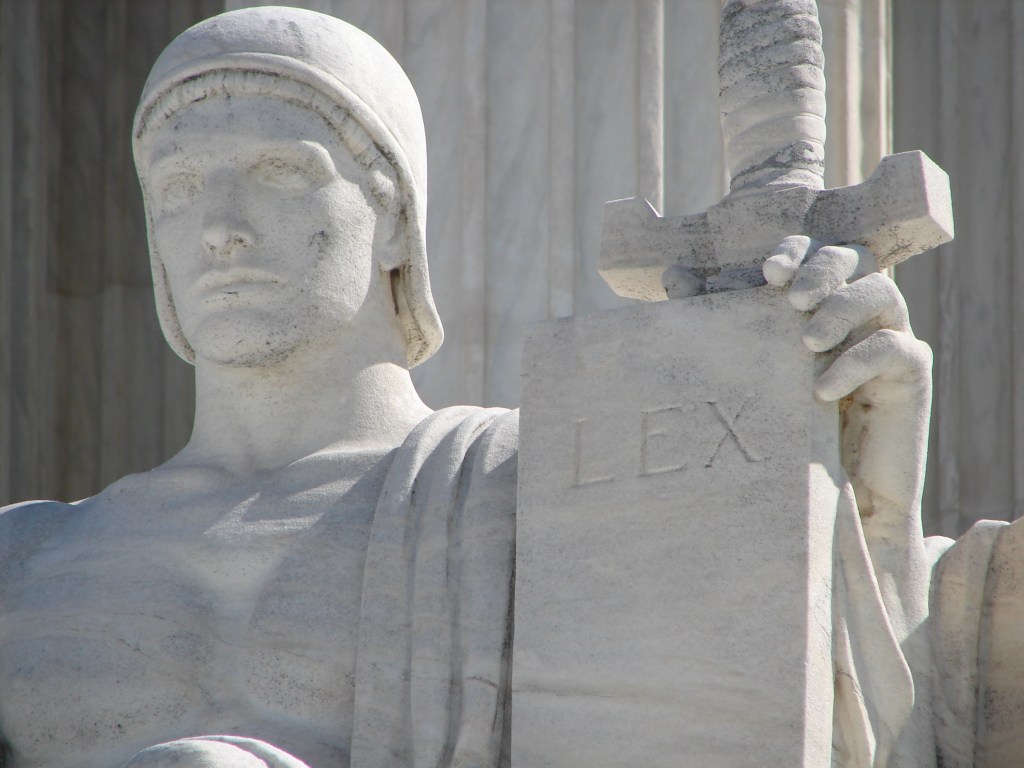
The statue called Authority of Law, adorning the steps of the U.S. Supreme Court in Washington, DC: LEX translates from Latin to “the law.”

Coming back to relate all this to free speech… when someone declares “[whatever]” in their exercise of free speech, they conceivably make no direct presumption about you or me or anybody, perhaps beyond their own self-centredness: “You have to listen to me because I have my right to free speech.” Conversely, that speaker may presume or flat-out know something about their audience, by which they’re able to push buttons, raise hackles, inspire applause, or generally incite some calculated reaction. Elementary though it sounds, what a speaker presumes when exercising free speech is simply and plainly that they have an audience – indeed, what need otherwise to qualify “free” speech? Ultimately, it’s this connection to audience that I will try to consider about free speech.

First, though, I should clarify – however broadly – that the corollary to a speaker is a listener, i.e. if you’re not speaking, then consider yourself part of the audience. Naturally, we have to be exposed somehow to the speaker, in person or by way of some recording or text. Maybe these are punctilious distinctions, but they seem necessary for what comes next.

What I tend to notice when I hear people invoking “free speech” may also seem elementary: it’s only invoked when an audience doesn’t want to hear it. This is so obvious yet so crucial to appreciate because within lies a difference as to what free speech even means: to the speaker, as I’ve described, it amounts to listen to me, but to the audience, it refers more to the anticipated outcomes or effects of speech yet-to-come. This is not to say a speaker has no aims, but rather to say a speaker has a more immediate concern, i.e. being heard, i.e. being allowed to speak, as in “free” to speak. Meanwhile, the audience also has an aim although I can’t decide which side of the coin: to not hear, i.e. to not listen, or to not hear, i.e. to silence the speaker – hence, as I say above, the need to qualify free speech from any other kind.

What I’ve come to notice about an audience in disagreement seems more to be the option for silencing the speaker, maybe because outcomes can’t happen when speech is pre-empted. I get that, an ounce of prevention, maybe well justified in some cases – yet there, now… I’ve just done it too, approving (if not opting) to silence the speaker. In addressing free speech, is the audience obliged to consider a message in some way apart from the speaker? “Apart” from the speaker seems problematic since no speech can occur without a speaker.

As speech is the catalyst or cause of certain outcomes, if and when it’s spoken, so speech itself is a consequence of something learned – a reflection of the speaker – which seems to return this to an issue of bias; I might alternatively call this bias an “education” or a “belief” but, in any case, it’s something more individual or personal. Again, in the ways we might consider the cause or catalyst of speech, these remain inherent to the speaker. Okay, then what of the speaker?

There does exist today an overriding culture of the individual, of discounting convention, of not merely being but embracing “yourself.” And there does exist today a self-orientation that values personalised education, and critical thinking, and questioning and problematizing how and why the way things are. These are briefly some general details that bear at least some influence upon speakers today.

Okay, what of these details? For one thing, such a self-orientation only goes so far: take the school principal, boasting and flaunting empowered students and their critical thinking, that is until the students think something critical about how and why the way things are at school. “After all,” the students say, “you teach us to be critical thinkers.” What goes around may eventually come around, though not always without a struggle (… and maybe some parental involvement!)

To be fair, some initial resistance to such critical thinking-slash-questioning is hardly surprising, from any perspective. But given our own tendency to root perspectives in one-place for longer stretches of time, maybe the rest of us are wise to remember Socrates for being unique: his no-place was his place, an ironic kind of certainty, which is a bit of clever word-play. Where he seemed to land was “no place in particular” beyond perhaps “here, for long enough to ask some questions.”

Of course, it was also this freedom, taken to questioning things, that eventually helped to estrange the community from Socrates – which is also a bit of clever word-play – finally at the cost of his life. In our culture, which venerates the individual, maybe we should be thankful for slightly less orthodox individuality – we should be thankful for bias (instead of trying so hard to ‘eliminate’ it). Talk about integrity. Alternatively, imagine that world ruled by Socratic ignorance – free speech everywhere and many an ear to listen, just none finally willing to believe – how much worse, in that world, if might made right.

Individual rights, by definition, only make sense within a community, which was my cause to raise bias, which I likened to education though maybe I’d better call it “learning” – a post for another day. But more than this, more nuanced, is that individual rights only make sense as a community. If they cannot be shared, and respected, mutually, and tolerated, they can only come to a head. As to free speech… per se it remains only a concept because it is people who enact it, as speech – people make the concept felt. People ultimately make “free speech” something manifestly real; sometimes, especially lately, I feel like we don’t seem to get this, as if we view ourselves actually having the same idealistic glow as our ideologies. That would be fine if we all shared the same ideology.

Sometimes I feel like we view ourselves actually having the same idealistic glow as our ideologies. That would be fine if we all shared the same ideology.

A final word on bias-slash-education-slash-learning, paraphrasing my previous blog post… are lessons designed for a teacher to teach, or for a learner to learn? Or is it some mixture of both? If we’ve all been to school, even so, numerous learners still comprise an education system, just not all at once – this we end up calling “culture.” So how can education ever be singular, as in “personalised,” as in an education for you while another, separately, for me? How, that is, unless you want all sorts of cultures all walking around bumping into each other at every turn, and I don’t mean a “diversity-as-strength” kind of way because that still implies some rule of law conformity. I mean anarchy.

We all learn, yes, but being educated is a collective trait, found somewhere at once in between all learners and their teachers and anyone else involved. So, as to free speech… once somebody communicates via real speech, another listens and reflects, maybe responds, and somehow, somewhere in between them, occurs an understanding. If that understanding is “I don’t understand you,” well, at least your work is cut out for you.

If the catalysts and causes of someone’s speech are an issue of bias, then outcomes and effects seem an issue of endurance or, as the case may be, a lack of it – as Cose puts it, what’s “comfortable.” Unlike the so-called individualism of education and the extent one decides for oneself – so-called rights – I would argue that endurance is borne more widely, if not entirely, of culture and conscience, the degree we each conform irrespective of ourselves… would these be responsibilities or infringements? How would any died-in-the-wool individualist answer that? I think I know (… see what I did there?).

From having considered in some way the free speaker, I’ve ventured into the audience, whose ears may or may not be so permissive. Yes, it’s people who speak – it’s also people who listen, and both of these always from some position of bias: if we hope to address any concern arising over free speech, start with bias – or, as I referred to it above, education learning. Yes, education has its own raft of issues, but it’s still probably better to address causes over outcomes, if the aim is to restore our health.

Click here to read Pt. II The Speech of Free Speakers – “A Delusion of Certitude”?