Mixed Metaphors

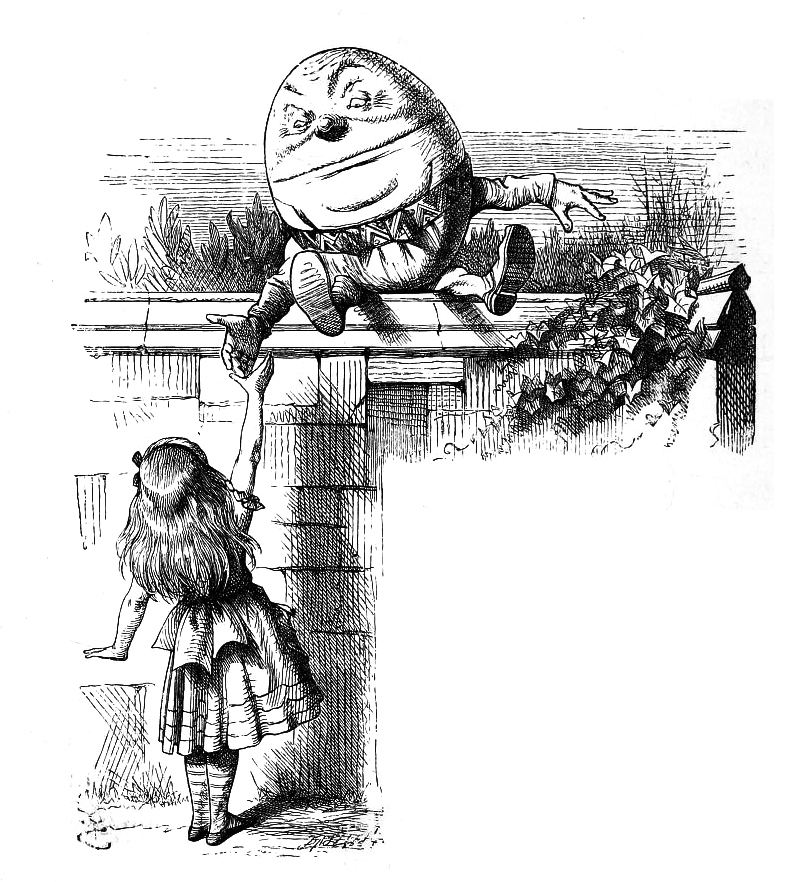
Featured Image Credit: “Humpty Dumpty from Through the Looking Glass, by John Tenniel, 1871” in the Public Domain: https://commons.wikimedia.org/w/index.php?curid=238447

Our collective world comprises interactive individuals, and upon this belief lies the basis for accepting constructivist accounts of knowledge and knowing. That our knowledge is “personally constructed, socially mediated, and inherently situated” (Clarke, 1998, p. 48) does not preclude an external reality – not for me, anyway!

My own ontological perspective seems more post-positivist: what we interpret doesnt preclude a reality that exists ‘when nobody is looking’.

Were prone to making what might better be called falsifiable statements than statements of “truth,” in such a way that our descriptions merely symbolise what we think weve interpreted. For me, bias is a fact and, as we account for it, not necessarily pejorative. We value and strive to keep an open mind precisely because we do not have an empty mind but, rather, a finite mind.

If you’re curious to learn more, Avenier and Thomas (2015) make a fascinating distinction between the epistemic assumption of pragmatic constructivism, in which inquirer and inquired are inseparably intertwined, and Guba and Lincoln’s (1989) more commonly known constructivist perspective.


For years now, I’ve wondered whether learning is a metaphorical renovation. It’s no perfect comparison – no metaphor could be – but I like renovation for suggesting that something original remains, upon which we build, and rebuild.

… plenty of work ahead, though isn’t that kind of the point?
Photo Credit: Stefan Lehner on Unsplash

As it happens, renovation suits a perspective on learning called constructivism, which regards learning as an active process by which a person integrates new experiences with what they already know. This distinction between known and new knowledge has been an avenue for critiquing constructivism’s overwhelming predominance, as has the general notion that active learners mean passive teachers, as has the nuance of what ‘active’ even means – thinking about stuff or doing stuff. Other nuances distinguish something learned from something experienced, or something internal – uniquely derived – from something external that is accepted – belatedly – as consensus.

All of this implicates haves and have-nots: access to knowledge and experience, to schools and teachers. And all of this raises more profound questions, such as whether someone’s constructed knowledge interprets a shared cultural understanding or sets their own personally valid reality. If you’d told me all of this a few years ago, my metaphor would have just said thanks and carried on none the wiser. And I suspect that’s still the case for some people, at least for those who don’t read past third paragraphs.

In case you weren’t aware… constructivism is often paired in opposition to what are called ‘traditional’ perspectives of learning – typically though not only K12 perspectives – evidently as a response to teaching deemed too instructive and knowledge deemed too intrinsic. Deemed by whom exactly? Well, given constructivism’s widespread observance nowadays, that question may have fallen away from any one’s assessment to everyone’s assent. Take me, for instance, the renovationist – surely I’m embracing the current outlook, right, even just out of convenience, if not expediency? Anyway, what self-respecting teacher even breathes traditional approaches anymore, e.g. constructivism’s lowly precursor, cognitive development, or education’s arch-nemesis, behaviourism? Surely, for teachers, constructivism is simply unquestionable common sense.

For me anyway, not sure for you, this pairing of perspectives is presented in a way that suggests an oddly false dichotomy, as if the sole alternative to the progress and change of singular constructivism is the oblivious rote bundled up in ‘traditional’ approaches: either the one or the other(s). Some teachers I know might rather say the one now is the other, the student-centred model of constructivism being no less standardized than the didactic teacher-driven system it supplants. Facing this either-or stipulation, some teachers I know might also detect no small antipathy for the traditional bundle, as if every teaching moment throughout the limitless bygone era preceding ‘today’ could only have been nothing but defective. It’s a miracle we’re even here to tell the tale– er, I mean ‘spin the narrative’– er, ‘speak your truth’. And if all these absolutes lay it on a bit thick, then I guess we agree that stark dichotomy makes for great fallacy.

OK, for good reason, I’m usually not too explicit, but just this once, let’s go:

Every person has a backstory that no one else can know completely, which means people’s lives are more complex than first glance suggests, which means an assumption made is an irresponsible leap to conclusions.

Every teacher has a unique perspective on learning because you’re not me just like I’m not you. And just like me, you apply your perspective in a classroom, at a school, with students you know better than I do.

If we’re able to grant each other a unique perspective and backstory, as any good constructivist ought to be doing, then how do we explain antipathy toward anything? The one appropriate response for a teacher would seem to be patient understanding.

Anyone in education today who’s been noticing fewer and fewer teachers learning to teach any differently, any one from another, may also have noticed that it’s all constructivism all the time, a clean sweep. Teachers today, like students of old, receive Freire-ian bank deposits to “Teach ‘this’ way – are you teaching ‘this’ way?” At the same time, these same teachers are told to “eliminate their bias,” at which point… I guess? may every unique perspective shine, as… creative? as they want to be, helping students become – wait for it – self-regulated critical thinkers. It’s irony on toast.

Back in the day, before my self-declared renovationism, teacher educators took strides to inculcate in me and my cohort a constructivist perspective on learning. It probably helped me that I teach humanities and social sciences rather than natural sciences or math although I’m pretty sure I have a post-positivist streak somewhere inside me. In any case, I’m also willing to accept [ your perspective here ] because whatever a student and teacher decide between them to suit their circumstances… just who am I to say? The most I’d offer is my two cents, and respect their place to decide responsibly for themselves.

Does hatching an idea mean thinking outside the box? Photo Credit: cottonbro on Pexels

… which, by the way, is why I avoid being explicit: I’m not out to ‘explain’ anything, plus honestly, the cryptic stuff can be fun.

As a teacher, I’ll offer, propose, opine, draw attention to particulars. Where appropriate, I’ll be a skill instructor, which is actually a principal focus across my subject areas. Skill practice can suit more direct teaching – demonstration, progression, feedback – yet even then I like questions that draw student awareness towards refining their own performance. Elsewhere, I’ve put it this way: help people make thinking a habit because we test and refine ideas by discussion and reflection, which are the purview of thinking. Thinking is the labour that helps set at least some part of an idea’s value, and good thinking is informed by knowledge, practised with discipline, and weighed by healthy scepticism.

My teaching tries to help students to learn two things: (i) that they can think, and (ii) that their own thinking is a step toward their own decision-making.

Good thinking is informed by knowledge, practised with discipline, and weighed by healthy scepticism.

… which is why, to me, the humanities and social science renovationist, all this makes ‘explain’ a four-letter word.

Explanation is deficit-based, elevating the one who knows and diminishing the one who needs. At its core, this is neither shared inquiry nor the inherent practice of thinking but an untenable decoupling of one from the other. When the aim is thinking, explanation engenders no humility on the part of either person but ego and dependency on the part of both, enabling the one’s listening to the other’s telling. All this underscores ‘student-centred constructivism’ by virtue of the trust and rapport to be found, or at least to be founded, at the core of a meaningful student-teacher relationship.

Like I said to open, well and good to label my renovation metaphor as constructivism, if it helps someone characterise my teacher’s perspective on learning. As for me, setting aside overt social philosophy and acknowledging real concern over power and authority, the one –ism I can readily associate with the kind of learning I try to stir up is egalitarianism (… still working on the metaphor). As learning necessarily means teaching, even if it’s the same person doing both, we ought to ask from the constructivist perspective on learning what we think about its associated teaching.

That thing I’ve been noticing the past how-many-years about fewer teachers learning to teach any differently, one to another… maybe it’s intentional, and constructivism was only meant for K12 learning. Maybe telling candidates ‘how to teach’ somehow better suits their learning how to teach, especially in a brief, intensely packed 11-month program. I’ve literally watched instructors tell candidates, “Not like ‘this’. Like ‘this’. Teach like ‘this’.” Still, for me, not sure for you, telling isn’t teaching, telling is telling. And teaching is teaching, and as each will have its place according to circumstance, if they meant the same thing, we’d use the same word. So if the candidate who will someday perform my surgery or land my flight needs to be told something, then somebody better damn well tell them.

To professing constructivists worldwide, but really, to anyone staking a claim: proudly wearing the t-shirt promotes the brand label. If constructivism was intended strictly for K12 learning, not teacher candidate learning… that’s something to clarify, and soon. And not just one way or the other but both ways because, until then, one outcome of telling people ‘how to teach’ will continue to be the negation of opportunity for them to learn ‘how to teach’, on their own terms in their own time in their own contexts.

Metaphorically speaking, of course… what here is the learning, and what is the teaching? Photo Credit: Stefan Lehner on Unsplash

Nearly as often, to be fair, I’ve also been noticing how-many-candidates with similar expectation: to be taught ‘how to teach’. It’s a passive perspective on learning that – no surprise – is unable to speak for itself, except maybe a little frustration: “Why do you always answer questions with a question? Why is the answer to everything ‘It depends’?” So here’s maybe another indication of people’s past experiences with teaching that takes somewhat less account of learning.

Wow, and all this from a renovationist… you won’t likely hear from anyone else that constructivism isn’t part of the landscape, a huge part – even “hegemonic,” although also “absurd” – and growing. In fact, that’s been something else to make me wonder… whether twenty years hence, enough time will have passed for an espoused perspective on learning to actually inform our teaching. By the time they’re old enough to be teacher candidates, today’s K12 students may finally have brought with them the changes we like to tell each other we’re making on their behalf.

Click here to read Crossed Purposes

On Bias: IV. Right Bias?

Featured Photo Credit: Adam Derewecki on Pixabay

Click here to read On Bias: III. Fun With Dialectics

On Bias: IV. Right Bias?

Here’s an idea: let’s eliminate bias!

We’ll all finish breakfast together and head out, everyone trying their very hardest, pitching in with, like, mindfulness and all – and boom, we eliminate bias. Well, except for all its inevitable ripple-effects, what with that ‘cost to everything’ thing and everything that goes with that, but… here’s the thing: we eliminate our bias!

I hear this idea fairly often in Teacher Education: “Eliminate your bias.” Actually, it’s more of a recommendation than an idea, come by honestly, as I see it, from a place to (a) preclude unconscious assumptions, which I gather to be individual, and (b) guard against inherent power structures, which seem bigger than individual, at least as far as their fount if not their flow – which is sort of like saying the heart itself is not quite the circulation that depends on it, or that life is not itself the exactness of living. Basically, the difference between (a) and (b) might be cause-and-effect although, when anyone says “basically,” it’s bound to be an oversimplification, so maybe just forget I said it.

And as I’m about to mention ‘space between’, of course I’ll be speaking metaphorically: for example, the space between teachers and students.

Where the one ends and the next begins …some more than others
Photo Credit: Matheus Bertelli on Pexels

Speaking of metaphorical space between… from my own experience, I’ve found where one person ends, as it were, another finds space to begin. In between them is space… sometimes a void or distant divide, or sometimes an inseparable overlapping affinity though, more likely, something less fringe-worthy in between. It is space filled by dialectical influence, by relational back-and-forth, something I’ve elsewhere called a kind of curriculum. And where all this is true for all, even so I suspect it will resonate more with someone who was told at school that they were, say, a troublemaker, or a top student – at different times, I was told both, so I oughtta know.

But as metaphorical space relates to ‘eliminating bias’, well… when teachers are told to eliminate bias, or minimize it in their planning and practice, for being superficial the suggestion for me is essentially misleading.

Dusek distinguishes between a generalised teacher bias, “expectations regarding the performance of children who are equivalent on some objective measure,” and what seems to be more individuated teacher expectancy, the “significant effects due to the teacher’s own, self-generated expectations regarding students’ performance” (p. 679). Expectancy, he notes, can beget bias such that a teacher “subjectively [feels that some] students are [less capable than others] of grasping certain material.” Apparently, the difference between teacher bias and teacher expectancy, as in “some objective measure” and “self-generated expectations,” is something like objective-subjective.

When teachers are told to eliminate bias from their planning and practice, the suggestion is superficial and thereby misleading.

Now, one could expound for pages, distinguishing external from internal, collective from solo, or communal from individual, or arguing apparent vs inherent, without vs within, or knowing vs doing, or even exploring remembrance-reaction or learned-instinctual. They all seem nurture-nature in some way or other (which yes, I’ve had to reverse from the more common usage, nature-nurture). I didn’t even bother with hyperlinks because there are just too many options – search for yourself and see, any similar form for any of these pairings. Fun with dialectics, indeed.

Instead, I simply note here how I described it on the homepage in its more common order, nature-nurture: there’s me and there’s not me. It’s a philosophical difference, definitely epistemological if not also ontological, so take it or leave it, but at least please understand it for your own philosophy as well as mine.

As all this pertains to teaching – because I write here most often as a teacher – the difference seems one of perspective, which is probably pretty telling, so educators take note. Where the difference seems one of perspective, with each person left to construe what other people also construe, maybe the most we could expect from a bunch of persons is consensus – seems a shame, then, to demand something instead like conformity.

To those unconscious assumptions that Teacher Ed aims to preclude I relate Dusek’s teacher expectancy – both seem more individuated. But as one sets upon “eliminating bias,” whether that one is a teacher or anyone else, how exactly do we measure expectations? How do we even identify assumptions that are unconscious? Is there “some objective measure,” maybe some kind of systemic outcome, to help us determine where bias ends and expectancy begins? Because, if there were, bias might almost even seem reliable, maybe have some practical utility – seems a shame, then, to eliminate it, I mean if that were true.

Less formally, I can imagine teachers intentionally mitigating expectancies in order to respect student autonomy – I’m pretty sure I have. Thanks to Dusek, let’s consider an attempt at identifying and mitigating expectancies to be, by extension, an attempt at managing bias. And this much I’ll grant you, Teacher Ed: indeed, we can manage bias. And surely this would affect ensuing outcomes – those times I managed, I’m pretty sure that was my thinking.

“… every ripple, rippling and re-rippling, placid at times though many times not”
Photo Credit: Linus Nylund on Unsplash

Maybe a systemic distinction between bias and expectation could indicate some kind of synthesis… of people, of history, of institutional aims and cultures, and all their back-and-forth influences – every ripple from every pebble tossed, rippling and re-rippling across the gulf, placid at times though many times not. All this is its own continual cause-and-effect-yet-more, in which bias seems as much an unending if curiously dissociated mutual negotiation of each with every other.

Mackenzie – remember Mackenzie? – may have been on to this, too: he finally quells our “deplorable” state of bias as “… not something which should be feared in education… [but rather] the beginning of a process of debate… [ending] either in a discussion of appropriate emphasis, in the accuser coming to see that an allegedly neglected viewpoint has indeed been covered, or in the accused learning something new” (p. 499). Okay, maybe Mackenzie’s still a little polarised, but he’s unquestionably a little more flexible, too: therein the patient, and all. And maybe there really is something to all that ‘mindfulness’ crap, aside from being so popular.

Biased people, biased history, biased institutional aims and cultures… with literally everything to consider, yet being only human, we’re inevitably certain to leave something out on account of that limit, our incapability for anything beyond: eliminating bias starts chipping away at all we know because bias is essentially what we are. Eliminate bias, eliminate self, which could mean ‘change’ or could mean ‘self-destruct’. So, how to proceed?

For starters, let’s not just openly acknowledge bias, let’s embrace it: the rigor of education, of discourse and sharing and research… if two heads are better than one, imagine the dialectic arising from a dozen, or a hundred. We already know the potential of entire communities. Let’s value the humility of learning precisely because no one can say it all, know it all, or do it all. No less was suggested by Sir Francis himself: we all can do better together, and not just kumbaya – gotta love some bacon. Let’s learn and teach how to reason and how to communicate, and how to be biased.

Let’s learn and teach how to reason and communicate: how to be biased.

And let’s let bias be. If it limits alternatives, bias also clarifies too many. Ambiguity can amplify what we already know and also what we don’t; from there, we proceed. Elsewhere I’ve mentioned my ignorance in a museum: where I knew nothing about the exhibits, plenty others did know, and certainly over time, we all come to know however much. In the meantime, though, I’m partial for my ignorance, and a decision befalls me to take action, to study and learn, or to do something else.

Study is only a potential outcome of education, making education only a potential process of constant renovation, of who we are and what we know. Study is a decision that not everybody makes, I think because it’s humbling. It brings us to realise how much we’ll never know. Some rare few master plenty, but even they have limitations. We do what we can, or anyway, we ought to. But whether or not each of us accepts our own responsibility for our own decisions, come what may, we will still face the outcomes.

For all this, on balance, I’d say bias is a good thing. It changes as we grow, even if ‘change’ just means leaning further the same direction. Given our context – myriad influences, ceaseless decision-making, the whole roiling rippling mess – we’re probably wise to consider bias dynamic: fluctuating, buffering, whispering continually in our ears, always remaining, never quite resembling…

Bias is potent energy, our source of passion, opinion, vision: our perspective. Where a world without bias would be flat and dull and monotonous, lucky for us “eliminating bias” is also mere aspiration. For the world in which we live, bias marshalled by a culture of responsible morality can actually enrich our collective experience.

“…a world without bias would be flat and dull and monotonous,” so if you think this pic is oversaturated, maybe the world has too much bias… or could it be you simply see a world with too much bias?
Photo Credit: analogicus on Pixabay

That’s why, when teachers are told to minimize or eliminate bias from their planning and practice, I take the suggestion as essentially misleading for being superficial. Bias is an always-thing, not something we minimize or eliminate but something we identify and address, and if we’re wise enough, something we incorporate. Bias is not pejorative, it’s descriptive, and even people you admire have it. Everybody has it, which is perhaps most obvious when they say they don’t – that’s a fool’s game to be avoided by responsible teachers.

Worse, teachers who do plan and practise under this spell of rectitude risk falling blind to the costs of their still-biased decisions: believing they have somehow minimized or eliminated their bias, they merely shift its cost from whomever they sought to protect onto somebody different. As I’ve concluded about decisions more generally, a teacher’s so-called ‘best’ decisions would seem to be their most informed decisions. If so, then I think a teacher’s professionalism can oblige no less yet can also demand no more.

For me, there’s no such thing as unbiased – if a single word can be an oxymoron, ‘unbiased’ is it. There is, however, such a thing as multi-biased; in the current lingo, that would be interdisciplinary or holistic, or what I might otherwise simply call responsible, considerate, or even mature, or how about maybe just educated.

Click here to read Common Ground

On Bias: III. Fun with Dialectics

Click here to read On Bias: II. Wrong Bias?

On Bias: III. Fun with Dialectics

Above-below, up-down, in-out… let’s understand these as some basic opposite pairings in English vocabulary.

Some pairings seem as rooted in tradition as opposition – love-hate, war-peace, success-failure – while some pairings automatically imply something else – just as ‘landlord’ pays its dues to ‘tenant’, so ‘parent’ only makes sense alongside ‘child’. Along the same line, as surely as ‘zenith’ is joined to ‘nadir’, something ‘ahead’ is followed by something ‘behind’. Conversely, it goes literally without saying that a ‘turn’ to face Thing 2 is the same pivot away from facing Thing 1. Being a duality, two moves at once, maybe this is why one good turn deserves another – after that, on we go.

Looking up the Odesa Steps… not the Eisenstein montage today
Looking down the Odesa Steps… only the landings are visible

Photo Credits by Oleksandr Malyon – Own work, CC BY-SA 4.0, https://commons.wikimedia.org/w/index.php?curid=94182671 https://commons.wikimedia.org/w/index.php?curid=94182670

But our vocabulary is not always so obvious or easily taken for granted… something ‘ancient’ by contrast might only suggest something… well, less ancient: ‘modern’, ‘current’, ‘contemporary’, how about ‘fashionable’ – now we’re talking connotation as much as denotation. And with plenty of other word-pairings – ground-air, hard-soft, strong-weak, first-last – if any of these are less automatic than good-evil, to-from, wet-dry… well, they still seem just as opposite. Funny, though, a word like ‘moon’ implies ‘planet’, yet no planet requires a moon.

Actually, this post isn’t some attempt at anything formal although, if you’re up for it, knock yourself out.

Theory-practice, reflection-action, curriculum-pedagogy, classroom-real life, content-skill, teacher-student… education is all about such pairings. For the sake here, let’s consider these as ‘dialectical pairings’, where each concept is not merely reciprocal to the other but inextricably indispensible, such that the two concepts together comprise not a united opposition but a concerted reciprocity. And from the two arises something further, something more.

Matter tells space-and-time to curve; space-and-time tells matter to move: their fearful passage is the two-way traffic of our stage.

Maybe that’s a bit much. Let’s just stick with ‘dialectical pairings’, in a loosely Hegelian way that says, “You complete me.”

Here’s one we all know from education… ‘fairness’ balanced in concert with ‘unfairness’… in accordance to circumstance, fairness being the treatment of people without discrimination, marked by impartially, as conversely distinct from unfairness, discrimination marked by partiality. But without circumstances specified, this distinction remains ambiguous, such that one could argue fairness – treating every person impartially – as being equality, treating everyone the same, rendering unfairness as inequality. More recently has a distinction also been emphasised between (in)equality and (un)fairness such that the resultant outcome of specific treatment is considered (un)equal while the ongoing act of treating is described as a measure of (in)equity, the specific measure evidently being human rights, typically as these rights have been defined by some authority.

Anyway, let’s consider fairness-unfairness as having arisen from something else we’ll call ‘bias’ although that may actually be more of a Hegelian reversal, if you see what I did there. OK, so we consider this, but on what basis? What I’m suggesting is twofold…

(i) Bias is an always-thing, and utterly inescapable
(ii) No matter how exactly we do something, bias instils every decision with unintended consequences

As a result of everybody’s overlapping biases, i.e. that system of forces made real by everybody’s ongoing decisions, somebody somewhere along the way incurs some cost in payment of an outcome

Sidebar #1: We’ve been facing a lot of absolutes, thus far… inextricable, indispensible, utterly inescapable – let’s consider these inexorable. As for absolutes, let’s consider them unlimited by anything besides themselves.

Somebody pays a cost… I call it a cost, and depending on the circumstances, maybe we call it fallout, or unintended consequences, or collateral damage. Depending on the circumstances, maybe we call it a trade-off. But what it’s called doesn’t negate the truism that there is a cost to everything, which is sometimes described in education as the hidden curriculum.

Sidebar #2: Ivan Illich is often credited with coining the term, ‘hidden curriculum’, and his meaning actually took to far wider critique than just education. Illich argued for the disestablishment of schools, comparable to the separation of church and state, on the basis that our most insidiously aberrant institution is compulsory schooling, which proliferates “the alienating institutionalization of life by teaching the need to be taught” (p. 34). Illich critiqued compulsory schooling’s duplicity, in which learning is ritualised myth-making, “something for which you need a process within which you acquire it” (p. 67), a problem defined by a self-justifyingly selfless solution:

“… other people told me [schooling] was… the most practical arrangement for imparting education, or for creating equality, [yet] I saw that most people were stupefied by this procedure, were actually told that they couldn’t learn on their own and became disabled and crippled… a new kind of self-inflicted injustice… a liturgy [for generating] the belief that this is a social enterprise that has some kind of autonomy from the law.… If the rain dance doesn’t work, you can blame yourself for having danced it wrongly.” (p. 66)

For Illich, words like ‘planning’ and ‘development’, ‘class and ‘equality’, ‘system’ and ‘assessment’, all central to North American schooling, are anathema to ‘knowledge as an intrinsic good’ and ‘coming to know things as inalienable living’ – those absolutes again.

And what it’s called doesn’t negate the responsibility to consider more than one perspective, on behalf of others, while weighing or enacting our decisions. If anything, bias demands responsibility unless, of course, your concerns lie elsewhere than somebody somewhere paying some cost. This, if you ask me, definitely falls to a matter of character, as does a sense of whether this post seems to have abandoned the whole ‘dialectical pairing’ thing.

Click here to read On Bias: IV. Right Bias?